| Author |
 Replies: 12 / Views: 4,170 Replies: 12 / Views: 4,170 |
|
|
New Member
United States
33 Posts |
Hello Everyone! I had a coin in my collection that I picked up many years ago on vacation in Mexico. It is a 1867 Mo 1 Peso (Maximillian). I always considered it one of my prized coins for its uniqueness, I never thought much of it as far as being a copy or fake but recent observations and new things I'm learning about coins have led me to question it. 1) Color. The color is completely dull and dead. No luster, shine or anything like that. 2) Weight. Krause lists the weight as 27.07. This one weighs 26.6 not too much of a difference but stil its worrying. I know there is slight variation in the 8R pieces but what about these? 3) Sound, I've done a few sound tests against my 8R's and its close but not the same. It has a higher pitched sound. Maybe the size difference affects the sound? 4) Look. When you look closeley at it, it looks pockmarked. I don't know too much about cast coins yet but it makes me wonder. The edge is reeded like it is supposed to be but I am hoping some of you can give me your opinion.   Edited by 8 R€ÅL€Š™
08/05/2010 10:19 pm
|
|
|
|
Pillar of the Community
United States
1801 Posts |
I am sorry to say that at first glance the coin looks like a cast copy. Very questionable surfaces and an overall "mushy" look. What does the edge look like? Can you spot any sign of a seam. I am no expert on the Maximillan coins but I would want someone with good knowledge to check this one out. Have you checked it with a magnet?
|
|
Bedrock of the Community
Australia
21794 Posts |
I agree with jfransch. Some ebay dealers will try to excuse the characteristic surface of cast coins as saying that the coin has some 'surface porosity'. |
|
New Member
 United States
33 Posts |
I didn't see a seam on the edge and the magnet didn't stick to it but that "mushiness" is also what made my suspect this coin. Here is a pic of the edge and a closeup of one part that has a lot of that "mushy" look.   |
|
Pillar of the Community
United States
5362 Posts |
8 R€ÅL€Š Sorry to say but you have one of the most common forgeries made in the 1960s there. The coin is a cast copy with "incorrect" reeding applied to obscure the edge seam. I have not seen one of these in about 10 years or more. They do not match the sophistication of the more Modern forgeries made with finer grained plastic materials.
The detail in the center of the shield is simply missing because it was moldied in a grainy material using a real coin. This type of early transfer process was rather crude and the details that should be there ARE NOT. But in the 50s and early 60s it was a common technology for low value numismatic forgery. The forgers figured (correctly I would add) that few people would really look too closely. It was a couple dollar type item but cost a few pennies to make.
Based on the weight you quote, 26.6 grams, the coin is most likely slightly oversized to compensate for the metal. These cast copies were typically NOT silver. That would have eliminated the profit margin.
Normally, a white metal often containing zinc and antimony was used but I do not see the typical zinc blooms here. The dead color points to a cast forgery as well.
The edge is critical. On the earliest copies I have observed, a plain edge was common. The forgers didn't do much other than grind off the seam. (I have one or two with the seam). But after buyers caught on the forgers did start adding reeds. But the reeds are typically wrong. So wrong that you do not need to do a reed count. (Counting the reeds is personally distasteful to me because I always get distracted. But these were so common in the 1970s in Boston that I got used to it. It seemed that we always got one or two each week and I got stuck doing a reed count just to be sure. SG was NOT used back then at least by the dealer I worked with.)
After casting it was normal to use a grinding wheel to smooth the edge of the peso. Then the reeds were applied in one of several ways. There are actually hand applied reeds - cut in ONE by ONE with a file. This is a rather scarce type and I buy many that I see of this type becuse of the work that went into it. I marvel at the waste of time. I have several 1866 and one 1867 with hand cut reeds. I have never seen a second 1867.
The second way reeds were added was a roller applied edge which resulted in a single overlap in the reeds somewhere along the edge. These came in several spacings including one that was very nearly correct. BUT correct reeding is uniform around the whole coin and there are NO OVERLAPS. This method is common - I own 4 using slightly different spacings and shapes. The final method also very common is the ring die. In this method the completed casting is driven (pressed) through a funnel shaped ring which has the reeds cut into the inside of the ring. As the coin is pressed through the ring die it cuts the reeds like grooves into the metal. The metal being pushed aside will leave two tell-tale signs. First a seam at the top center of the reed where the two metal curls meet. Second the ends of the reeds where the coin enters and exits the ring die will have split or open ends. For these 2 reasons the grooves are often cut OVER DEPTH and then the tops of the reeds are ground down on a grinding wheel to remove the mid line and split ends. This last method is preferred by the Chinese and is still in use. But it results in a V shaped grove.
Based on the photo of the edge I think you have an early attempt at a ring die application because of the apparent grinding lines on the tops of the reeds. I could be wrong about this. So please look for a seam (overlap) in the reeds as well.
Specific Gravity testing should conclusively identify this forgery and possibly provide a clue to the metal used.
This forgery is NOT CONTEMPORARY and while they do sell well, I see no real value in them even as early numismatic copies.
True contemporary forgeries of the Maximillian Peso are limited to Mo issues to the best of my knowledge and they are RARE. An 1867 or a copy from Guanajuato would be spectacular if it was actually contemporary. It would be like finding a Contemporary Hookneck 8R from a mint other than Mexico City. Something that has NEVER HAPPENED.
Edited by swamperbob
08/06/2010 11:01 pm
|
|
Pillar of the Community
United States
5362 Posts |
I just noticed that there is a small trace of a perimeter seam - indicating that the coin as molded was stretched a bit to enlarge the diameter. This often is mistaken for a collar seam but in this case it is not a collar seam it is a remnant of the copying process. 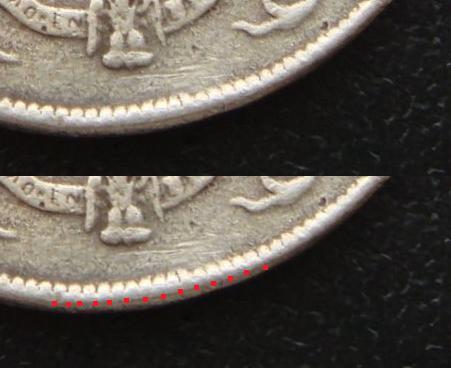 |
|
Pillar of the Community
United States
5362 Posts |
8 R€ÅL€Š I just noticed one other point in your original letter that should be commented on: Quote:
3) Sound, I've done a few sound tests against my 8R's and its close but not the same. It has a higher pitched sound. Maybe the size difference affects the sound? First of all the standard peso and the 8R had the same physical parameters so there should be no appreciable difference in size. If there is and the peso is larger - it is a fake. But it is not so much the size of the coin as the metal used to make it that effects the pitch of the ring. Re-reading what you said I suspect that the coin is high in copper. Copper rings at a very high pitch compared to silver. Some copper alloys (for example brass) can RING LIKE A BELL. Hence bell metal.  So the fact that the coin Rings but at a "HIGHER PITCHED SOUND" is a great indicator of potential forgery. Coins of the same diameter, thickness and density should have the same ring unless the coin was struck on a very poorly made planchet or it has been drilled, heated or has been altered in some substantial way. The most sensitive of the factors is not size but alloy. The German silver family especially those high in zinc content, pewters, lead and antimony all will not ring well at all. Those are the dull thudders. The bronzes, brasses and coppers and most copper-nickel coins will ring but the pitch is higher. Steels may be made to ring but the duration will be much shorter than silver or copper. Try droppeing a few world crowns of known metal content on a hard surface like a granite countertop or a glass display top and you will be able to tell the difference readily. In most coin shops the glass countertop is fine for a quick test. Use coins in the 5 for a $1 junk box for this kind of testing. I don't recommend droping a really high grade or expensive coin.  You might end up owning it or at least getting asked to leave.
|
|
New Member
United States
33 Posts |
Hello Swamperbob,
Thank you very much for your very detailed information. This confirms my fears regarding this coin. I bought it from a market vendor that sold coins and I didnt know too much about these so I took a chance.
You said that the physical paramaters of the peso and the 8R were the same? This fake peso is smaller than the 8R it is actually slightly bigger than the old syle 1 oz libertads like the 1993 & 1994 version so that should of been a big red flag if I knew back then.
Well now I can toss it into my "junk" coins pile instead of keeping it in its own airtite with my other favorites, and time to start looking out for a nice deal on a real one.
Thank you again!
|
|
Pillar of the Community
United States
5362 Posts |
If it is smaller than the Mexico City 8R - it simply has to be too thick. If it is the correct thickness I would love to know the SG. Because based on the appearance and ring it should be copper or brass but they have SG's of 8.9 or so. This means that to get the weight right they HAVE to be BIGGER than an 8R.
|
|
Valued Member
United States
74 Posts |
What is the correct measurement for the thickness of the 8 Reale/Peso?  |
|
Valued Member
United States
74 Posts |
What is the correct measurement for the thickness of the 8 Reale/Peso? |
|
Pillar of the Community
United States
5362 Posts |
The problem with physically measuring the thickness of an 8R or peso (any coin for that matter) is that it is difficult to be precise. Once the coin is struck, the surface is irregular and the thickness varies point to point - where is the correct spot to measure? Do you average a series of thicknesses? How many places are enough? Once you are complete taking measurements, how do you use the data? Is that form of data actually useful?
Even diameter of some 8Rs can be misleading. Anyone who has studied older 8Rs that were struck in presses without collars, realizes there is a significant range of diameters of coins that are REAL. Add to that the fact that diameter of those coins is often irregular because the coins are NOT ROUND and the problem compounds.
That is precisely why we have to use Specific Gravity measurements instead of relying on the size of coins. Calculating the volume of the coin is most easily done by determining the displacement of water caused by the coin. Every gram of water displaced by the coin LIFTS UP on the coin REDUCING the apparent weight of the coin when it hangs freely in water. The measurement of this differential weight can be made to the 1/100th of a gram very easily.
But how accurately can you measure the thickness or diameter of the same coin?
Only the poorest of alloys can be detected by physical measurements. The old time gold balances that had a slot were good for detecting debased coins BUT coins of only slightly incorrect assay were NOT detectable in that way. They were even worse at detecting forged silver coins if the alloy was close to original.
The difference we are trying to detect is rather small. The thickness would be the parameter that would need to be measured the most precisely but it is actually the one that can be measured LEAST accurately of all.
It is simply not worth the effort to measure the thickness of most silver coins because the answer reveals nothing about the true nature of the coin.
|
|
New Member
United States
33 Posts |
Here are a couple pics of the edge compared to a 8R, I couldnt get the camera to focus well on both of them but you can still tell that the fake peso is slightly thicker. Also a pic of the fake peso on top of a 8R. You can tell that the diamater is slightly smaller than the 8R.   |
| |
Replies: 12 / Views: 4,170 |
|




 Posted 08/06/2010 03:32 am





