FRANCIS The design used on the edge is the colonial type but it is most likely too worn to show the overlaps or to allow you to determine their exact length.
However, the weight you posted 28 grams is too high. An original 8R would not have been that heavy and given the wear level and the gouge near the edge I would expect a 1 gram loss. I am afraid that if the weight is precise (28.0 grams) that you have a counterfeit.
 epop
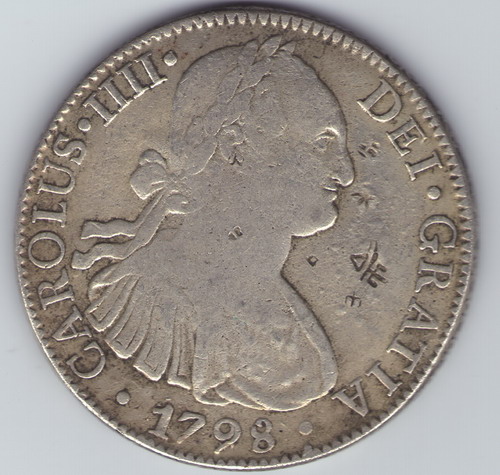
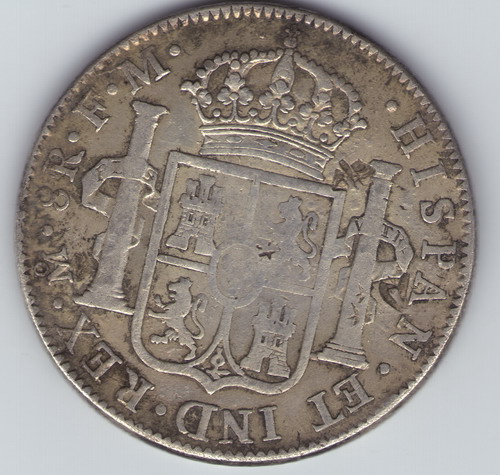
epop Your 1798 looks a bit better but I do have two areas of concern which BOTH point toward the same conclusion.
First, On both sides of the coin I see surface lumps that look suspicious. Most are in the field in front of the King's face BUT they also occur in and around details on the other side. They are worn but still present. Lumps like this by themselves are NOT PROOF that the coin is a fake. But they are an item that makes me look further. That is because while they CAN OCCUR on real coins they are far more common on the late 19th century bullion forgeries made for the China Trade. The lumps are caused by surface damage on the dies themselves. This type of damage was routinely removed in the mint by re-surfacing the die. The forgers, who were more interested in die life than in the beauty of their output did not tend to surface the dies so more lumps and bumps are common.
Second, there is a feature on the edge of the coin which is an error seen on many of the same class of bullion forgeries. The EXTRA VERTICAL BAR between two circles. That identical feature is seen on many of the bullion copies. Here is a detailed comparison of what I see.

Once again, this is a clue NOT PROOF by itself. The next step is to check the edge at exactly 180 degrees from this point and see if it has an OVERLAP in the edge. If a similar ABRUPT change occurs it could be real. But if the edge on the opposite side is normal - circle - rectangle - circle etc. You have a counterfeit.
Even if it is a counterfeit, it is most likely one of the bullion forgeries made in the US after 1870. Most dealers treat them as real and they sell for the same prices as real coins especially for common date worn coins. They did circulate along side real coins for decades and they do contain the full weight (usually) of silver.
You should weigh your coin and if possible run a test to determine specific gravity.
I am trying to educate collectors about the fact that this group of bullion forgeries actually exists. Most average collectors simply do not know or do not care. It is a situation very similar to the 1950 D US 5 cent coin. In that case, (as in the case of Portrait 8Rs) the counterfeits outnumber (or certainly approach on number) the originals on the market but that is a different story.









 Posted 08/13/2010 11:53 pm