| Author |
 Replies: 41 / Views: 13,839 Replies: 41 / Views: 13,839 |
|
|
|
Pillar of the Community
3660 Posts |
Quote:
That would work too, but the taper of the collar is probably not more than about a thousandth of an inch over the thickness of the collar which is several times the thickness of the coin. It may be vary difficult to square your measuring device the coin and the taper of the coin over the thickness of the coin would be very small and probably hard to measure. Not saying it can't be done, but I don't have that kind of equipment. Maybe elaborate and sophisticated equipment could be limited to a level, a plate of glass, a machinist's square and an UNC coin. Level the plate of glass......stand the square on the glass.....stand the coin on edge, (obverse flush to the blade of the square)......remove the square carefully and slowly by sliding the square away from the coin. Gravity and coin height/weight may be sufficient to tell the tale. If the coin does not at least fall, it may lean. Now set up with the coin reverse to the square blade. If I am correct, the coin should fall or lean to the same side as in the previous set up. Once again, I have none of the ingredients necessary to complete this experiment. (Strictly a thought). |
|
Pillar of the Community
United States
3076 Posts |
Great thread and understandings!,,,I would wonder since we have the techno one could use a micrometer to measure the each side of the coin they can measure to the 10, and 100 thousandth of an inch, on the other side, I think your analogies of how the dies were positioned in the die, most interesting,,,I have never heard of the flats on dies or the set screw ideas, nor have I researched how they were set, there was undoubtibly some way to set the dies....if not and it was determined by the operator, we would have many many more listed die rotations, in fact there would be many outside of the listed rotations, of say, 10 degress 45 90 180 ect.....I think there would be many more such as 37 1/2 degree's or 23 3/4 degrees if the dies simply came loose....I think it is plausible that those placing the "flats or set screws" in the dies could have placed them in the wrong spot, resulting in there placement into the press/setup resulting in the rotations we see in the minting process. How ever I do have one interesting point to ask, in most instances the dies alignments were proper as far as die rotation is concerened... Why is it when I look at Clashing, which is supposed to be the dies hitting when a planchet is not within the press as it is operating, and the dies strike each other...WHY is there ROTAIONS amounst the clashing......as noted from approx 5 to 7 degree's? many a VAM is noted by this rotation....Any concepts for this ? By the way Zee the glass is a great reference for a measurement. just by its manufacturing process its nearly perfectly "FLAT AND LEVEL" I use it for many things. I don't have a 2-3 inch micrometer or I would try to measure the edges, to find out the taper idea.. like to hear some ideas of the clash rotations, as they do define them self to die varieties for Morgan dollars... |
|
Pillar of the Community
3660 Posts |
Quote:
one could use a micrometer to measure the each side of the coin I would think that the jaws of the micrometer would have to employ pinpoint tips or the jaws of the caliper would need to be razor sharp in order to measure only the extreme edges of the coin. I personally like the method of using back light between the edges of a stack of coins better. (Less chance of error). Quote:
I think it is plausible that those placing the "flats or set screws" in the dies could have placed them in the wrong spot, resulting in there placement into the press/setup resulting in the rotations we see in the minting process. Plausible, the flats are on the dies themselves....the setscrews are threaded though the sides of the cups (die stakes) that the dies sat it. As I do believe that the dies were removed and turned in at the end of each day (for security and accountability purposes), this would lend itself well to that notion. One day the flat was found, the next day, it wasn't. I think that the flat may have been missed on occasion during set up as this would have been accomplished by 'feel'. If a coiner used the eyeballing method though to find the flat, slight miscalculations could have been made. Is there not a variety (1882 CC vam-2 that is known with many degrees of rotation? If so, could this be a result of a loose set screw, allowing a die to spin? If so again, is there really sound rationale for giving numerous die state designations to this VAM? Could not the die spin back and forth rather than in one direction only? Quote:
Why is it when I look at Clashing, which is supposed to be the dies hitting when a planchet is not within the press as it is operating, and the dies strike each other...WHY is there ROTATIONS amongst the clashing......as noted from approx 5 to 7 degree's? I think that maybe this 5-7 degrees was within acceptable mint variance (going back to your thoughts on the folks who actually put the flats on the dies). Nobody would have noticed back then, (and even collectors of today probably are not going to notice) a 5-7 degree variance from one side of the coin to the other, or even bother looking for it. With a clash however, the rotation is brought into clear evidence by all factors being located on one side of the coin. (Much more obvious to see). Quote:
the glass is a great reference for a measurement.
just by its manufacturing process its nearly perfectly "FLAT AND LEVEL" Not really, all glass is not inherently flat. I think that I specified 'plate glass', (if I didn't, I meant to....my mistake then). Even so, perfectly flat plate glass will not level the surface. A 'level' must be employed to level the glass so either coin fall or tilt could be achieved. I wish that I had some of this stuff, I would like to try it. (The coin must be UNC as well). I think that visual evidence on the coins themselves causes additional tests to be unnecessary though (In 'MY' opinion anyway). |
|
Bedrock of the Community
United States
17884 Posts |
Quote:
Plausible, the flats are on the dies themselves....the setscrews are threaded though the sides of the cups (die stakes) that the dies sat it. As I do believe that the dies were removed and turned in at the end of each day (for security and accountability purposes), this would lend itself well to that notion. This is correct, also a die used one day pair with a die so it had no rotation, may be paired the next day with a die that has in improperly ground flat and show a rotated die. (They did not try and make sure they kept die pairs together.) Quote:
I think that maybe this 5-7 degrees was within acceptable mint variance (going back to your thoughts on the folks who actually put the flats on the dies). In general mint tolerance is 15 degrees +/-. Quote:Is there not a variety (1882 CC vam-2 that is known with many degrees of rotation? If so, could this be a result of a loose set screw, allowing a die to spin? If so again, is there really sound rationale for giving numerous die state designations to this VAM? Could not the die spin back and forth rather than in one direction only? Yes a loose set screw could allow the die to spin. It may still be possible to link die state information to various rotations. There is a similar occurance in the early die large cents. 1807 S-276 usually comes with a 180 degree rotation but can be found rotated anywhere around the clock. One person has made a study of this variety though and has found that there are four rotations that make up the majority of the coins seen. He has also corrolated those rotations with die state wear to the obv and reverse dies to show that the dies were removed from the press and then reinstalled with different rotations at least four times an the order of those instalations. The other rotations then resulted from the set screw working loose and the die rotating from those starting positions. (On the very early dies they did not grind flats in the die body and either simply tightened the screws against the body or punched a shallow depression in the die body for the screw to set into. Only a slight loosening of the screw would be needed for the die to start rotating. It can be difficult discussing the ways they have used to prevent die rotation because they have used more than one method and a few different die body shapes over the years. |
|
Pillar of the Community
United States
1582 Posts |
Guys, I posted scans of this coin here in the forum about four or five years ago when I first started collecting Indian Head cents - thought I had a big dollar coin - no such luck, so I've just held onto it. Thinking it was something worth alot (still pretty green back then) I forked over the bucks to have it graded by ANACS, but this being the only coin I've ever sent in for grading, I didn't know squat about what to ask them to do, so they just graded it and sent it back. I sent it off to a friend out in Washington State, and he measured the rotation, and took the picture. Might not be worth alot, but I still think it's cool. Ralph 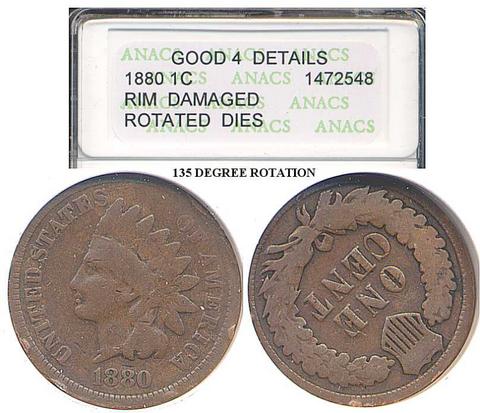 |
|
Pillar of the Community
United States
2760 Posts |
That's a nice 1880 rotated Indian. I have a couple rotated Indians myself, and just checked to see if I had an 1880. Turns out I have an 1880 in G6 (problem free) that is rotated 100 degrees, and is slabbed by ANACS. Pretty similar to yours! As for value, which you mentioned a lot in your post, I won mine at auction for $30. Yours is definitely a keeper in my book, even if it's a little damaged.
|
|
Pillar of the Community
United States
1582 Posts |
Cool Robbudo! Never know, the two might have come from the same set of dies.
The individual who owns the rotated dies census site has my coin listed there as R6.
I don't intend to get rid of it, but, as for value, I probably spent more having it graded than it's worth.
Ralph
|
|
Pillar of the Community
United States
1582 Posts |
Guys, an area you might want to explore is the Mercury dimes. I have a complete set of 77, and over 40 of them have some degree of rotation. Ralph |
|
Pillar of the Community
United States
2760 Posts |
Hi Ralph, I just got my 1880 out to look for marks that would identify it to a particular die. The only thing I found was that the top right part of the I in UNITED seems to be slightly broken from the main part of the 'I'. This could very well be PMD, but it's the only thing I can find. How does yours look? And about your rotated mercuries, whats the average rotation and what's your greatest rotation? |
|
Pillar of the Community
United States
2760 Posts |
here's the pic. I almost see a separation like this in yours (even though my hunch is still PMD), so I thought I'd throw it out there. 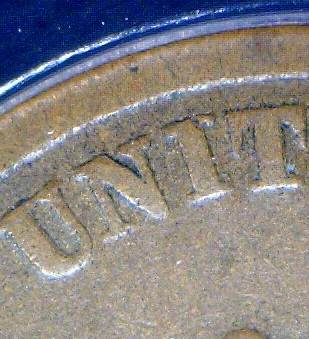 Edited by robbudo
10/29/2010 8:10 pm
|
|
Pillar of the Community
United States
1582 Posts |
can't really tell about the I, but there appears to be a small die break on the upper half of the first S in STATES.
As for the Mercs, most are minor - a couple might reach 40 degrees (if memory serves me correct). Can't look at the coins right now as I don't keep my collection at home - just got to be too big, and, while it's not a really high dollar collection, the value is more than I want just laying around, so I rented a box at the bank. I took scans of all my coins before taking them to the bank; however, I just scanned the obverse of each coin as well as the obverse album pages (that alone was alot of scanning) - just didn't have the gumption to scan all the reverses as well on all those circulated coins.
Ralph
|
| |
Replies: 41 / Views: 13,839 |
To participate in the forum you must log in or register.
Disclaimer: While a tremendous amount of effort goes into ensuring the accuracy of the information contained in this site, Coin Community assumes no liability for errors. Copyright 2005 - 2026 Coin Community Family- all rights reserved worldwide. Use of any images or content on this website without prior written permission of Coin Community or the original lender is strictly prohibited.
Contact Us | Advertise Here | Privacy Policy / Terms of Use
|
| Coin Community Forum |
© 2005 - 2026 Coin Community Forums |
| It took 0.38 seconds to rattle this change. |
 |
|





 First Page
 Previous Page


 Posted 09/13/2010 02:26 am


