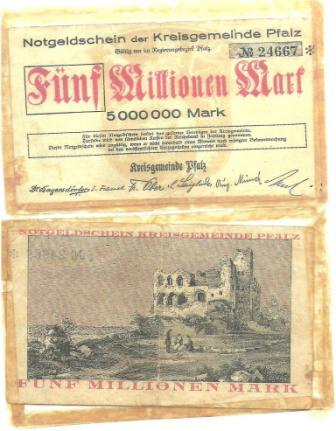
It is indeed German, but it's not technically a banknote. It's a piece of "notgeld", a German word which means "emergency money".
After WWI, the German economy basically collapsed. The government reduced issue of coinage, and most of the coinage in "circulation" was being hoarded and not actually circulating. To fill the gap, state governments, cities, towns, local businesses, the Railways, all started issuing their own private tokens and scrip. There are thousands of issuers of these notes, and hundreds of thousands of different types recorded - the most complete catalogue of notgeld ran to over 30 volumes!
Some notgeld was issued primarily as a substitute money, but many pieces were printed specifically for sale to tourists and collectors. Many are highly decorative and feature local landmarks or other themes.
Your piece is from the
hyperinflation period. As confidence in the German government collapsed in the early 1920s, the value of the mark collapsed too. Inflation ran at hundreds of percent
per day - people would spend their money as soon as they got it, because they knew it would soon literally not be worth the paper it was printed on.
Quote:
...since I don't speak German...
I don't either, though I took it for a few years in high school. I've found translation programs like
Google Translate to be of some help, though I often have to supplement it with my old school German-English dictionary. Deciphering the "fraktur" script often used on German notes and notgeld can also be challenging.
"Notgeldschein" means "Emergency note". "Kreisgemeinde" means "regional community". "Pfalz" is the name for a district of Germany, known as "the Palatinate" in English; it currently comprises the southern half of the German state of Rheinland-Pfalz.
I found your note on
this website, which illustrates the varieties and denominations issued by this district. Your note is undated, but according to that website the later notes were dated 11 August 1923. Pfalz was under French military occupation at the time, and a few months after this note was issued, a secessionist movement arose in Pfalz, which briefly declared the region
independent. Speyer, the city named on the note and under which it is filed in my notgeld checklist, was one of the centres of the rebellion.
Don't say "infinitely" when you mean "very"; otherwise, you'll have no word left when you want to talk about something really infinite. - C. S. Lewis










 Posted 09/22/2010 08:34 am


