| Author |
 Replies: 75 / Views: 6,427 Replies: 75 / Views: 6,427 |
|
|
|
Pillar of the Community
 3660 Posts |
Quote:
The New Orleans mint had older equipment compared to the San Francisco mint. A good point....and a strong contributing factor depending on what you might consider 'equipment'. Quote:
The New Orleans mint had a much higher percentage of weak strikes compared to San Francisco and Philadelphia.
I will take your word for that, and this feature would be symptomatic to the direct cause. Quote:
The New Orleans mint had a higher percentage of clashed coins compared to the other mints. This also 'could' be a symptom of equipment adjustment to the problem. Quote:
The New Orleans mint had a higher percentage of rotated coins (extant) compared to the other mints. I am not really sure what to think about that. So we have these things to consider: Equipment, people, process. The equipment was inadequate, so the people adjusted the processes. What equipment was inadequate, which people adjusted what processes? I would much rather discuss it rather than just blurt it out. It is a better way of learning than just reading. |
|
Pillar of the Community
United States
709 Posts |
I think you have to take into context the aftermath of the war between the states (civil war 1861-1865)in regards to the severe reconstruction policies of the North that were placed on the defeated South. That aspect with respect of the workers dislike (mostly southerners) to management (Yankee carpetbaggers)and it's not surprising "things" happened with respect to equipment. Sloppy performance was likely the norm.
|
|
Pillar of the Community
 United States
1551 Posts |
|
|
Pillar of the Community
United States
709 Posts |
From wipipedia concerning that period with the mint. Occupation by Union forces A piece of the U.S. flag William Mumford tore down from the New Orleans Mint in 1862 became a symbol. For many Southern sympathizers, the Mint soon became a symbol of their hatred for the Union occupation. After U.S. Marines under Farragut had raised the U.S. flag on the roof of the Mint in April 1862, a professional steamboat gambler named William B. Mumford ascended the roof and tore the flag down. He ripped the banner into shreds, and defiantly stuffed pieces of it into his shirt to wear as souvenirs. Union General Benjamin Franklin Butler, the military governor of New Orleans (who was soon to be derisively nicknamed "Spoons" for allegedly pocketing the silverware of New Orleans citizens arrested for treason against the United States), ordered Mumford executed in retaliation. And so, Mumford was hanged from a flagstaff projecting horizontally from the building on June 7, 1862. Mumford's hanging made national headlines. Jefferson Davis demanded that Butler immediately be executed if captured.[19] The event stuck in the minds of many New Orleanians: eleven years later, in 1873, a visitor to the city named Edward King mentioned it in his description of the structure.[20] The mint reopened as an assay office in 1876. Its machinery was evidently damaged during the war, but because of its importance, unlike the mints at Charlotte and Dahlonega, in 1877 U.S. Mint agent James R. Snowden asked the superintendent of the office, Dr. M. F. Bonzano, to report on the condition of the facility for minting. Upon receipt of Bonzano's report, new minting equipment was shipped to New Orleans. The building was refurbished and put back into active minting service in 1879, producing mainly silver coinage, including the famed Morgan silver dollar from 1879 to 1904 |
|
Pillar of the Community
United States
672 Posts |
I wonder if the weather in New Orleans had anything to do with the equipment? Humidity, temp, etc. It is dramatically different than CA, NV, or PA. Keep in mind there was no AC or anything, just a thought.
|
|
Pillar of the Community
3660 Posts |
Outstanding insight Terry.....simply outstanding. Yes........It was indeed these exact sentiments that were the root cause for the issues that you see on the New Orleans mint coins today. However, these sentiments were not one sided. The war not only served to tear our nation apart from within, it left our people with disdain, stereotypical impressions, and even hatred for the next hundred years. No other event in U.S. history has affected us in the way that the civil war has. Quote: Upon receipt of Bonzano's report, new minting equipment was shipped to New Orleans. The building was refurbished and put back into active minting service in 1879, producing mainly silver coinage, including the famed Morgan silver dollar from 1879 to 1904 Yup, an undertaking accomplished with funds appropriated by the U.S. Congress, based mainly on past requirements, without regard to the either current or future production quotas that Congress would place on the mint. Result: A refurbished mint capable of sustained coinage production of prior levels, but incapable of increased production volume required by Congress. |
|
Pillar of the Community
3660 Posts |
Good point Americanamafia, in fact this very humidity thing has been brought up before as a possible factor in the 'pitting' that is observed on several Orleans minted coins. Good observation.
|
|
Pillar of the Community
3660 Posts |
Okay, we are getting close here, the refurbishment was inadequate either because of Congress' lack of vision, or its refusal to fully fund a this venture in the South......Or......Maybe the vision was not realized by those on the scene assessing 'refurbishing' requirements. This is neither here nor there, it just didn't work out.
Now, what portion of the refurbishing was lacking? Were there were enough presses, enough workers ?.......Silver was imported directly from Mexico to the port, so what was was the weak link?
|
|
Pillar of the Community
United States
5700 Posts |
I believe from the literature I have seen and read there may of been many factors that lead to the "different strikes" in the coins produced in different mints, I believe ALL the working Dies were produced at Philly and distributed to the other mints, some were even changed once arrived or changed from mint to mint as they were needed. I also know the process in which these master dies were made differed, being some dies were basined, a form of shaping the dies or polishing them to create the needed curvature around the perimeter to give the dies the ability to have the proper flow of metal to strike the coins, which resulted in different finishes on coins from die to die , from mint to mint, the polishing compounds or materials used and the people who used these materials also differed as most employees have differing systems in which they would work and the degree of getting the job done, some would polish longer giving a certain finish or some less, giving a completely different finished product. I Believe the working conditions in each facility was probably about the same, workers did not have air conditioners, and people and their abilities would of had to show in these conditions, some places were probably more inclined to moisture which I see in some coinage as rusted dies used and polished to remove this effect, I do not think the dies were treated as they should of been, being oiled or greased on a consistent basis, during the dies lifetime. I know from my seeing and researching the records, that the coins produced from the New Orleans Mint were to become some of the most outstanding coins as far as ones having the "best" die breaks and die cracks to date, and certain areas were also known to have been produced with weaker struck coins while the San Francisco mint, ( The Granite Lady ), was known to produce strong struck coins. I also know the process of basining was not performed on all dies or working dies for all the mints, which would, IMO, Lead to a differing degree of a life time of these dies used, granted some dies would of been polished to remove clash marks, which would at times enhance the product produced from the dies and give a proof-like finish as compared to the original dies which gave a proof finish, talk about rambling........PS, ZeeWool, I can not believe you, as stated, do not have a coin or do not collect coins but have the passion, knowledge you obviously exude for this hobby!!  |
|
Pillar of the Community
3660 Posts |
I think that possibly you confuse master dies with working dies then Mike. No master die was basined (ever). Master dies are created directly from the master hub. Working hubs are created from master dies and working dies are created from working hubs. As far as different strikes being obtained at different mints due to different people employing different methods, I might agree there, but believe that 'most' irregularities originated at Philly prior to shipment. Basining was not a form of shaping dies. Shape, curtature and flow avenues are results of hubbing..... Working hubs sometimes developed chips that were transferred to the dies....Basining simply removed chaff or other superficial relief irregularities (over the entire die face, not just the perimeter) due to hubbing. The working conditions at individual mints is a factor that I feel varied greatly. The issue of rusted dies is purely speculative at best. This condition appears to be indicative of rust caused by moisture.....this condition appears also to be indicative of contact with a corrosive substance. Consider sulfuric acid for instance.....spill a bit on a die face, it eats or pits immediately, wipe it off, strike a few coins.....look again....you didn't get it all off the first time.....further pitting.....wipe it off again....strike more coins.....I am NOT saying this is what happened, but rather using this as one example of further possibilities. The strike strength of the coins that you hold in your hand could also be dependent on a variety of factors. All mints had one basic problem in common though, and that one problem contributed more to the various cracks, weak strikes, premature die wear, Cuds, clashes, etc, etc, than all other factors combined. Do you know what that problem was? You refer to basining yet again.....Basining had nothing whatsoever to do with die life......1921 Morgans were not basined for instance. Does this cause any bells or whistles to sound concerning the presence of 'scribbles' on many reverse dies? Some experts feel that these 'scribbles' are attempts to add a busy appearance to an area otherwise void of design. Yeah, right. Believe it or not Mike, it is true.....not only do I own no Morgans or Peace, I am ridding myself of all other coins as well. I am neither dealer or collector. It just is not me. While I can empty my vault easily enough, I find it much harder to empty my head, and that is why I am still talking to you today. |
|
Moderator
 United States
23522 Posts |
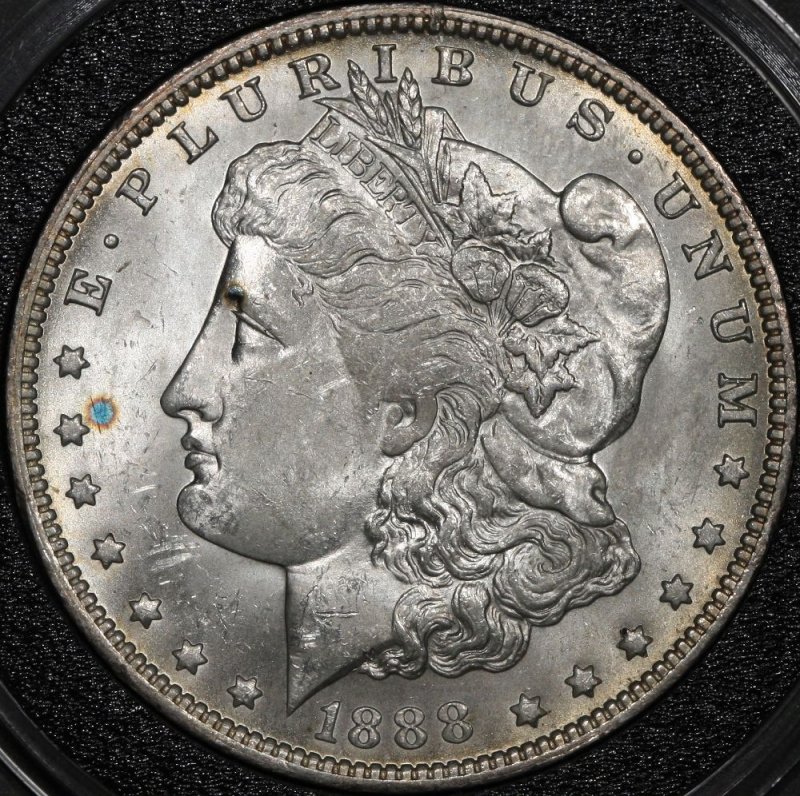 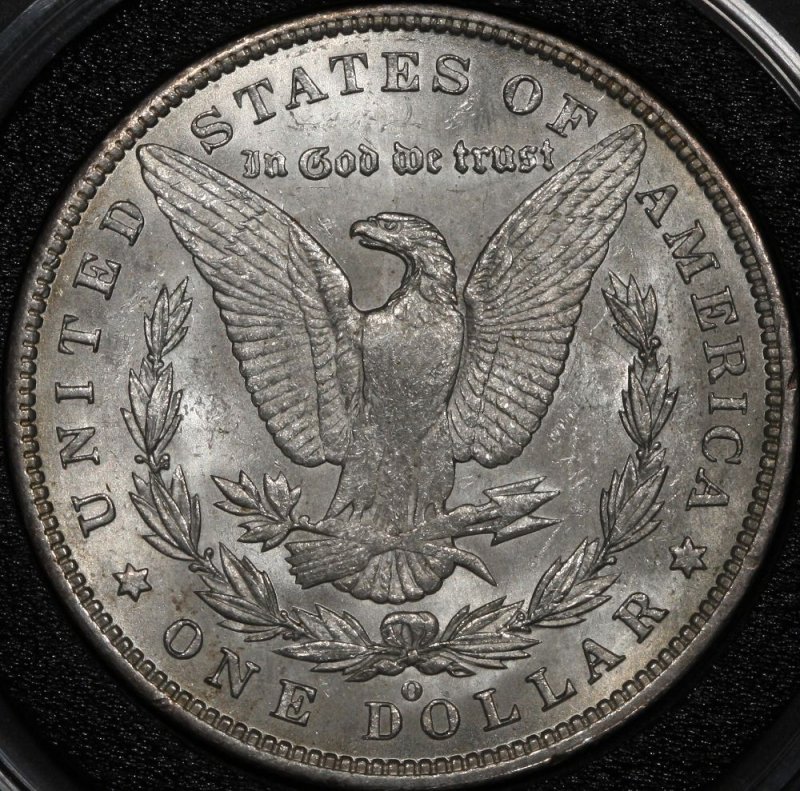 Although this coin belongs to Metalman, I've held it in my own hands and it's unquestionably a Mint State, as-struck 63-ish coin. What detail there is, is sharp; I saw no real signs of excessive die wear on it. It's my opinion that Philadelphia isn't a whole lot drier than New Orleans. It's only 30 river miles from Delaware Bay, and the Delaware River is still tidal at Philadelphia. I go there frequently; take my word when I say it's just as hot-'n-nasty as it is here at the shore.  Some of the worst pitting known with Morgans are the 1921 Philadelphia issues. My opinion is that much of New Orleans' problems stem from a systemic, laid-back, lackadaisical approach to the science of minting coins at that mint. |
|
Pillar of the Community
3660 Posts |
Quote:
I'll share with you later Well 'later' has come, so.... as promised, (even after several clues), void of guesses or speculation, (with the exception of Dave), deja vu, here is the answer: Quote:one problem contributed more to the various cracks, weak strikes, premature die wear, Cuds, clashes, etc, etc, than all other factors combined. Do you know what that problem was? Improper annealing is the answer. Quote:
Premature die wear out was 'THE' major problem at the New Orleans mint. What are the possibilities that could cause increased die wear? An engineer was assigned to New Orleans by the Mint Director in Philly to find out. While the Philadelphia mint had difficulties annealing dies consistently, the New Orleans mint could not anneal planchets at a rate commensurate with required production levels. This engineer sent to the N.O. mint found that the planchets were neither heated to a high enough temperature or kept at temperature for a duration that could be considered effective for striking coins. Result: the planchets were so hard that when struck, silver displacement (flow), did not adequately transpire. (Weak strike) but actually, the strike was not weak, the problem was that the planchets were too hard. If you were supervisor of the N.O. mint, and you had complained about the need to expand your annealing capabilities, and funding fell on the deaf ears of the Congress, while the Mint Director in Philadelphia ordered production levels increased, what would you do? You are capable of annealing only half of the planchets per month required to meet production levels, so you might cut corners on proper annealing procedures, in an effort to save time. To counteract the lack of metal 'flow', caused by your hard planchets, you might adjust the upper die in your presses by loosening the lower die, setting it 1/32" below flush with collar top in strike position, relocate the upper die to set on the lower die, thereby causing 1/32" more downward travel of the upper die at strike in effort to offset the hardness of the planchets. When clash occurs though, it will be more severe than normal die placement, coupled with increased die wear from striking a harder planchet.....and the die adjustment is rather ineffective as well. The lesser of the two evils (the greater being the kiss of death from not meeting production quota). |
|
Pillar of the Community
United States
672 Posts |
I think you would have a hard time arguing that the humidity in PA is simmilar to NO. Plus saltwater humidity is completly diffrent than freshwater humidity.
|
|
Pillar of the Community
3660 Posts |
|
|
Pillar of the Community
United States
672 Posts |
They pretty much said what I thought they would, neither of them are California lol. Shoreline proximity I didn't think of that, I was thinking of the type of water near them, salt vs fresh (and some would argue brackish). I think what you mentioned about hard planchets would play a major roll too.
|
| |
Replies: 75 / Views: 6,427 |
To participate in the forum you must log in or register.
 
- The Tyrant Collector - PCGS Youtube Interview
- Counterfeit Detection: ANA Video - Introduction, With Brian Silliman And Jim Robinson Ep. 1
- Counterfeit Detection: ANA Video - Mistakes, Risk Factors, And Counterfeits & Alterations, Ep. 2
- Counterfeit Detection: ANA Video - Pimples And Pits, Looking At Cast Counterfeits, Ep. 4
- Counterfeit Detection: ANA Video - What Year Is That Cent? Key Date Coins, Ep. 5
- Counterfeit Detection: ANA Video - Diagnostics Of The 3, 5, And 10 Cent Coins, Ep. 6
- Counterfeit Detection: ANA Video, Counterfeit Quarter Dollar Diagnostics, Ep. 7
- Counterfeit Detection: ANA Video, Counterfeit Classic Commemorative Coins Diagnostics, Ep. 8
- Counterfeit Detection: ANA Video, Counterfeit Silver Dollar Diagnostics, Ep. 9
- Counterfeit Detectection: ANA Video, Classic US Gold Coin Diagnostics, Ep. 10
- Counterfeit Detection: ANA Video, Diagnostics Of Chinese Made Counterfeits Of US Coins, Ep. 11
- Counterfeit Detection: ANA Video - Wrap Up Recap With Brian Silliman And Jim Robinson Ep. 12
- 2026-P Jefferson Nickel Possible Die Chips, Die Cracks And Other Anomalies
- Commems Collection Modern: What If? 1993 Bill Of Rights Circulating Coinage - A 1990 Attempt
- Split Grading - An Idea That Would Drive Collectors Mad
- 1960 D Lincoln Memorial Cent (Small Date) BIE
- Is This 1888-S A VAM-10, 10A Or Something Else?
- 1994 Brazil 10 Centavo - With Die Clash
- US 1 Cent 1856 Altered From 1858?
- 2009-P Quarter, Puerto Rico, Reed / Edge Error Or PMD?
Disclaimer: While a tremendous amount of effort goes into ensuring the accuracy of the information contained in this site, Coin Community assumes no liability for errors. Copyright 2005 - 2026 Coin Community Family- all rights reserved worldwide. Use of any images or content on this website without prior written permission of Coin Community or the original lender is strictly prohibited.
Contact Us | Advertise Here | Privacy Policy / Terms of Use
|
| Coin Community Forum |
© 2005 - 2026 Coin Community Forums |
| It took 0.39 seconds to rattle this change. |
 |
|






 First Page


 Posted 09/25/2010 8:50 pm


