| Author |
 Replies: 42 / Views: 18,260 Replies: 42 / Views: 18,260 |
|
|
|
Pillar of the Community
United States
3076 Posts |
I am not thinking that striated planchets has any thing to do with die life, rather that the striations occur in the planchet process reguardless of the dies life..Its late.. I will post my example tommarow..Gene
|
|
Pillar of the Community
3660 Posts |
Then we think alike on this topic Gene.
|
|
Pillar of the Community
United States
3076 Posts |
It is my understanding from studies last year when I found this coin. and I thought it was a "WHIZZED" coin at first, until I realized all the groves were uniform in appearance and angle..A whizzed coin would be like a hand sanded item with scratches going in every direction.. Striated coins are produced BEFORE the coins are cut into planchets, In this process the silver is supplied in a sheet form, then cut down to workable sized strips that will be fed into a machine that will punch or cut the planchets into there "ruff dimention" now it is in a smaller sheet form at this time moving across rollers which will feed this sheet to the planchet process...it has been known that either dirt/grit or metal or something as simple as stuck rollers that the sheet rolls across scratches the sheet producing straight lines across the sheet, and this doesn't mean its all the sheets, as we would have thousands and thousands of them seen in all years and mintmarks, they are not so common but not ultra rare I think...but I could be wrong on that point... If one thought it was in the die, there would be say 50,000 or what ever the life of the die could produce, and this is not the case as the evidence is not supported for any year of the Morgan series..The cause is not in the die....but in the process, here are some pic,s as well as those shown in this thread already, straight lines at the same angle, Striations.... 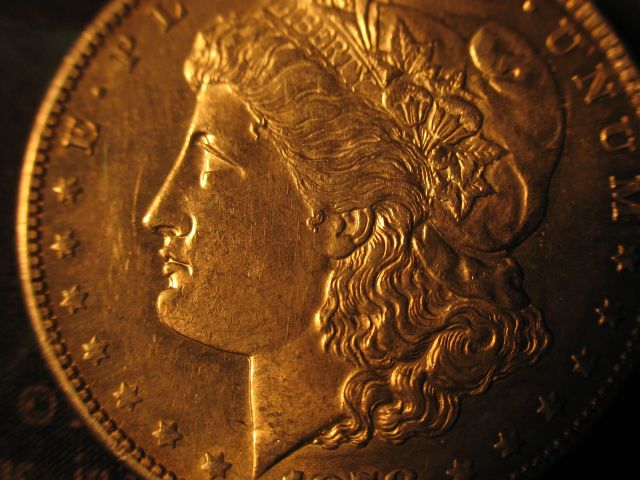 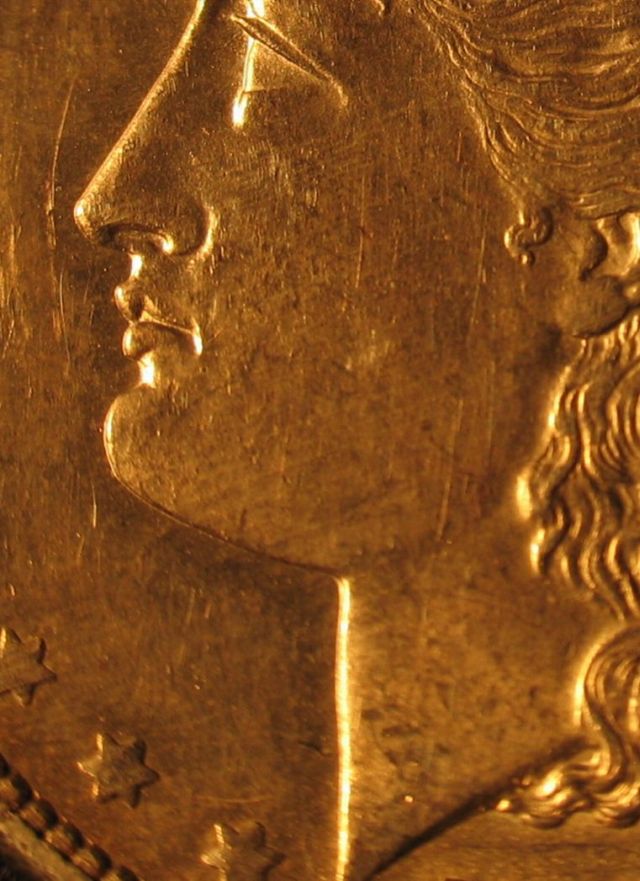 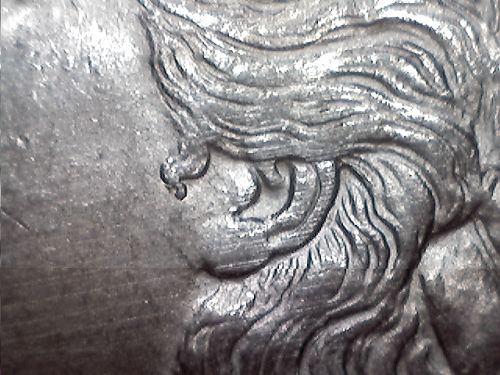 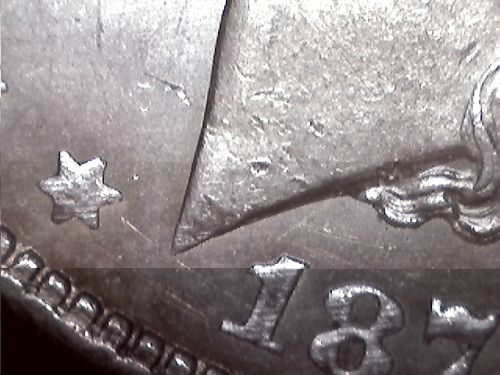 |
|
Pillar of the Community
3660 Posts |
Actually Gene, (and I don't know about Morgans or Peace, but) on earlier dates and various denominations, these marks 'were' on the dies, and transferred as raised lines on the coins.
|
|
Pillar of the Community
United States
3076 Posts |
That was my point Zee these lines are not raised as they would be if in the die, but rather lines in the planchet, notice even in the hair, the lowest in the die they are still there.. and they are indented not raised..
|
|
Pillar of the Community
3660 Posts |
Yeah, I know Gene. I can understand your coin, as the lines are in the planchet rather than the die, but when the lines are in the die, rather than the planchet, I wonder what the cause might have been.
|
|
Pillar of the Community
United States
3076 Posts |
THEN I guess, this would be, an example...of when coins exibits "recessed" lines deep with in there surface rather than "raised" lines or considered gouges or polish lines, depending on the circumstance.....there are not many examples of STRIATIONS in general, and rightfully so........If it were within a die feature there would or should I say a common feature seen in all of the years minted..........yet this is not so....just my thoughts.
|
|
Moderator
 United States
23522 Posts |
Quote:
Yeah, I know Gene. I can understand your coin, as the lines are in the planchet rather than the die, but when the lines are in the die, rather than the planchet, I wonder what the cause might have been. I would think, then, that the working hub had to put them there. |
|
Pillar of the Community
3660 Posts |
Yeah, right you are Gene, and I really don't know what to make of it. I've seen it mainly on pre-steam press era coins.  |
|
Pillar of the Community
United States
3076 Posts |
I would think then Dave you would realize its not in the die, but the process which brings the material into minting......if it were into the die.........there would be many a VAM with striations and noted for the cause.....but this is not so....striations are a known occurance, and I have not seen, DIE RELATED for a certain year,,, HAVE YOU? \and not to debate this idea but rather to research it... |
|
Pillar of the Community
3660 Posts |
Heritage archives are full of them Gene.
|
|
Moderator
United States
23522 Posts |
So how deep are the striations originally, that they would survive a 150-ton strike into all reaches of die depth? Or did they appear during the strike?
|
|
Pillar of the Community
3660 Posts |
Yeah, this is something that I also have been wondering. Surely they must have been substantially reduced during strike, which makes me wonder that they should have been so obvious as to be detected prior to entering the press?
|
|
Pillar of the Community
United States
3076 Posts |
looking at my photo's, I think you are correct, they are diminished somewhat depending on the recsessed areas, for examples, the pic of the face and ear, the face is less in depth, than the hair is, and the surface area (flat )areas show minimal striations, its the recessed areas, like the stars and face and hair that retain the striations, as they were not squished as much, or to the degree the flat areas were..just a thought here..
|
|
Pillar of the Community
United States
3076 Posts |
very interesting discussion, lets not let this die here...as I'm soon off to bed LOL...
|
| |
Replies: 42 / Views: 18,260 |







 First Page


 Posted 10/20/2010 08:52 am





