| Author |
 Replies: 11 / Views: 3,547 Replies: 11 / Views: 3,547 |
|
|
New Member
United States
17 Posts |
I am looking into getting a stereo microscope and I was wondering what magnifications would be appropriate. I was thinking 10x and 30x...but was not sure if 30x would be enough to identify some of the different VAM varieties. Edited by stormbind
08/21/2006 10:23 pm
|
|
|
|
Pillar of the Community
United States
4589 Posts |
Sorry I do not know the answer, however 30X seems like it should blow up almost any detail one needed. What I can see with a 16x loop is incredible so I am sure 30x is great.
|
|
Rest in Peace
United States
2684 Posts |
Bryan and Superdave are most knowledgeable on VAMs and I don't know what they use, but I believe Jim is correct on the 30X since some VAMs are almost microscopic in nature. A standard 10X - 15X loupe might not be sufficient. As a biologist, I've had a fair amount of experience in magnification equipment and might offer some advice. If it's in your budget, secure a stereo dissecting scope (has a lot of other names depending upon who uses them and how they are used) with a three-piece rotating turret with varying power objective lens, e.g., 10X, 30X, 50X or even a 75X or 100X. These are removable on most scopes, so they can be interchanged. Surplus scopes of this type can be had for as little as $50 or - the sky is the limit. Electronics companies use them for quality control on their products and may surplus them off on ebay. One thing to avoid: true microscopes with objective lens of 100X to 500X, primary lens of, say 5X to 15X and total magnification of 500X to 2500X; these are a little too strong for coins unless you want to identify the bacteria which might be on a coin.  (I love playing with the new smilies!) Alternatively, a stand-alone fixed-focus collapsible stereoscope of the type used to read aerial photos are a lot less expensive and far more portable, but also lack the magnification and focus flexibility of the larger scopes. Maybe five bucks on ebay. |
|
Pillar of the Community
United States
954 Posts |
All depends on how much you want to spend. I and quite a few others use a QX3 or a QX5, toy microscopes you hook up to your computer and view on your monitor. It also takes pictures  . I use 60X and it looks like this... 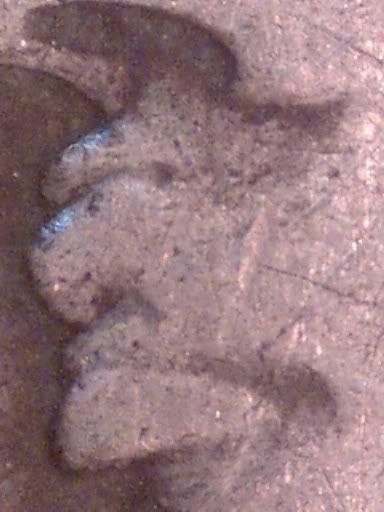 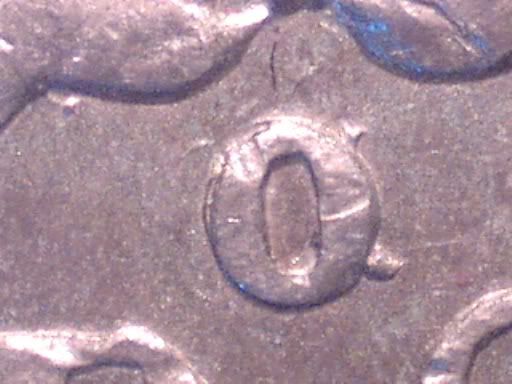 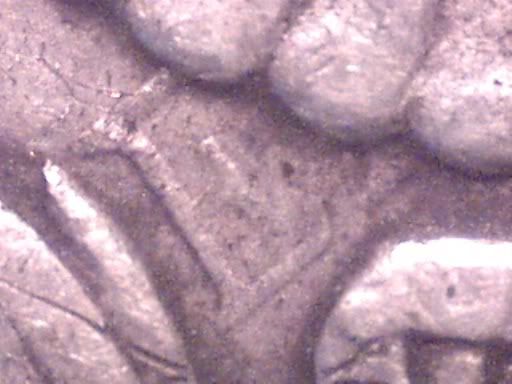 Not bad for a $27 toy huh? You can find these used on ebay, or about $80 for the QX5. |
|
Moderator
 United States
23522 Posts |
QX5 for the win!  Seriously, as Becky's O/CC pic illustrates, you'll be happier with more than 30x magnification to look into the more arcane variants. In al honesty, I'm growing disillusioned with my QX5 - it's all-plastic, and the platform is not as stable as I'd like to get a consistent focus. It's a great scope for the money, and the direct computer interface is a great timesaver, but I'm seriously thinking along Morgan Fred's stereomicroscope lines for the future. |
|
Pillar of the Community
United States
4589 Posts |
wow great feed back everyone I know that I have learned alot here.
|
|
New Member
 United States
17 Posts |
Thanks for your information about the Q3 and Q5. I am really looking for something a little higher quality than these. Morgan Fred..I always thought that the most magnification you could get out of a Compound Light Microscope was 1000X. I believe this limitation to be due to the wavelength of visible light. After you get any larger than 1000x you you are looking between the wavelengths of the light beams and the image is very dark. That's why Electron Microscopes were invented...because the wavelength of an electron beam is much smaller than a beam of light, therefor yielding a much greater magnification before you stretch out the wavelength. This is all considering Transmission Compound Microscopes...the light passes through the specimen being studied. Obviously this would not be the best choice for viewing coins. This is why I have decided to go with a Stereo microscope. Stereo Microscopes differ from Transmission Microscopes primarily for the use of 2 complete sets of optics offset from each other. This allows for depth perception...or images that don't appear flat. For a single magnification Stereo Microscope this would mean that there are two sets of objectives...one for each eye. Don't confuse this with a Transmission Microscope that has two eye peices and only one objective. The nose piece of a microscope contains the objectives. With microscopes that have different magnification levels the nose piece revolves allowing different objectives to be used. A Stereo Microscope with multiple magnification settings contains 2 objectives for each magnification used. For clarification a Dissection Microscope is a type of Stereo Microscope. Now for the good stuff :-D No Microscopes that I know of are made in the USA anymore. From the research that I have been doing the best quality brands are: Nikon, Olympus, Meiji, Leica, and a few others. These can be had for a few hundred bucks to tens of thousands. Here is a good article I suggest reading if you are thinking of getting a microscope for viewing of coins: http://dougsmith.ancients.info/micro.htmlP.S. Stereo Microscopes are the types used by the coin grading services. This is all coming off the top of my head so I appologise for any errors I have made...please correct me if I am wrong Storm :-D |
|
Bedrock of the Community
United States
14454 Posts |
I have a QX5 as well and I am looking for a better one myself, it does a great job for a introduction microscope but it is hard to get a slab under it and focus well and since most of my coins are graded this is a major problem for me. I have been looking into otherscopes but haven't found one I really like as of yet. But if you are searching raw coins then the QX5 works great and it magnifies up to 200x (which is more than you will ever need) I usually just use 60X, it has 3 settings, a 10X and 60X and a 200X and 60X seems to be the best because 10X is not enough (I personally do not think 15X would be either, 30X may be enough but not sure)and 200X is way to close
|
|
New Member
United States
17 Posts |
Byran,
I have a hook up in a major manufacturing business and I may be able to get a couple extreamly nice scopes for really cheep. Surplus type stuff. If you want I can look into getting two...but I highly doubt that I will be able to get more than that. They try to keep the scopes in the company. just let me know what you think.
|
|
Bedrock of the Community
United States
14454 Posts |
sure if you can get another one I would greatly appreciate it, just let me know when you find out and let me know a price as well and any info you may have about the scope
|
|
Rest in Peace
United States
2684 Posts |
quote:
Originally posted by stormbind
Thanks for your information about the Q3 and Q5. I am really looking for something a little higher quality than these.
Morgan Fred..I always thought that the most magnification you could get out of a Compound Light Microscope was 1000X. I believe this limitation to be due to the wavelength of visible light. After you get any larger than 1000x you you are looking between the wavelengths of the light beams and the image is very dark. That's why Electron Microscopes were invented...because the wavelength of an electron beam is much smaller than a beam of light, therefor yielding a much greater magnification before you stretch out the wavelength.
Storm, you may be quite correct. It's been more than 15 years since I used any type of microscope except dissecting scopes. I do remember in our Natl Park Service lab (going back 35 years) that our best scope had both 10X and 15X primary lens (eyepieces) with a 100X objective on the turret, but this combo was strictly oil immersion for identifying really little things like pollen and parasite eggs and other itty bitty thingies where we needed to "see inside". It was a pain to focus, then clean up the machine and after ourselves, messed up my vision for the rest of the day, so didn't get used much. The field of optics has changed a lot. We had Bauch & Lomb (US made in Rochester, NY IIRC) and Zeiss optics with only a smattering of Nikon (cameras, lens, and binoculars) in our Federal lab; Canon was only just building its reputation for fine optics. And the costs are a lot lower than back then. Even the nomenclature has changed; for instance, I don't remember the term nosepiece. All my personal scopes were so old (but still generally worked, made in early 1900s) that when it came time to separate from them, instead of selling them knowing the new buyer wouldn't be able to find parts nor accessorties, I donated them to a local Scout Camp's Nature Lodge where I knew they would find plenty of use, but without the worry of breakage - if something broke, no real loss. |
|
New Member
United States
17 Posts |
For those of you that are intrested I did a little digging around on the Wiki and found an excellent article that talks about the defraction of light waves and how it affects the magnificaton or resolution of a microscope. The article can be found here: http://en.wikipedia.org/wiki/Optical_MicroscopeThe article also covers stereo microscopes. Enjoy :-D |
| |
Replies: 11 / Views: 3,547 |
|










 Posted 08/22/2006 1:46 pm


