



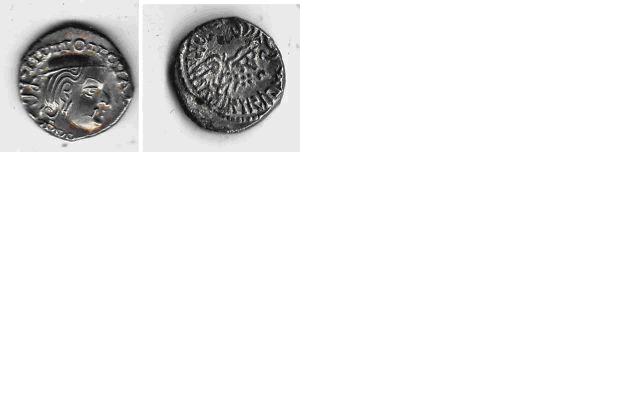
This is actually from ancient India, from a series of subordinate rulers of what is now north-western India, known in English as the Western Satraps, circa 300 AD. The wikipedia link illustrates several of the coin types; the grifterrec and zeno.ru sites have more comprehensive listings.
The obverse legend is Greek lettering but gibberish, random letters placed on the coin by people who could no longer speak the language. The king's actual name is around the reverse, in Brahmi script. The date the coin was issued, using the Saka Era calendar, is on the coin, to the left of the portrait, but I haven't got any good references for these coins that let me translate it.
The sun-moon-and-mountain symbol first used on the reverse of these coins is still sometimes used on the coinage of modern Nepal.
Don't say "infinitely" when you mean "very"; otherwise, you'll have no word left when you want to talk about something really infinite. - C. S. Lewis
This is a tetradrachma of the Western Kshatrap (Satrap) group of rulers.On the Obverse, there is the bust of the ruler and on the reverse, there is a hill made of arches and the name of the ruler and the name of his father struck in Nagari script.
Disclaimer: While a tremendous amount of effort goes into ensuring the accuracy of the information contained in this site, Coin Community assumes no liability for errors. Copyright 2005 - 2026 Coin Community Family- all rights reserved worldwide. Use of any images or content on this website without prior written permission of Coin Community or the original lender is strictly prohibited. Contact Us | Advertise Here | Privacy Policy / Terms of Use