| Author |
 Replies: 17 / Views: 3,178 Replies: 17 / Views: 3,178 |
|
New Member
United States
2 Posts |
Dug this up in a public park this spring with my metal detector. Wasn't too deep, but was crusted with hard dry dirt. Expected it to be a cheap No Cash Value gaming token. Think I peed a little when I saw "2 Cents". Definitely holding onto this one I think. You can still see the dirt on it, I wouldn't have a clue how to safely clean it, and I sure wouldn't wanna mess up the green patina. 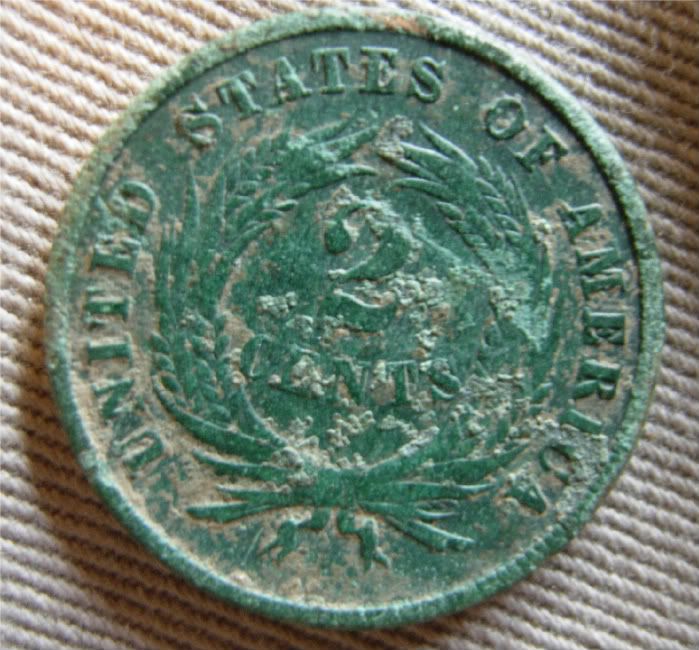 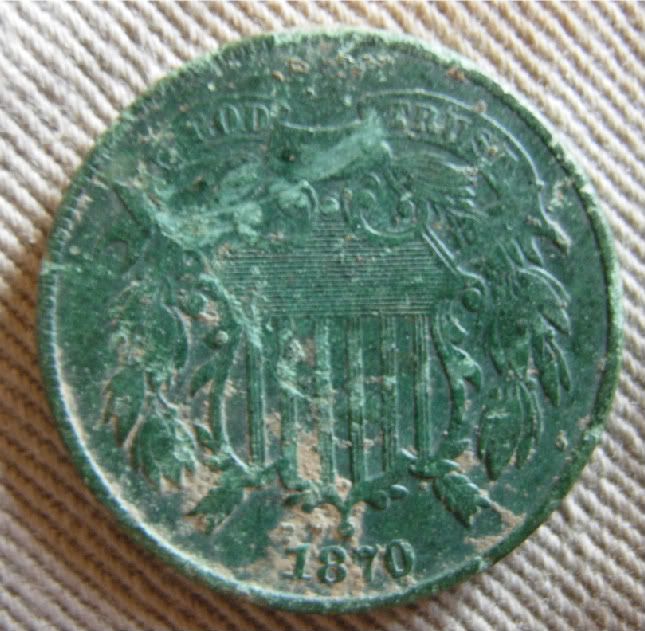 Edited by Smooth23
11/18/2010 10:30 pm
|
|
|
|
Pillar of the Community
United States
4846 Posts |
interesting, hard to tell if thats corrosion, patina, or paint.
|
|
Pillar of the Community
3660 Posts |
Does copper normally develop a green patina? Looks like it might have been new when it found its way to the ground.
|
|
Bedrock of the Community
Australia
21789 Posts |
Copper can in fact develop a green patina. I would guess that this coin has spent some time buried. I have seen Roman coins like this. With Roman coins, the green can have a beneficial affect on eye appeal, and so increase the value, probably less likely with this coin. Eye appeal, as you can guess, is a personal thing.
The green is chemically copper hydroxycarbonate, the 'hydroxy' and the 'carbonate' can vary against each other.
What bothers me a little are the brown encrustations, and I think the coin would be better off without them. With ancient coins, a common approach is to store the coin in olive oil for some months, and even a year or more, and maybe the brown stuff will loosen.
After all of that, I think it is a very nice coin, and well photographed. Good photography allows more accurate comment.
|
|
New Member
 United States
2 Posts |
Thanks for the input(though I welcome any more!) Yes, I'm sure it spent awhile in the ground, the area I dug it from was a fairground in the 1800s and early 1900s, and it was sitting in very hard pack ground just on the infield of where a horse track once sat. The brown encrustations are dirt. I've heard of soaking in oil, I just worry about the effect on the color. Only coins I've seen this color on before are pennies, and usually in streaks rather than uniform throughout.
|
|
Pillar of the Community
United States
1000 Posts |
If you like the green, disregard this message...but my fear is that the green is actually verdigris which is active corrosion. It might eventually eat the coin up and you will lose the detail it currently has.
I have not seen anyone in the US coin collecting community actually give value to green patina on a copper coin, in fact some might feel like throwing a haz-mat suite over the top of their Lincoln's to make sure it does not spread.
Maybe badthad will chime in...the creator of verdicare. But I believe in the past he has recommended some techniques to remove. But that is just my opinion.
GREAT FIND BY THE WAY!! The best I have dug is a 1940 something wheat...no silver for me yet, either.
|
|
Pillar of the Community
United States
2600 Posts |
Smooth,
BadThad, a member here on the forum has a product, verdicare, that will help this coin greatly. You might contact him.
Jim
|
|
Pillar of the Community
United States
3294 Posts |
Neat, 1870 is one of the scarcer dates too.
|
|
Pillar of the Community
United States
3283 Posts |
 To both of the above posts, and you should let us know how it goes. That is actually a very nice coin if you can bring it back some. |
|
Valued Member
75 Posts |
Fine DETAILS, environmental damage. My own " Two Cents"  |
|
Pillar of the Community
United States
2335 Posts |
Too bad about the green. It's a little hard to grade with the "smear" that runs across the WE of In God We Trust but the rest of the coin appears to be XF or better. I'd probably consider VerdiCare if it was my coin.
|
|
Bedrock of the Community
Australia
21789 Posts |
I was searching the vcoins website and found some ancients priced in the thousands that had a very obvious green color, though not as quite pronounced as the 2C in question here.
I would seem that somehow that the verdigris film on these coins has been passivated or was otherwise inactive. No doubt such coins have been professionally cleaned.
I would agree that this very obviously green coin would not sit very well alongside it's contemporaries.
|
|
Valued Member
United States
160 Posts |
The Statue of Liberty is coated with copper which has turned green due to chemical reactions between the metal and water
|
|
Bedrock of the Community
United States
17884 Posts |
Copper and bronze coins definitely develop green patinas (Most copper compounds are green in color).
If the raised areas are just dirt then I would first just try soaking in distilled water to dissolve and rinse away the dirt. Distilled water will not affect the green patina. But be warned the color may not be the same underneath the raised stuff.
If distilled water doesn't work you could try acetone but if water doesn't do it then I don't have muc hope for acetone. Then you could try the olive oil. Be warned though that the oil method can take a LONG time (months to years) and it may affect the patina because olive oil is slightly acidic. If the acid worries you you might try mineral oil instead. Over time it may also losen th crud, but it will be even slower because the acid in the olive oil makes it work faster. After you are done with the oil a soak in acetone or xylol will remove the oil, but may leave the coin with a "dry" appearance.
|
|
Pillar of the Community
United States
4989 Posts |
Looks like the copper-clad top of most old buildings in NYC (!)
|
|
Valued Member
United States
455 Posts |
I think that the green patina on the coin is very attractive. Perhaps you should keep it as is to remind you of where it came from! I like it.
|
| |
Replies: 17 / Views: 3,178 |







 Posted 11/18/2010 10:56 pm





