| Author |
 Replies: 7 / Views: 3,444 Replies: 7 / Views: 3,444 |
|
|
Pillar of the Community
United Kingdom
2490 Posts |
Yesterday I was going through my "unresolved" box for another query, and I came across this: 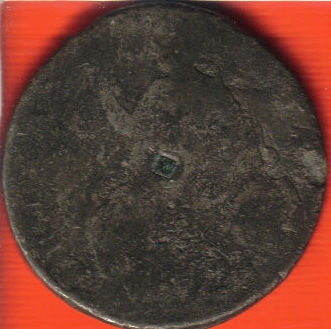 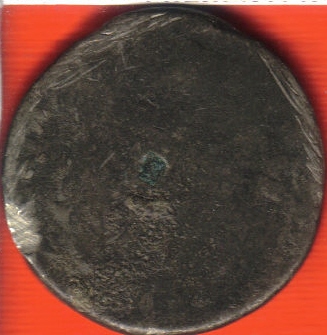 Now you're all obviously impressed with this numismatic masterpiece. My question is what is it? Over forty years ago when I put it into its manilla envelope I'd written on the outside " Bimetallic halfpenny, probable forgery, James II" The metal is tin, parts of it having been filed away, and there is a copper plug in the centre. It weighs 11.2g and diameter is 27mm. Maybe my eyes were a lot better in 1967, but these days I can't discern a great deal of detail. Any thoughts? Identified - moved to British Coins forum - Sap |
|
|
|
New Member
United Kingdom
8 Posts |
it is a james ii farthing with a tin plug in the centre, it is definitely not a forgery.
|
|
Pillar of the Community
United States
2605 Posts |
The production of tin coins with copper plugs continued just for a few years. Apparently you chose the 1/2d denomination based on the size of it, and you chose James II because you could see only one bust, not two (that would be William and Mary).
The reason for the composition was presumably to assist the ailing tin industry and to deter counterfeiting.
But in just a few years quick extensive corrosion of plugged coins became apparent. Also counterfeits in lead began to appear. If you have a contemporary counterfeit (you could check if the metal is lead) it would be as cool as a genuine coin.
|
|
New Member
United Kingdom
8 Posts |
tin farthings were issued under james II plugged with copper, (sorry got it the wrong way round before too much bacardi hic!) I have an expansive collection of farthings from the maltravers and rose farthings up to the last in 1956. I have two very fine examples of the james tin models.
|
|
Pillar of the Community
United States
2605 Posts |
Quote:
I have two very fine examples of the james tin models. Do you mind sharing pictures of those, johnp, I'd be curious to look at better preserved examples. |
|
Moderator
 Australia
17000 Posts |
My example of a tin plugged halfpenny is, frankly, in not much better condition than the one alganbagerap posted. 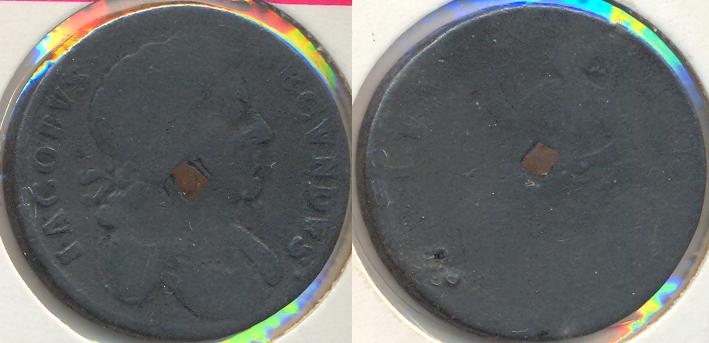 And I paid Au$300 for mine, last year. So even in that beat-up condition, alganbagerap's example is worth keeping. I primarily purchased mine because of the edge inscription: a Latin motto and the date. Not only is it one of the earliest examples of an edge inscription, and the first coin where the date was inscribed on the edge of the coin, but the motto is meaningful for me. "Nummorum Famulus" is Latin for "Servant of the Coinage". James II used it to imply he would do the right thing by the English people and do his best to give them good quality coins. My coin club, the QNS, adopted it as their motto. Don't say "infinitely" when you mean "very"; otherwise, you'll have no word left when you want to talk about something really infinite. - C. S. Lewis
|
|
Valued Member
United Kingdom
60 Posts |
The coin would have been better 40 years ago (your eyes as well likely!).
Tin pest is a pain in the proverbial and once it starts it continues to eat away at the coin, meaning you will have lost a lot of detail..
|
|
Pillar of the Community
 United Kingdom
2490 Posts |
I think I'm about to do something very foolish, disagree with Sap. " Not only is it one of the earliest examples of an edge inscription, and the first coin where the date was inscribed on the edge of the coin," I think that the immediate predecessor of this coin, the Charles II tin farthing was the first to be edge dated. 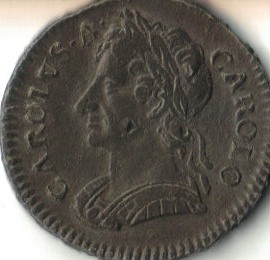 Admittedly both Charles and James farthings were issued with the same dates 1684/85 but Charlie boy did get there first. 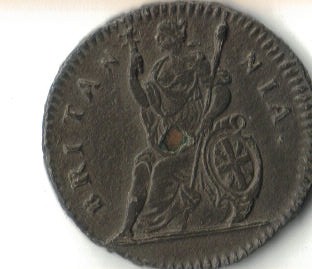 |
| |
Replies: 7 / Views: 3,444 |
|










 Posted 11/30/2010 6:01 pm


