| Author |
 Replies: 19 / Views: 4,041 Replies: 19 / Views: 4,041 |
|
Pillar of the Community
United States
1053 Posts |
i have a question  some pennies that I have are "wood grained" does that make the coin worth any more? or is it just some kind of alteration some one did to it? |
|
|
|
Pillar of the Community
United States
1418 Posts |
It actually happens when they are mixing the metals. Some can be worth a small premium.
|
|
Pillar of the Community
United States
1659 Posts |
Do you have pics?
It's all about eye appeal as far as whether or not it adds any premium. If they are unattractive, it can actually decrease value.
|
|
Pillar of the Community
United States
1418 Posts |
To determine premium, it's just like toning. Eye appeal is everything.
|
|
Previously Banned Member
United States
8 Posts |
I sometimes save these
The only ones I have seen that are really cool looking are some wheat pennies with wood grain
other then that I pass most of them up when I find them
seems like I see a ton of them from the 80's
|
|
Pillar of the Community
United States
809 Posts |
Some naturally toned coins are pretty cool looking,but artificially toned coins and "wood grained" coins to me are damaged coins.  |
|
Bedrock of the Community
United States
12437 Posts |
Awww, how can you say that this beauty is a "damaged coin"?  |
|
Pillar of the Community
 United States
1053 Posts |
hey so is wood grain technically an error coin?
|
|
Pillar of the Community
United States
1450 Posts |
That is a great question,one I will not attempt to answer but I will state some guidelines as I understand them(and these could be incorrect also)and do a little logical deduction. First,an error is a one time event producing a single coin with that characteristic,usually something associated with the minting process such as an off-center strike,struck through grease,cloth,etc. A variety is produced by a mistake made on a die that produces multiple copies of the same coin. Here's the rub,as I see it in your question,and based on my understanding. Since the woodgrain effect would affect all of the planchets from a given sheet of metal,it would make woodies a "variety". However,since it is caused by an error in the minting process,not an error on a die,it should be considered an "error". Now,that is the logic as I see it(again,probably wrong or incomplete)so I will call it a "variety" since many coins with the same issue will be produced. Okay guys,hit me with where I am wrong. This is just my "thinking out loud" so help straighten me out if I'm wrong!
|
|
Pillar of the Community
United States
1053 Posts |
really I'm not that experienced at coin collecting, so I dont know if your wrong, but thanks for the information, it really helped.
|
|
Pillar of the Community
United States
809 Posts |
That is a beauty bio!! |
|
Valued Member
Canada
311 Posts |
I was searching a lot of my wheaties and notice a few wood grained cents. The funny thing is they were all the same year. I believe 1942 if I am not mistaken. Go figure.
|
|
Pillar of the Community
United States
4992 Posts |
My newly acquired 1833 large cent has some nice woodgrain on the obverse: 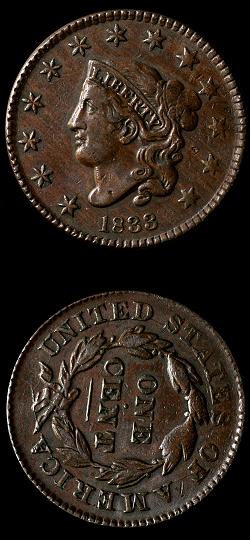 |
|
Pillar of the Community
United States
3284 Posts |
Hockingzig,
Sounds logical to me. More a variety than anything else.
I think every lincoln collection should have a woodie or two in it.
Nice cool addition for added interest.
I didn't know they were present in modern coin though (memorials)
|
|
Valued Member
United States
255 Posts |
I am voting for variety. I personally love the wood grain effect. I have sa feeling the ones with good eye appeal will have significant value in the future. Biokemist6 that 1919 is a beautiful example of what I mean.
|
|
Rest in Peace
United States
1943 Posts |
I think varieties are from dies only. Woodies would be an error, more specifically a planchet error just like struck from the wrong stock is a planchet error that effects the whole sheet they are punched from.
|
| |
Replies: 19 / Views: 4,041 |







 Posted 12/18/2010 8:55 pm


