











 Posted 01/11/2011 12:41 pm


Die Deterioration is usually seen on the devices sides facing the rim. Die wear usually follows this wear pattern.
IE:Poorman's so called doubled die:
https://www.coincommunity.com/forum..._MANS_DD.jpg
RPD's Happened on the 19 Century coins when the date devices were added by hand. On 20th century coins the devices were on the master die. Making an RPD impossible except for the few times two different year hubs were used. So in these cases it was not a punched digit issue, but two different years hubs used.
(The following coin is a faked example, but the inset shows the correct view of the real deal.)
https://www.coincommunity.com/forum..._on_Date.jpg
https://www.coincommunity.com/forum...heritage.jpg
Machine Doubling is usually shown as flat shelf doubling on devices. The devices are not doubled, but damaged when looked at closely.
https://www.coincommunity.com/forum...DOUBLING.jpg
https://www.coincommunity.com/forum...ing_coop.jpg
https://www.coincommunity.com/forum...erse_001.jpg
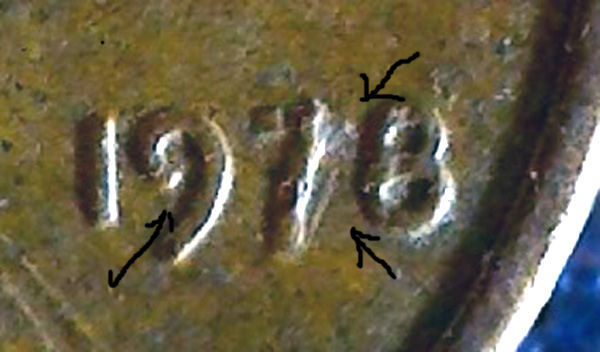
Not sure what is being pointed to on the 9 in the date, but between the 7 & 8 is a faded die scratch. Die scratches are found on coins struck after a die clash has been polished off of the fields of a die. They start off sharp and defined. Later they flatten with more coin struck. The fields flatten the scratch and they fade into the fields. These may be used to match up known dies or to prove they are from the same die as the scratch in in a different location.
https://www.coincommunity.com/forum..._scratch.jpg
Fading die scratches may remain stronger in areas between the devices and inside of devices. This is what I see on your coin between the 7 & 8 on your date. Hope this helps.
IE:Poorman's so called doubled die:
https://www.coincommunity.com/forum..._MANS_DD.jpg
RPD's Happened on the 19 Century coins when the date devices were added by hand. On 20th century coins the devices were on the master die. Making an RPD impossible except for the few times two different year hubs were used. So in these cases it was not a punched digit issue, but two different years hubs used.
(The following coin is a faked example, but the inset shows the correct view of the real deal.)
https://www.coincommunity.com/forum..._on_Date.jpg
https://www.coincommunity.com/forum...heritage.jpg
Machine Doubling is usually shown as flat shelf doubling on devices. The devices are not doubled, but damaged when looked at closely.
https://www.coincommunity.com/forum...DOUBLING.jpg
https://www.coincommunity.com/forum...ing_coop.jpg
https://www.coincommunity.com/forum...erse_001.jpg
Not sure what is being pointed to on the 9 in the date, but between the 7 & 8 is a faded die scratch. Die scratches are found on coins struck after a die clash has been polished off of the fields of a die. They start off sharp and defined. Later they flatten with more coin struck. The fields flatten the scratch and they fade into the fields. These may be used to match up known dies or to prove they are from the same die as the scratch in in a different location.
https://www.coincommunity.com/forum..._scratch.jpg
Fading die scratches may remain stronger in areas between the devices and inside of devices. This is what I see on your coin between the 7 & 8 on your date. Hope this helps.


