|
This page may contain links that result in small commissions to keep this free site up and running.

Welcome Guest! Registering and/or logging in will remove the anchor (bottom) ads and the security checks. It's Free!
To participate in the forum you must log in or register. | Author |
 Replies: 15 / Views: 13,126 Replies: 15 / Views: 13,126 |
|
|
Pillar of the Community
Australia
2830 Posts |
the country we now know as Papua New Guinea or PNG acheived independence in 1975, and since then it has had its own coinage, based on the Kina.
Prior to independence, PNG was two territories: Papua, and New Guinea, both administered by Australia, but with different circumstances.
Papua was annexed by Queensland about 1885, and ceded to the Commonwealth after federation.
New Guinea had been a German colony, with its own very distinct and beautiful coinage: everything I've seen is dated 1894.
Australia occupied German New Guinea in 1914, and continued to administer it, later under League of Nations and U.N. mandates.
A series of coins were issued for the Territory of New Guinea. Curiously, the legend on the coins refers to NG, but not to Papua.
I am opening this thread because I have not seen any catalogue of NG coins: years, mintages, values, varieties, etc.
I have complied a list of denominations and dates, from what is available in the market, but would like to know any other details that CCF can add.
And, of course, is there any published material on these Territories ?
shillings - silver - 1935, 1936, 1938, 1945
sixpence - silver -
1935, 1943
threepence - silver - 1935, 1944
penny - bronze - 1936, 1938, 1944
so, you could put together the whole set with just eleven coins (if that's all there was).
The 1936 penny is a bit special, because it is one of the few coins in the British Empire to bear the name of King Edward VIII.
All of the above are distinctive, because they have a central, circular hole. Apparently the locals suffered chronic shortages of pockets, and liked to carry their coins on a string, worn around the neck.
I gather that, in spite of the hole, the coins were the same composition, diameter, and mass as their Australian equivalents. I suppose that they must have been thicker ... Any comments ?
Peter
note to mods: I accept that some may think that this thread might be better described under another rubric.
|
|
|
|
Pillar of the Community
United States
2605 Posts |
Thanks for this informative thread. I have five NG coins but I never looked into how many were are out there.
And since I collect type set, I need only one more coin, KG5 threepence of '35.
When I get a chance I'll pull my coins out and check their thickness.
|
|
Moderator
 Australia
17030 Posts |
Quote:
A series of coins were issued for the Territory of New Guineau. Curiously, the legend on the coins refers to NG, but not to Papua. That's because the coins were not legal tender in Papua. Papua used regular Australian coins, though New Guinea coinage probably would have been accepted if any made it that far. Quote:
I am opening this thread because I have not seen any catalogue of NG coins: years, mintages, values, varieties, etc... is there any published material on these Territories ? Back in the early 1980s, collecting "British Oceania" (New Guinea/PNG, New Zealand, Fiji) was popular amongst Australian collectors - so much so that the precursor to the "Maccas" guide was the "Australasian Handbook of Coin Collecting" by Alan Patterson, with entries for all four countries. If you want a comprehensive listing of all the coins, notes, tokens, medals and primitive monies of Papua, New Gunea and PNG then the book for you is "From Cowrie to Kina" by W.J. Mira (published 1986). It doesn't list catalogue values nor does it discuss rarity very much, but it's packed with history. Quote:
I gather that, in spite of the hole, the coins were the same composition, diameter, and mass as their Australian equivalents... Well, the penny was smaller, and the threepence and sixpence were cupronickel, not silver. The only New Guinea coin made of silver was the shilling. An Imperial shilling (.925 or .500 fine) should weigh 5.66 grams; the New Guinea shillings weigh in at 5.38 grams. Quote:
so, you could put together the whole set with just eleven coins (if that's all there was). Correct, unless you choose to include the two great rarities of the entire series, the halfpenny and penny of 1929. A sad story there: the coins were struck, shipped out to the colony and were ready for issue, but then somebody pointed out that the two coins were identical in size to Australian sixpences and shillings, which would render the then-common practice of using rolled coins impractical, as nobody would be able to trust whether a roll of sixpences didn't have a few halfpennies slipped in without busting the roll open, inspecting and re-wrapping. So the coins were never issued for circulation; they were eventually sent back to the Melbourne Mint, where all but 400 of each were melted down; those 400 were sold in pairs for a shilling a pair. Don't say "infinitely" when you mean "very"; otherwise, you'll have no word left when you want to talk about something really infinite. - C. S. Lewis
|
|
Bedrock of the Community
Australia
21794 Posts |
I have an incomplete set WITHOUT the the halfpenny and penny of 1929:
5 marks 1994 gVF, (scarce, .900 silver)... a 'ring in', but a nice coin to have; it was given to me by a great aunt, who was born the daughter of a Methodist Missionary in New Guinea in 1915.
1/- '35, '36,'38, '45, (.925 silver)
6d. '35, (cu ni)
3d. '44, (cu ni)
1d. '36, (Edward V111 bronze)
The shillings sixpence threepence and penny are all Unc, and are common.
Will post pics. soon.
The 1929 coins, as Sap has indicated, are elusive, and bring big money at auction. The penny and halfpenny of this date look like the shillings.
|
|
Pillar of the Community
United States
790 Posts |
I bought an entire set (minus those tricky ones) in a Dansco Folder for about $25. I got the entire "country" in a single purchase. Not so much fun to collect tlike that but the deal seemed pretty good.
|
|
Pillar of the Community
 Australia
2830 Posts |
thanks everyone: I'm about half-way there.
|
|
New Member
Australia
1 Posts |
Hi doing some research for my Grandfather who is trying to find some information on a New Guinea King Edward VIII Shilling of 1937.
His brother returned from a Navy vist in WW2 with such a coin but to date he cannot find any reference to it by way of collectors, shops, etc. There is plenty of references to pennys but none in relation to shillings.
It is locked away in a bank and I have asked that he try and get a photo to verify but in the interim thought that I would try and help.
Thanks in anticipation.
|
|
Moderator
Australia
17030 Posts |
Quote:
...New Guinea King Edward VIII Shilling of 1937... If it's a genuine Edward VIII coin, the date will be 1936, not 1937. And you haven't found any reference to Edward VIII shillings for New Guinea because no such coins were made; the only silver coins struck in his name were from the Indian state of Kutch. This old thread lists all the circulation coins struck in the name of Edward VIII; the only one from New Guinea was the penny. I'd have to double-check my copy of Mira to see if there were any Edward VIII shilling patterns made, but from memory there were not. If it is actually a "1937 New Guinea Shilling" then it's most likely some kind of unofficial fantasy coin. We're definitely going to have to see pics of your grand-uncle's coin to find out exactly what it is. Don't say "infinitely" when you mean "very"; otherwise, you'll have no word left when you want to talk about something really infinite. - C. S. Lewis
|
|
Formerly nancyc
Australia
5385 Posts |
My PNG Pre Decimal collection: 1d: 1936 3d: 1944 6d: 1/-: 1935, 1936, 1938, 1945       life is a mystery to be lived not a problem to be solved
|
|
Moderator
Australia
17030 Posts |
OK, I dug out my copy of Mira and looked up the Edward VIII chapter. Hubs (the tools the mint uses to make working coin dies) for Edward VIII threepences, sixpences and shillings were prepared at The Royal Mint in London in anticipation that they would be needed, but no dies, patterns or coins were ever made from them and none of these hubs were ever sent to Australia. All but one of the shilling hubs were officially destroyed in 1952, the last one remains in The Royal Mint archives and is illustrated in the book. So whatever mjp's grand-uncle's coin is, it's not an actual 1937 Edward VIII shilling. Don't say "infinitely" when you mean "very"; otherwise, you'll have no word left when you want to talk about something really infinite. - C. S. Lewis
|
|
New Member
Australia
10 Posts |
Cheers for this information (even though it's a thread from a few years back).
I've always been interested in the Territories of Papua and New Guinea, especially because of the WWII research I've been doing over the past 13 years or so (and two trips to PNG).
I'll be trying to put together a complete set of these coins - it shouldn't be too hard from what I can see (apart from the 1929s).
Thanks once again!
Edited by Janglais
02/21/2013 7:16 pm
|
|
New Member
Australia
4 Posts |
Some time ago, my wife came home from her weekly coffee morning and told me that one of her friends had mentioned she had a large tin of coins which she inherited from her late father, and I had been "volunteered" to go and look at said coins and advise on the best way forward. So I turned up at the appointed time, to find the tin was somewhat larger than I had been led to believe. When I lifted the lid, I was faced with a layer of mostly base-metal coins from SE Asia, dated mostly in the 1970s. So I wasn't expecting to find much. But all was forgiven when I got to the bottom of the tin and found this: 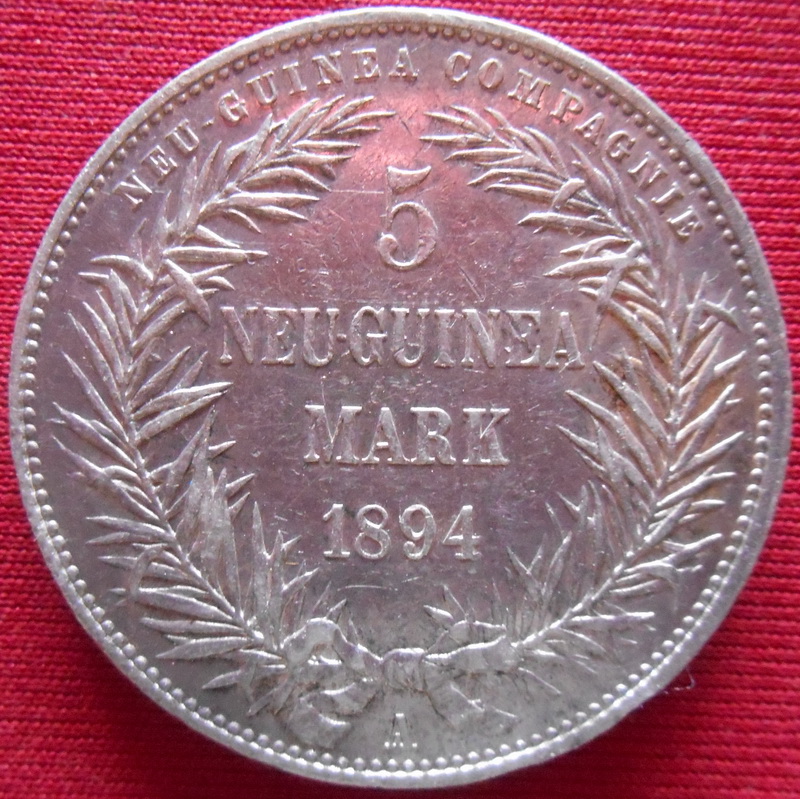 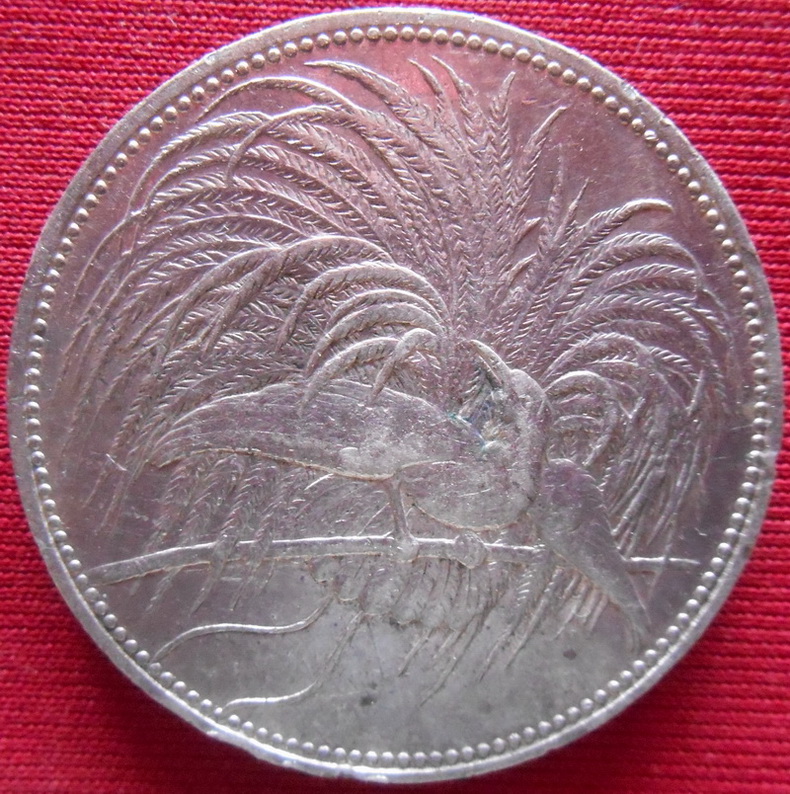 The moral of the story - real finds are still out there, so keep looking! Wife's friend was very pleased with the healthy four-figure price I got for her. |
|
Moderator
United States
197800 Posts |
Excellent!  |
|
Bedrock of the Community
United States
27514 Posts |
That was a very nice find, jrg_from_oz! I have seen these in auctions and they always bring $$$$. And  to the CCF! Inordinately fascinated by bits of metal with strange markings and figures
|
|
Moderator
Australia
17030 Posts |
As the "coin expert" volunteering for a missionary charity that frequently has coin collections donated to it, I have gone through my fair share of very similar "tin of coins" hoards. And yes, they can sometimes contain rare or valuable items. Two such hoards in the past couple of years have had a gold sovereign each in them, for example, just sitting there at the bottom of a pile of common mixed world coins. Haven't found any German New Guinea coins so far, and the only GNG coins I have in my collection is a 1 mark I bought at auction in Brisbane a couple of decades ago, and a half-mark I bought from a dealer recently.
But New Guinea shillings, of various dates but very often near-mint-state 1945 coins, are very commonly found in such coin hoards here in Australia. A lot of Australian soldiers were in New Guinea during the war, on the Kokoda Track and elsewhere, halting the Japanese advance, and many of the soldiers souvenired a few of these coins while they were there.
Don't say "infinitely" when you mean "very"; otherwise, you'll have no word left when you want to talk about something really infinite. - C. S. Lewis
|
|
Bedrock of the Community
United States
80344 Posts |
Awesome find, jrg_from_oz!   That one is worth huge money! Errers and Varietys.
|
| |
Replies: 15 / Views: 13,126 |
|
To participate in the forum you must log in or register.
Disclaimer: While a tremendous amount of effort goes into ensuring the accuracy of the information contained in this site, Coin Community assumes no liability for errors. Copyright 2005 - 2026 Coin Community Family- all rights reserved worldwide. Use of any images or content on this website without prior written permission of Coin Community or the original lender is strictly prohibited.
Contact Us | Advertise Here | Privacy Policy / Terms of Use
|
| Coin Community Forum |
© 2005 - 2026 Coin Community Forums |
| It took 0.52 seconds to rattle this change. |
 |
|
| |
| |




 Posted 01/12/2011 10:59 pm


