











 Posted 01/30/2011 2:37 pm


Independent State of Croatia (NDH) or Nezavisna Država Hrvatska is a state that is established on 10 April 1941. on the initiative of the National Socialist Germany and Fascist Italy, who meet the ancient Croatian aspirations for independence after the disintegration and capitulation of the Kingdom of Yugoslavia. However, the state is virtually a protectorate of the Axis powers. The state is ruled by the Ustasha leader Ante Pavelic Headman movement, while the King Tomislav II. had only a symbolic role and as such was abolished after the Italian capitulation 1943rd year. NDH is also a territorial condominium Germany and Italy, while some earlier Croatian areas such as northern Dalmatia directly occupied and annexed by Italy, under whose control they were until the fall of Benito Mussolini. The state has gone from the world stage 1945th years after the fall of Hitler's Great German Reich.
Money, monetary policy
By area NDH charging for goods and services were used in the following currencies:
-Dinars, which were left over from the Kingdom of Yugoslavia (until 1942)
-Italian lire (Italy until the fall of 1943.)
-German Reichsmark
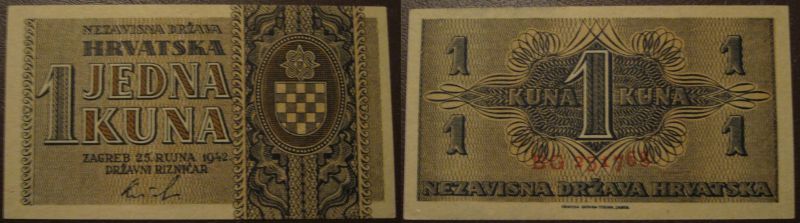
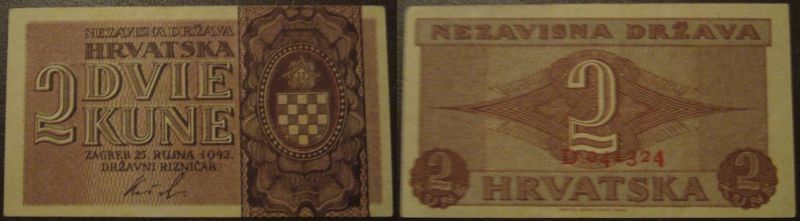
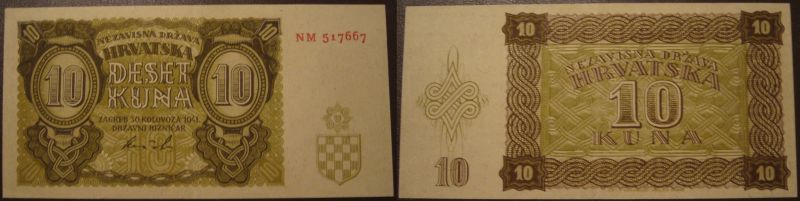
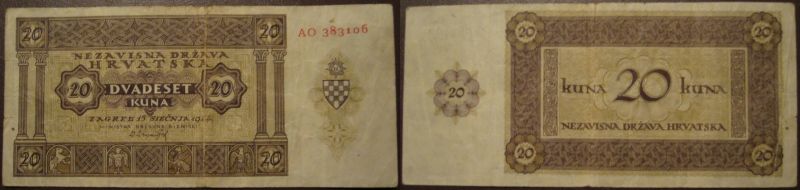
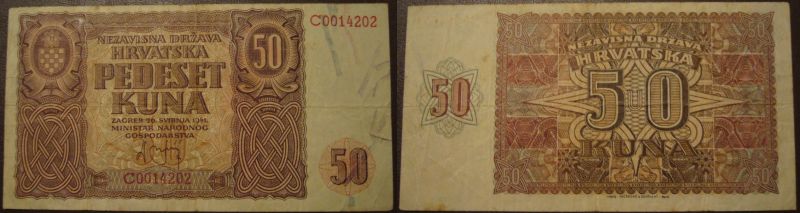
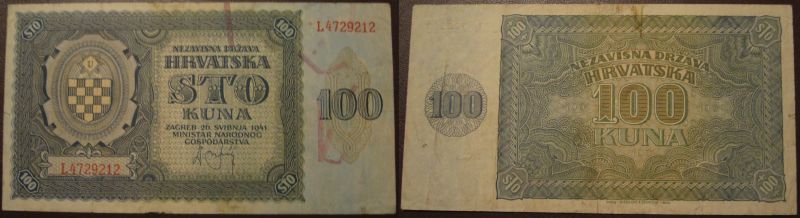
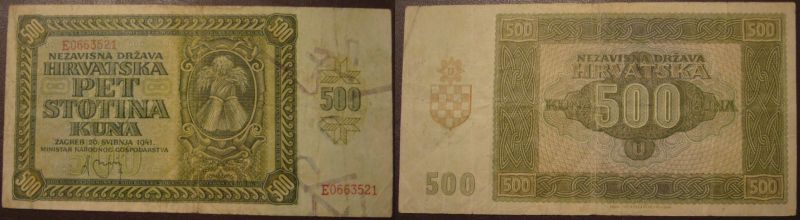
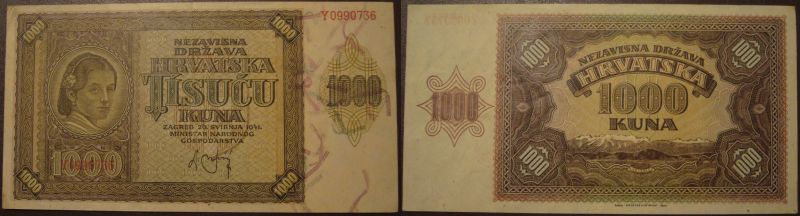
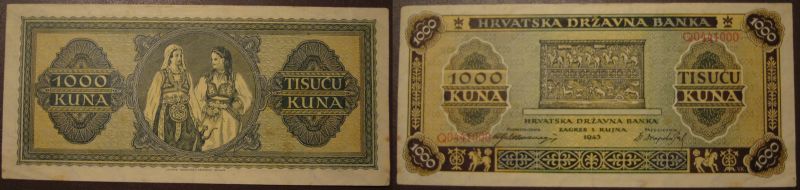
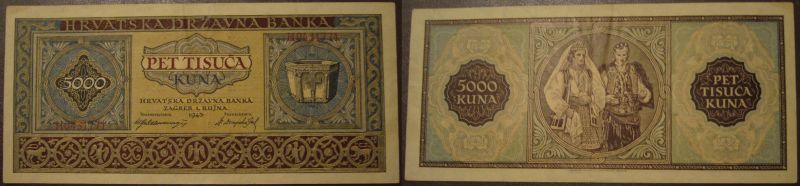
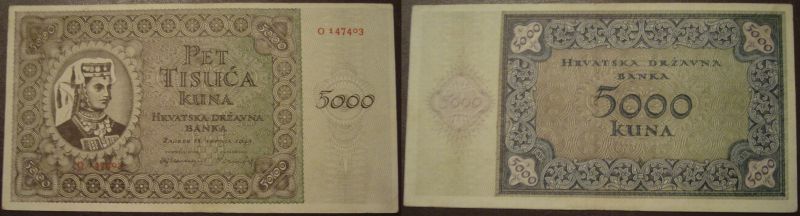
-Kuna Banknotes in circulation: 0.50 Banica, 1 and 2 kuna (25 September 1942.) 10 kuna (30 August 1941.) 50, 100, 500 and 1000 kuna (26 May 1941.) 5000 kuna (15 July 1943.) 1000 and 5000 kuna (1 September 1943.) Banknotes (rate) due to war conditions are not given in full were made: 100 and 500 kuna (1 September 1943.) 20 and 50 kuna (15 January 1944.) Banknotes in the making: 10000 kuna (only draft) (1 September 1943.)
Using the remaining dinars from the Kingdom of Yugoslavia inflicted much damage at first, because of porous borders with Serbia was not possible to control the size of the emission of money. Exchange rate 1941-45. in relation to the German RM (Reichsmark) was fixed to 20 and Kuna for 1 RM (1 USD = RM 2.50 or 50 kuna). Since the fall of 1942. For transfers from the world of citizens and soldiers serving in the Wehrmacht applied course 40 kuna = 1 RM, the spring of 1943. 60 kuna = 1 RM, the autumn of 1944. Up to 8.5.1945. 120 kuna = 1 RM.
Money, monetary policy
By area NDH charging for goods and services were used in the following currencies:
-Dinars, which were left over from the Kingdom of Yugoslavia (until 1942)
-Italian lire (Italy until the fall of 1943.)
-German Reichsmark
-Kuna Banknotes in circulation: 0.50 Banica, 1 and 2 kuna (25 September 1942.) 10 kuna (30 August 1941.) 50, 100, 500 and 1000 kuna (26 May 1941.) 5000 kuna (15 July 1943.) 1000 and 5000 kuna (1 September 1943.) Banknotes (rate) due to war conditions are not given in full were made: 100 and 500 kuna (1 September 1943.) 20 and 50 kuna (15 January 1944.) Banknotes in the making: 10000 kuna (only draft) (1 September 1943.)
Using the remaining dinars from the Kingdom of Yugoslavia inflicted much damage at first, because of porous borders with Serbia was not possible to control the size of the emission of money. Exchange rate 1941-45. in relation to the German RM (Reichsmark) was fixed to 20 and Kuna for 1 RM (1 USD = RM 2.50 or 50 kuna). Since the fall of 1942. For transfers from the world of citizens and soldiers serving in the Wehrmacht applied course 40 kuna = 1 RM, the spring of 1943. 60 kuna = 1 RM, the autumn of 1944. Up to 8.5.1945. 120 kuna = 1 RM.
Edited by nikola
01/30/2011 2:44 pm
01/30/2011 2:44 pm


