| Author |
 Replies: 22 / Views: 7,423 Replies: 22 / Views: 7,423 |
|
Pillar of the Community
United States
731 Posts |
W.W. Wilbur Token Cent - Slave Auctioneer
Pictured below from my cabinet are three varieties of the merchant tokens of W.W. Wilbur of Charleston, South Carolina. These tokens were issued as a means of advertising W.W. Wilbur's diversified businesses in Charleston, and were traded at the value of one-cent. The tokens are the same diameter as the later U.S. large cents.
W.W. Wilbur's business was quite diverse, and included auctioneering, mercantiles, brokerage, notary, and most infamously, the slave trade. Charleston newspapers of the era confirm the existence of W.W. Wilbur's business ventures, including various advertisements for his auctions. Most notably, one advertisement in particular included a family of slaves up for auction. Subsequently, after discovery, it was this advert which forever connected the business activities of W.W. Wilbur with the notorious slave trade.
Due to the multitude of various varieties proffered, it's most plausible that varieties of these tokens were minted over a period of several years. Estimates vary, but some theorize that thousands of these tokens were originally minted. Obviously, only a small fraction of the original numbers survive today.
Presently, there are 13 confirmed varieties of this token, with two distinct obverse types and three distinct reverse types. The various varieties consist of combinations of these obverse and reverses, in conjunction with various metal compositions. The varieties are listed below, along with notes.

The first of the W.W. Wilbur specimens pictured below is a recently discovered variety, made by the author of this post in July 2010. Although other varieties have a silver colored appearance and use different die combinations, including those that were brassed or made of German silver, none until now have been discovered with this particular silvered obverse-reverse combination. This finding has been confirmed by Tony Chibbaro, author of the article 'The Tokens of W.W. Wilbur of Charleston, S.C.', (c)2007. Upon examination of the photos, he states:
Quote:
I have looked over your pictures and can tell that your token is an unpublished variety! Your token is not German silver (which would make it Adams/Miller 8B, Rulau SC8B), but is silvered brass. This is decidedly a silvered brass planchet because the brass is plainly evident where the silver plating has worn off. This can easily be seen when looking at the figure of the auctioneer and the palmetto tree, both of which show the underlying brass planchet. I noted in my article that there were silvered brass examples of a different die linkage. Yours is the first silvered brass specimen reported in the die linkage 2-B.
Thus, since this particular variety has not been seen until now, it is quite rare indeed - an R-9 (unique)!
Upon examination you will notice scratches on both sides of the specimen, but remarkably, survival of the token's finer details, including the dentils. You will also notice the evident wear of the silvering on the planchet, revealing areas of the brass planchet underneath.

Pictured below is an example from my cabinet of the 'Thin Tree' variety, SC-7. Axial lighting with glass tilted at a 45° angle was used.

And finally, also from my cabinet, another example of the 'Bushy Tree' variety, SC-8A. Axial lighting with glass tilted at a 45° angle was used.

As time permits, I will post other varieties of the W.W. Wilbur token from my cabinet.
Thanks,
- Cheetah Edited by CheetahCats
02/26/2011 06:27 am
|
|
|
|
Pillar of the Community
Australia
2830 Posts |
our coins have so much history to share ...
|
|
Pillar of the Community
United States
4432 Posts |
Great post, Cheetah. I wasn't aware that there are so many varieties of these. I have a few and will try to compare them to your pics.
The silvered pieces are desireable. Yet, I'm inclined to question whether the silvering on the one in your post is original; perhaps, applied some years later, during the Civil War era? The reason I suggest this is that the silvering appears stonger on the raised, lettered area than it is in the recessed fields. Thoughts?
Also, isn't an R-10 rating warranted for a unique token? I'm of the impression that R-9 indicates between 2-4 specimens known. These discovery pieces like yours are great finds! So much has yet to be discovered and published ...
|
|
Pillar of the Community
 United States
731 Posts |
Quote:
The silvered pieces are desireable. Yet, I'm inclined to question whether the silvering on the one in your post is original; perhaps, applied some years later, during the Civil War era? The reason I suggest this is that the silvering appears stonger on the raised, lettered area than it is in the recessed fields. Thoughts? Thanks for your input. While I see a few places where the silvering appears stronger in a few letters AUCTIO N CO MMISSION, the silvering is quite consistently worn in most raised places, including devices and on other lettering.The silvering within the fields around the lettering is also consistently stronger. Gilt brass and German Silver varieties show a similar phenomena. It should be noted that this discovery was published about 8 months ago. As Mr. Chibarro is recognized as the foremost authority on S.Carolina Tokens, I must defer to his assessment. Please post a few of yours!  Thanks. |
|
Valued Member
United States
117 Posts |
Fascinating piece of history. It's almost like a metal business card. Interesting enough too that South Carolina is abbreviated as So.Ca. instead of the more usually seen So.Car. or S.Car.
Edit: I can't spell.
Edited by Uhhhh
02/27/2011 09:37 am
|
|
Pillar of the Community
United States
1147 Posts |
I have a two different examples and will put some photos up. One thing I do notice is most all examples I see are both weakly struck and usually have moderate wear. I bring this up as there is silver present in the scratches so would it be plausible this was silvered at a later date?
|
|
Pillar of the Community
United States
1147 Posts |
I posted after reading you initial post and only after realized someone had already brought up the idea of silvering at a later date. My guess is that it was silvered at a later date but continued to see circulation either possibly as a pocket piece.
|
|
Pillar of the Community
United States
1147 Posts |
W.W. Wilbur SC5 29mm Brass 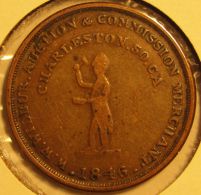 Reverse 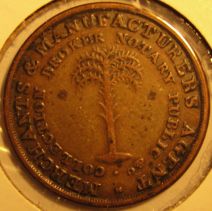 |
|
Pillar of the Community
United States
1147 Posts |
W.W. Wilbur SC7A 29mm Copper 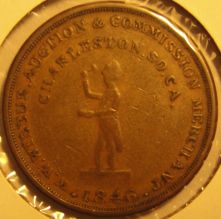 Reverse 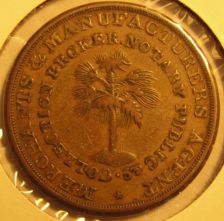 29mm Brass |
|
Pillar of the Community
United States
1147 Posts |
I believe my attribution is right but feel free to correct me. I am using a tensor light with a warm light bulb which gives off a bit of yellow in color. The SC5 has some light cleaning evident but is a decent example and well struck reverse. Believe that is a Palmetto tree on the reverse albiet an ugly one.
|
|
Pillar of the Community
United States
731 Posts |
Quote:
I believe my attribution is right but feel free to correct me. I am using a tensor light with a warm light bulb which gives off a bit of yellow in color. The SC5 has some light cleaning evident but is a decent example and well struck reverse. Believe that is a Palmetto tree on the reverse albiet an ugly one. Both your attributions look right to me. I opened up your pictures in Photoshop to get a closer look and it was red rather than yellow that I had trouble filtering out. I couldn't tell from the size of the images if your SC5 had any light cleaning. Both are terrific examples of the two varieties. I do believe you're right about Reverse A being a Palmetto tree too; albeit a caricature. My thought is that whoever the diesinker was probably had never seen a Palmetto tree in person. Given Charleston at the time, Wilbur probably had contracted diesinkers to produce his tokens from outside of South Carolina.
Thanks for posting. Do you have any other W.W. Wilbur varieties?
Here is one SC5A (copper vs. SC5 brass) from my cabinet that I obtained a few months back... Edited by CheetahCats
03/04/2011 12:00 am
|
|
Pillar of the Community
United States
1147 Posts |
I do have a SC9 I would grade VG and will post a photo of it as soon as I find a better light source. Your images are much better than my quick snapshots.
|
|
Pillar of the Community
United States
731 Posts |
Quote:
I do have a SC9 I would grade VG and will post a photo of it as soon as I find a better light source. Your images are much better than my quick snapshots. Look forward to seeing your SC9 :)
Here is a link to a recent post which describes the method I use to photograph my specimens. It is much less complicated than it may appear.
https://goccf.com/t/77885#662362
Thanks,
- CheetahEdited by CheetahCats
03/04/2011 01:48 am
|
|
Pillar of the Community
United States
731 Posts |
Quote:
As time permits, I will post other varieties of the W.W. Wilbur token from my cabinet.
Here are some additional W.W. Wilbur Tokens from my cabinet:
The specimen below is an SC-5, brass, in Choice VG condition:

The next specimen is an SC-7A, copper, EF Details. There is a die crack at obverse 6 o'clock:

The final specimen for today is an SC-9, in brass, in Choice VG Details.

After examining many W.W. Wilbur tokens (both in my cabinet, as well as general population) it seems that the SC-9 variety is the only specimen struck in COIN TURN rotation, while all of the other varieties are in MEDAL TURN.
Further research is warranted.
Thanks,
- Cheetah
|
|
Pillar of the Community
United States
1147 Posts |
I have been unable to find a better bulb for my tensor light here in town. I still intend to post some more pictures when I find a better lighting source.
|
|
Pillar of the Community
United States
731 Posts |
Quote:
I have been unable to find a better bulb for my tensor light here in town. I still intend to post some more pictures when I find a better lighting source. You'd probably laugh if you saw what I use for my lighting source. |
| |
Replies: 22 / Views: 7,423 |









 Posted 02/26/2011 09:58 am


