| Author |
 Replies: 56 / Views: 5,179 Replies: 56 / Views: 5,179 |
|
Valued Member
United States
75 Posts |
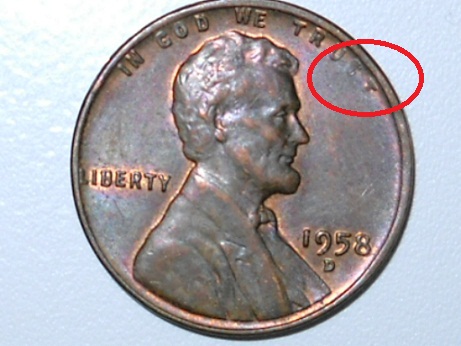
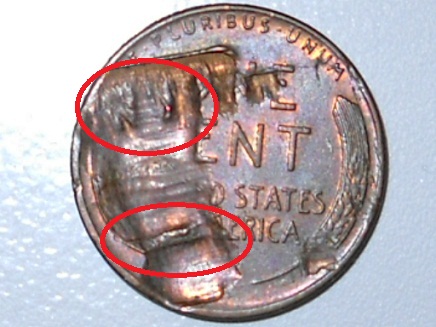
Ok, so I got the feeling that I needed to go through my wheats again to see if there was any I missed that would fill holes or any that just caught my interest. Well half way through I found this and just pitched it in the keep pile cause it was funky. Well now I'm hoping I've really found something. This is a 1958-D Wheat cent as you can tell, however, on the reverse it seems to have some sort of error. I can even make out letters in the mark and there is some effect to the obverse because of it. 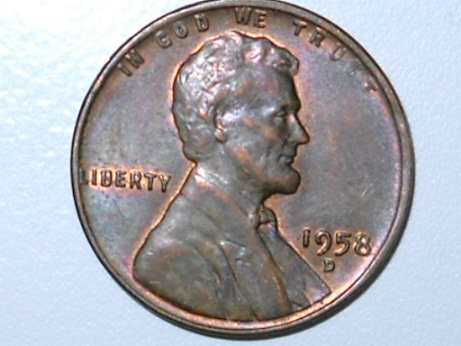 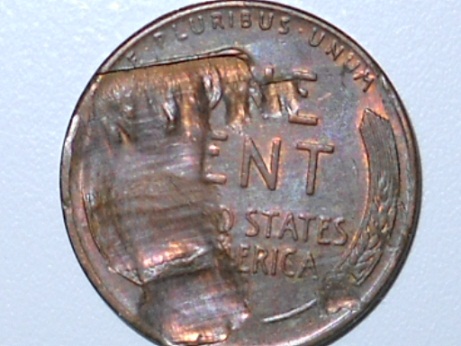 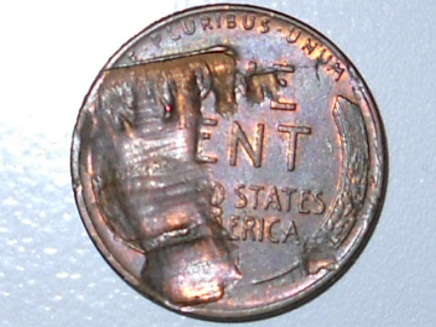 I can make out a W or an N as well as what looks to be a T. The obverse effect can be seen on the S and T in the word TRUST. Also, there seems to be some sort of extra feature on the reverse, closer to the bottom edge. I'll post more pics pointing stuff out. Any input on this coin would be greatly appreciated. |
|
|
|
Valued Member
 United States
75 Posts |
|
|
Pillar of the Community
Canada
1161 Posts |
At first I was thinking either Lamination Peel or delamination (not sure if delamination is correct term). After looking at the reverse further...it looks like the edges of the affected area have pushed up metal in certain areas. Excuse my terminology. The built up metal has me thinking PMD. It almost looks like something was heated up and the pressed in to the coin. The obverse does not show any damage that you would normally see from a vise, clamp or if the coin was hammered in some way. So my guess is for PMD of some type. Now...lets see what the experts have to say. |
|
Pillar of the Community
United States
737 Posts |
I agree. My completely unfounded opinion points to it being PMD. |
|
Pillar of the Community
United States
601 Posts |
It looks like you have a fantastic partially split planchet (after strike). Could have had a small part missing when struck, which would account for the weakness of Trust, but the rest of it split off after strike, which is why the obverse has full detail.
I'm willing to bet that if you weighed it, it's weight would be noticeably under the standard 3.11 grams.
Edited by liveandievarieties
03/07/2011 01:57 am
|
|
Valued Member
United States
302 Posts |
I kind of disagree with you liveanddievarieties. It looks like to me something very hot rolled on the coin. I can see where the edge was affected by the hot object. And the big clump that looks like a lamination on the top is where the hot object lifted up or fell off. I am almost postitive its an PMD. |
|
Rest in Peace
United States
9104 Posts |
either PMD or a chunk that fell out after striking. any planchet missing that much metal would have significant missing detail on the obverse, not just a couple of slightly light letters. |
|
Pillar of the Community
United States
7629 Posts |
This is so blatantly and obviously an error it amazes me that anyone could call this damage. It's a lamination, and a MAJOR one. You CANNOT possibly have a coin with such a perfect obverse and a HUGE scoop out of the reverse without it having to do with the mint.
This would be a partial split planchet after the strike, and if it were for sale it would bring pretty decent money - at least $10-$15, possibly more.
|
|
Valued Member
United States
75 Posts |
Thanks for the info so far. I'd like to see what a few more people say. At first I was thinking PMD but then my questions turned to the extra letters that I'm seeing. Anyone know whats up with that? or is that an effect of a split planchet? |
|
Valued Member
United States
337 Posts |
i am by no means good at this type of thing but my guess is based on the fact that the front of the coin is pretty much spot on perfect
if the coin was struck with sometime post mint time the front would be damaged too
looks like some kind of mint damage to me
I don't know how you could modify a coin like that without damaging the front as well
|
|
Pillar of the Community
United States
3592 Posts |
I really don't think you need to go beyond coppercoins answer
|
|
Pillar of the Community
United States
3453 Posts |
What does PMD stand for? (I checked the Glossary and the term was not there). |
|
Pillar of the Community
United States
4846 Posts |
it stands for Post Mint Damage.
it seems to be a genuine error, but I still don't understand the weakness problem, the half the obverse should be nonexistent, no?
Edited by Adam_E
03/07/2011 10:06 am
|
|
Pillar of the Community
United States
3592 Posts |
Adam_E..the key words in coppercoins answer are "after the strike"
|
|
Pillar of the Community
United States
601 Posts |
PMD or PMDont? Anyone read that post?
|
|
Pillar of the Community
United States
601 Posts |
KoinKid- The "extra letters" that you're seeing are a combination of distortion caused by the error type and just the rough, random surface left after the piece of the planchet fell out. AdamE- The coin was struck with the back in tact. Therefore, the obverse received a full strike, as did the reverse. But after the coin was struck, the chunk fell out of the reverse. Somewhere, there's a struck fragment of the reverse. CoinsKelly- PMD is an incredibly overused term on this forum. Regardless of how fantastic an error is- you'll nearly always see someone call out "PMD!" in an effort to be "right". PMD is the default guess for those who don't embody the experience or knowledge to be giving out advice. Edited by liveandievarieties
03/07/2011 11:18 am
|
| |
Replies: 56 / Views: 5,179 |












 Posted 03/07/2011 12:23 am


