| Author |
 Replies: 9 / Views: 4,623 Replies: 9 / Views: 4,623 |
|
|
Pillar of the Community
Australia
585 Posts |
 In medieval Bohemia, the bloke who actually hammered the coin, was called "pregeř". Does anybody know a medieval English equivalent? 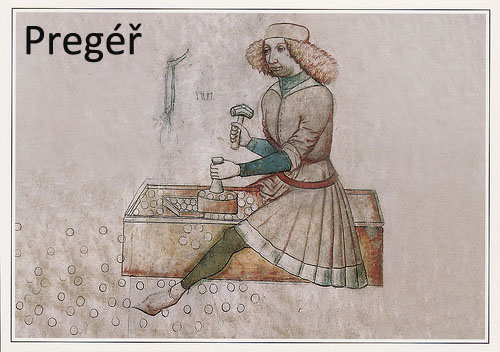
|
|
|
|
Pillar of the Community
Turkey
870 Posts |
Moneyer, I think. Some medieval English pennies have the mintmarks or symbols associated with the moneyer, the person who "issued" them.
|
|
Pillar of the Community
 Australia
585 Posts |
Moneyer or mint master issued them.
What I mean is the man with the hammer.
Edited by turtleoverhead
03/08/2011 08:26 am
|
|
Pillar of the Community
Australia
2830 Posts |
|
|
Pillar of the Community
Australia
585 Posts |
 Is there anybody less funny but more knowledgeable? |
|
Moderator
 Australia
17006 Posts |
Interesting question. I think "moneyer" is as correct as you're going to get. The only terms I can recall being used for this fellow are:
- someone with a big heavy hammer
- mint worker
- mint employee
- coiner
- minter
- moneyer
As I understand it, "coiner", "minter" and "moneyer" are synonyms. In later mediaeval and early modern times, these words would have been used for the actual mint-worker whose job it was to take blank bits of metal and turn them into coins. The official in charge, rather than the guy that did all the work, was the mint master.
In earlier mediaeval times, branch mints would have been much smaller affairs with just one or two employees, "moneyers" who did the job of both striking the coins and making sure they were of the right weight and fineness. After all, it was their name that was on the coins; the credit (or the blame for inferior coinage) would be solely on their shoulders. As far as I can tell, the guys whose names appear on the early English hammered coinage were usually the actual guys who swung the hammer.
I assume "minting" would have been a semi-hereditary craft, just like smithing, baking, weaving and everything else in mediaeval society that required special skills or training. So there would probably have been apprentice moneyers who learned their trade under a master moneyer for years before finally earning the right to become a full-fledged moneyer and be given dies with his own name on them.
Don't say "infinitely" when you mean "very"; otherwise, you'll have no word left when you want to talk about something really infinite. - C. S. Lewis
|
|
Pillar of the Community
Australia
2830 Posts |
Ihate to disagree with Sap, but the term "coiner" immediately makes me think of -
blokes dangling under gallows; and
ladies burning at the stake;
because those were the penalties for "Coining" under English law.
Apparently, the sentence of burning was replaced by hanging in 1790: enlightened times !
Some quick on-line research reveals that -
the last burning for coining was of Catherine Murphy in 1789; and
the last hanging for coining was of James Coleman in 1829.
As students of Australian history will know, many forgers, utterers, and coiners became "colonists".
Peter
|
|
New Member
United Kingdom
30 Posts |
There is no specific English language term for the man who actually wielded the hammer. In early/middle saxon times, the 'moneyer' (usually named on the coins) was almost certainly the person who did actually make the coins and not necessarily at fixed premises, although he would probably have had general labouring help for some of the work. In medieval times, the moneyer was a man of substance, often a local business man, king's crony or similar. To be a moneyer then was to hold the 'office' of moneyer (monetarius) rather than to have much involvement with the physical production of coins. There were other officers, such as assayers, appointed too and the mint was separate from the exchange. The king was not the only authority able to appoint moneyers. In some towns, Bishops, Archbishops or Abbots had the right to mint money and they held the power to appoint people to act on their behalf as moneyer. The King (or other authority) received seignorage from minting, amounting generally to about six pence in every pound weight of silver coined. The moneyer also received a similar sum for his income but had to pay all of the expenses in minting, plus the cost of having the dies made. The moneyer was also the person held directly responsible for all aspects of coinage production including fineness of the silver alloy used, weight of the coins and quality of strike. A 'Trial of the Pyx' was held frequently to examine samples of coins for this purpose - these trials are still held today for modern coinage produced by The Royal Mint. Moneyers could be and were held accountable for any deficiencies - there are records of some of them being fined huge sums of money or being executed or mutilated (sometimes involving castration). Chris Wren |
|
Pillar of the Community
Australia
2830 Posts |
occupational health & safety has moved along since those days, eh ?
|
|
New Member
United Kingdom
30 Posts |
Perhaps not so much occupational H&S as a (usually) effective deterrent! Counterfeiters and coin clippers were wont to have a hand cut off and nailed up over the door of the local mint as an example to others.
Things were simpler then - no consideration of a deprived or troubled childhood, no ASBOs, Police cautions, community service or slaps on the wrist - just a quick rope or off with your bits; but they were good times......!? Chris Wren
|
| |
Replies: 9 / Views: 4,623 |
|







 Posted 03/08/2011 08:24 am





