| Author |
 Replies: 23 / Views: 2,989 Replies: 23 / Views: 2,989 |
|
Pillar of the Community
United States
759 Posts |
Basically a request for educational purposes, most definitely myself, but I bet others as well.
I was wondering if anybody would be willing to dip a couple of junk coins then post before and after pics? If you could list the variables, such as solution used, amount of time dipped, concentrations, rinse routine, etc., that would be nice. For this context, I'm not referring to acetone treatment, but I'd love to see the results of that too.
Any takers? Real life experience from Forum members beats textbook pics for me. Thanks.
|
|
|
|
Valued Member
United States
355 Posts |
What is your end goal?
Are you looking to do this with any non-valuable coin, or ones which are completely corroded to hell?
Are you looking for methods or solutions which can potentially improve a coin (if it's truly improved is a side-discussion) or is this more for general curiosity e.g. what happens if I dip a coin in honey for 2 weeks?
Besides dipping coins, I'm wondering what some of the where/what/why is.
|
|
Pillar of the Community
United States
4992 Posts |
Edited by fenton
04/07/2011 2:08 pm
|
|
Pillar of the Community
United States
1388 Posts |
I bet this thread will drive many collectors crazy(  )... I don't want to be rude, as this is your thread. I think one thing should be mentioned first for inexperienced collectors that see this thread. Coins can easily be ruined and devalued by cleaning. There is a difference between cleaning and conservation.  |
|
Pillar of the Community
United States
539 Posts |
I would love to see the before pictures - they seemed to have been removed from photo-bucket
|
|
Pillar of the Community
United States
1388 Posts |
So here is a 1969-D LMC that is a trial piece... It is the same substance that Fenton used... Top right quarter is untouched... Top Left was dipped 5 seconds then rinsed... Bottom Half dipped 20 seconds... 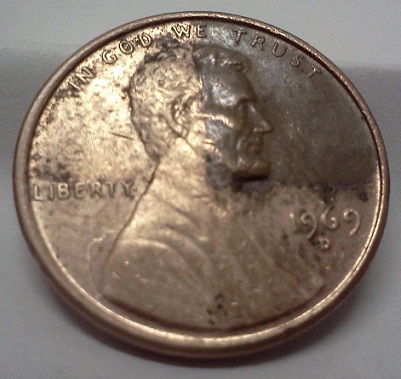 In my opinion, the only beautiful part of this coin is the untouched quarter of the coin. I think this "test subject" proves that it doesn't always make it better by cleaning...The pics were taken 24 hours after... |
|
Pillar of the Community
United States
2604 Posts |
Good thing the best part of the Lincoln Cent above is that it's the same part that has his face :) |
|
Pillar of the Community
United States
3592 Posts |
I'll have to agree that the copper cents should be left alone unless they are really bad...however, I would like to see some experiments on some of the ugly zincolns that are so common...not sure you can mess those up
|
|
Pillar of the Community
 United States
759 Posts |
Wow, I just read a great post from liveanddievarieties, then come over here to all this cynicism.
trent, relax. My end goal was already stated. Exclusively educational. I'd like to see the difference to understand why it's done and to help me identify such coins. I haven't cleaned a coin since I was 8 and have no plans of ever doing so. I WILL place one on the railroad tracks every single chance I get the rest of my life though, sorry.
darth, if the wording of that post drives anyone crazy, tough crowd. Thanks for the exhibits and really appreciate the explanation. Interesting that I bet the majority (people, not necessarily collectors) would prefer the dipped example. On the Morgan, it seemed to facilitate grading by members.
Anyway, gotta run. No ulterior motives here. I'm not that deep.
|
|
Bedrock of the Community
United States
20753 Posts |
I've done some really extensive testing on some already messed up coins for what your asking. However, I always forget to photo the before since I never think the end results could be substantially different. Then when it is, to late. There were some coins that I used so many different things on them I am amazed they still exist.
If you did a search on the search tab for coin cleaning, cleaning coins, Acetone, Tamato juice, etc. you may well find a real lot of interesting stories.
|
|
Valued Member
United States
355 Posts |
Sorry, I think my post might be getting misinterpreted. I am actually interested in this project, but as I was mentioning I'm a little confused on the specifics. I could honestly care less about what people do to this coins and none of my post was related to any of the altering of coins debates. But I am still confused on what the goal is and what the specifics are when you say dipping coins, but not in acetone. Is the goal stopping corrosion? Removing corrosion? Toning? ? I dunno, I'm just new and confused.
Edited by trent
04/07/2011 10:10 pm
|
|
Pillar of the Community
United States
1348 Posts |
The penny is a great example. I agree with the no dip policy on some coins, but others need it!
|
|
Valued Member
Canada
442 Posts |
I sort of like the dirty look :P
|
|
Pillar of the Community
United States
1388 Posts |
well I didn't want to de-face Mr. Lincoln  ... I actually saved a many coins by taking this "cleaner" from a family member before she used it on an assortment of Seated Liberty halves, and I felt froggy on trying it out for the first time. Just to be clear, no valuable coins were hurt in the production of that photograph  |
|
Pillar of the Community
United States
759 Posts |
My goal was nothing more than second hand observation of the results with the before pictures as a baseline. I've seen thousands of dipped coins, only a handful accompanied by before pictures. I have no interest in "dipping" a coin myself, but I thought this thread may help me understand better why it's done and assist in identifying them for use in buying due diligence.
As for the acetone comment, I think the definition of "dipped" comes into play. According to the definition here and comments by members, an acetone wash does not seem to be "dipping." That's why I mentioned it separately.
|
|
Bedrock of the Community
United States
20037 Posts |
There's probably already a 1000 posts here and on the internet covering this. Google is your friend. :)
|
| |
Replies: 23 / Views: 2,989 |









 Posted 04/07/2011 2:07 pm


