| Author |
 Replies: 20 / Views: 5,536 Replies: 20 / Views: 5,536 |
|
Pillar of the Community
United States
4008 Posts |
Not sure about this one. You can see a normal coin on the left, and the coin in question on the right. The devices are clearly thicker. Besides the date and EIRE, you can see thick harp strings, too. But, the devices have a weird "cut" to them. I tried to capture it in the 3rd pic. Is this a known variety? If it is a variety. 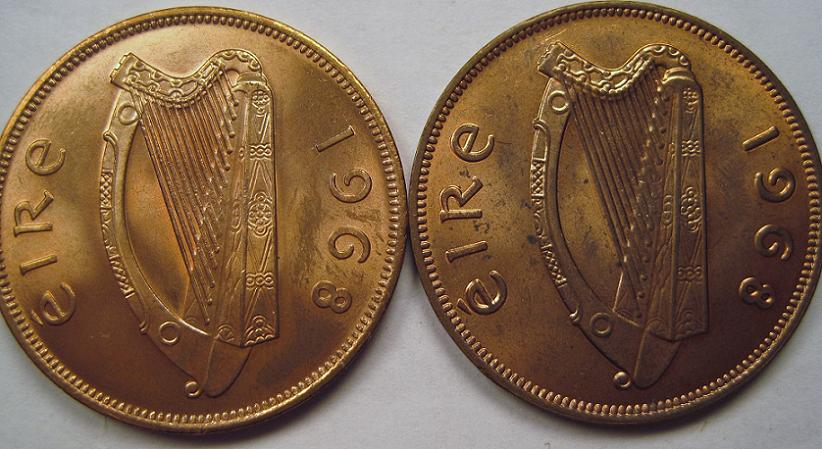 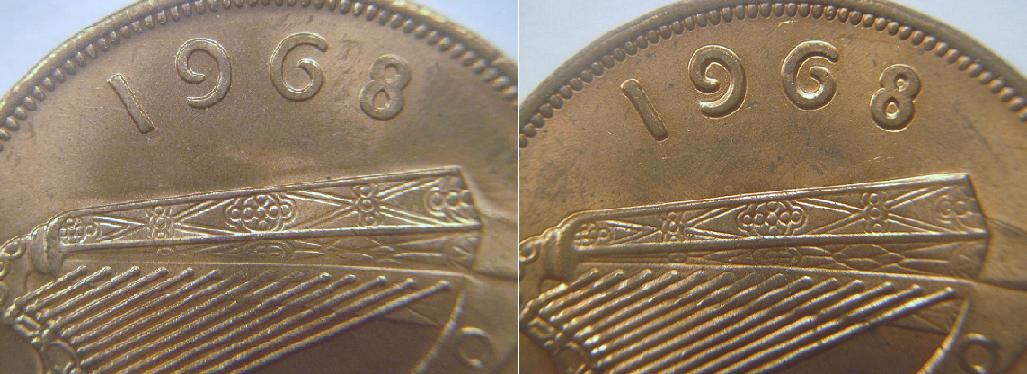 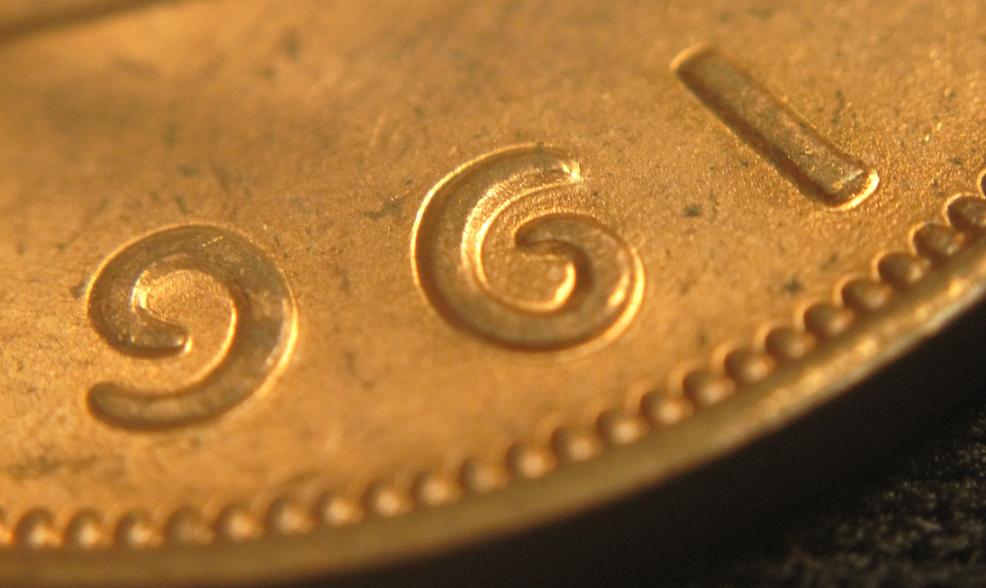 |
|
|
|
Bedrock of the Community
United States
10045 Posts |
I see something, but it's a toughie from pics, maybe you see some notching/separation?  |
|
Pillar of the Community
 United States
4008 Posts |
No DVC, I can't find any separation anywhere. The are definitely thicker and the "cut" of the devices is kind of at an angle. The best angle is at the bottom of the 6 in the 3rd pic.
|
|
Pillar of the Community
United States
4008 Posts |
Here's another date comparison shot. Maybe a large date and a small date?  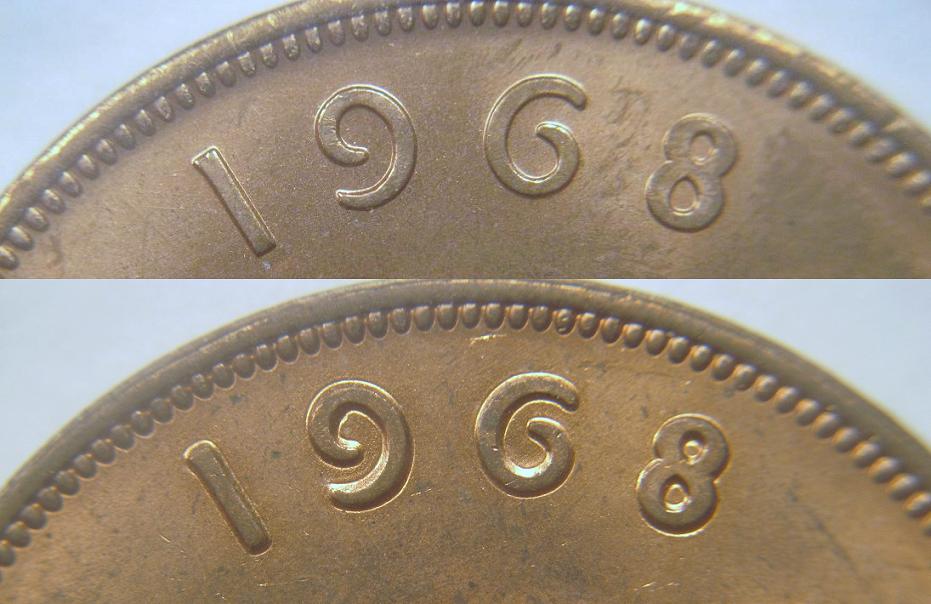 Edited by Scooby Due
04/09/2011 5:23 pm
|
|
Bedrock of the Community
United States
10045 Posts |
Wow...those digits are definitely different to my eyes! I suspect two different hubs. Perhaps two mints made these coins? |
|
Pillar of the Community
United States
565 Posts |
An Irish Large Date and Small Date.  Edited by td5173
04/09/2011 6:04 pm
|
|
Pillar of the Community
United States
4008 Posts |
Here's another harp comparison. 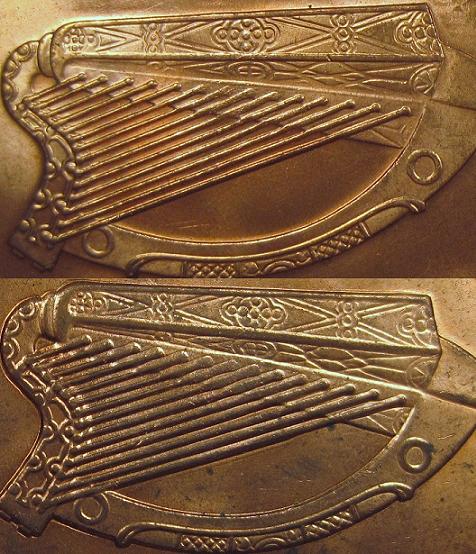 |
|
Bedrock of the Community
United States
10045 Posts |
I see design differences on the harp too.
|
|
Pillar of the Community
United States
565 Posts |
Yup I see that across the top of the harp. Good catch
|
|
Rest in Peace
United States
9104 Posts |
The three try-wrangles are different (second one circled) 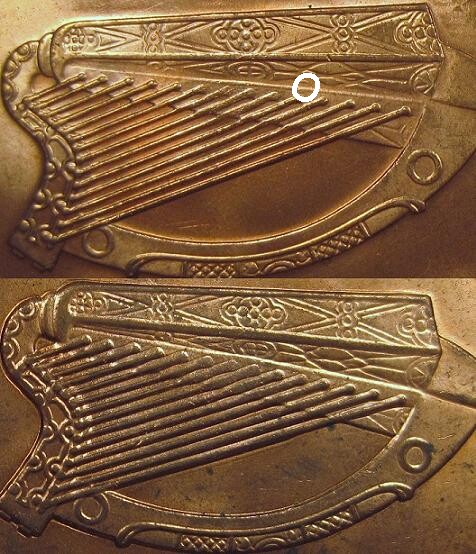 |
|
Pillar of the Community
United States
4008 Posts |
DVC, maybe I should send this coin to you and let you work your magic. I still think there is something to the "cut" or shape of the devices.
Look at the pic just above where you say "Wow...those digits are definitely different...". Look at the inside bottom loops of the 9 & 6.
Of course, if no one cares but us 3 or 4, what does it matter anyway, right?
|
|
Bedrock of the Community
United States
10045 Posts |
Hey Scooby, first, that in-depth comment by John Stafford-Langan of Irishcoins.com: Quote:I have a fairly extensive assembly (I'd hesitate to call it a collection) of Irish 1968 pennies - and I do have examples of this distinction - unfortunately I also have examples which fall into the gap between the two coins illustrated on the site, which suggested that this is not a case of two distinct pieces rather of a range of types of which these two are near the extreme ends - at least this had always been my understanding. However recent, as yet unpublished, research is uncovering evidence that The Royal Mint was under pressure to produce the coins for Ireland in 1968 (remembering that they had stopped the production of English pennies in 1967) as they were ramping up production of the new decimal coins (and complete replacement required many more coins than normal annual production for wastage and economic growth / inflation). And it looks as if The Royal Mint may have contracted the external producton of as much as 9 million of these Irish pennies - but the dies should still have been Royal Mint dies. The Royal Mint was in competition with other mints for the Irish business, which was at the time very attractive to them for the decimal coins as they did not need to retool for blank production for the Irish coins (which they would typically have to do for other countries), so they appear to have wanted to keep their short term production shortfall secret from the Irish Central Bank. If this was the case then even if The Royal Mint was responsible for the supply of dies to the contractor then if they were using different minting technology the die production may have resulted in these types of differences. I haven't really though much about the range of 1968 pennies for a while - but in the light of this new evidence (which I have yet to understand fully) I will have to look again. And it may be that instead of a continuous range of types with the extremes appearing quite distinct there may be two ranges of types - with some of the coins quite similar but the extremes being quite identifiable. The picture is confused by the fact that there was a small batch of 'proof' coins from an external contractor that came to light a few years ago - and which were initally identified as a small trial production of coins for a proof set to mark the end of the LSD coinage. But it now looks as if these coins may have been the trial pieces associated with the contracting of the external production of currency pieces to meet The Royal Mint shortfall. Interesting how he mentions an outside mint was contracted to produce business strike coins and proof coins. Whether the two were the same mint is unclear, but John thinks the dies were provided to these outside contractors. That makes sense to me, since it would be very time-consuming to reproduce the obverse/reverse designs faithfully "from scratch". And, it would be harder to hide the fact they outsourced production that way. The "range of types" mentioned by John above could be explained by differences in how dies were made, seen in differences on the harp. However, what if The Royal Mint sent a contractor an undated die, forcing that mint to create their own date? While total speculation on my part, the differences between the "large date" and "small date" are too great to be explained by minting technology. Those two dates came from different punches or hubs--however that was done. Later, I'll put together an overlay of the dates for comparison. A quick look on ebay suggests the (top) "large date" appears more common. |
|
Pillar of the Community
United States
4008 Posts |
I couldn't remember if I had sent that to you or not. I found that really interesting, too.
I have probably 40 or 50 BU examples that I compared and another 40 or 50 circulated examples and found one of each in each pile. As we discussed behind the scenes a little, I'll forward these to you and let you examine them. So, roughly 2 out of 100 exhibited the different style date. I know it's not scientific, but maybe it gives us a *rough* ballpark idea.
There were also a couple reverses that were slightly different than the others I'd like to send along to let you look at. Nothing as significant as the date, but the arrow or "bottlerocket" or whatever that is that the chicken is holding appears to be different.
I trust your expertise way more than anything I could come up with other than "it just looks different". Can't wait to see what you come up with. I'll let you know when they are the way. I'll be mailing some contest prizes out shortly, so real soon.
Thanks for your time and effort!
|
|
Valued Member
Ireland
131 Posts |
Interesting info, did remember to check my pennies that I have laying around the house Scooby but not one '68 I'm afraid, closest I could get was a '71 lol.
Norm
Edited by Spikey Norman
06/28/2011 2:55 pm
|
|
Pillar of the Community
United States
4008 Posts |
Want one?  Edited by Scooby Due
06/28/2011 3:20 pm
|
|
Bedrock of the Community
United States
10045 Posts |
Quote:
So, roughly 2 out of 100 exhibited the different style date. I know it's not scientific, but maybe it gives us a *rough* ballpark idea. If your sample is roughly representative of the total mintage, that would be ~4.2 million 420,000 of the "small/bold date" out of a total mintage of 21 million--which would be a nice variety!  And thanks...I try to do my best with photographs. I once did some photoanalysis for NASA; I guess that experience rubbed off on me Look forward to seeing the coins!  Edited by DVCollector
06/28/2011 11:06 pm
|
| |
Replies: 20 / Views: 5,536 |







 Posted 04/09/2011 5:18 pm





