| Author |
 Replies: 13 / Views: 1,993 Replies: 13 / Views: 1,993 |
|
|
Pillar of the Community
United States
1285 Posts |
Dave and I have privately discussed this coin a while ago and I have made no further headway. Hopefully the added pics help. The red highlights are the cracks on the obverse and reverse (some are faint but are visible at 16X). Sorry about all the pics. Things I notice. The counter clash is present on both sides (comes over / top of the wreath on the reverse -- first one for me) and I can count at least 3 clashes but there may be more. The bottom portion of the letters in "liberty" looks different and I Cannot summarize it in words. Dave, scratches from 3ED. Is there a good pic of this somewhere? 1 or 2 chips inside of the ear. Chip in between lips (touching upper lip and smaller than last weeks chip) In the word "trust" -- two small connections between S & T looks like a equal sign = and I cannot capture it. Below are some other general comments based on what I have gathered from reading at VW. Has pitting both sides (I think), with the rear being more prominent LLAR area, tops of both wings etc. It also has the streak effect on the obverse where it's sort of coming ¼ to 1/3 distance into the stars / lettering. One of the posts I saw on VW described some of the effects I describe as a "heavily worn die". There is more detail visible at 16X vs 10X everywhere on this coin (for a lack of better term - It's different). 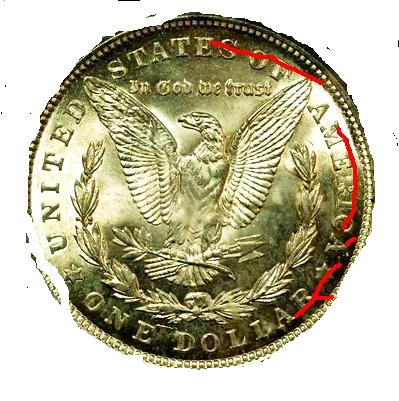 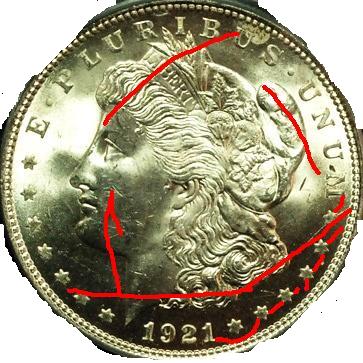 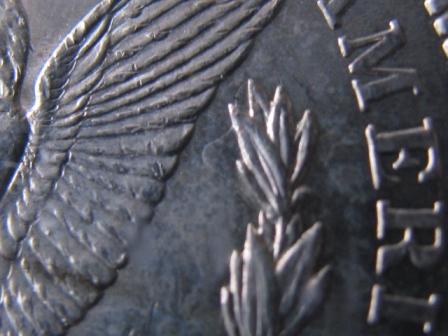 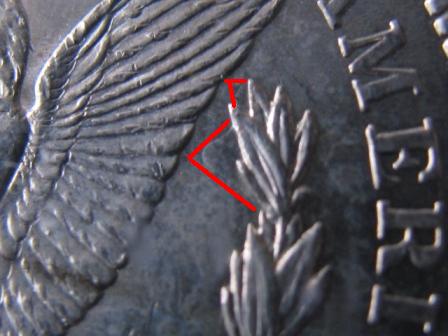 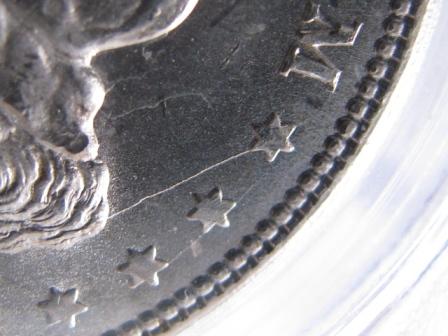 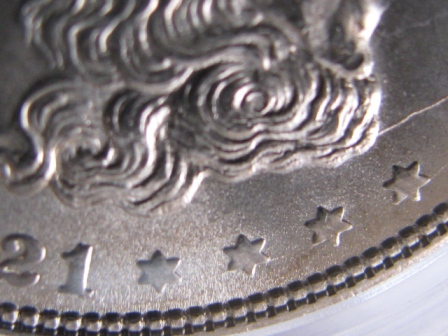 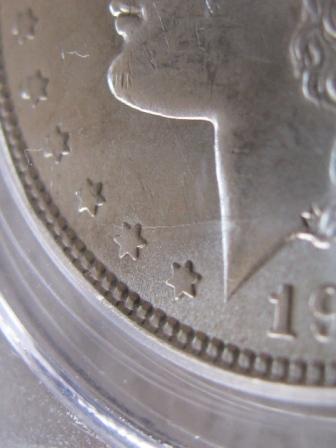 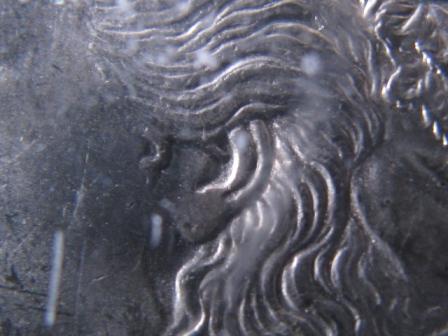 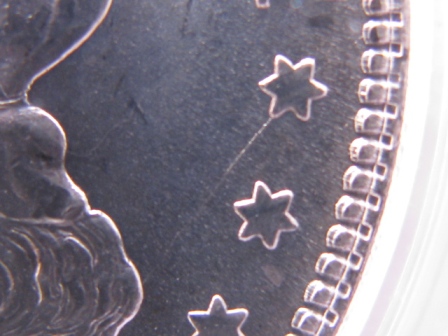 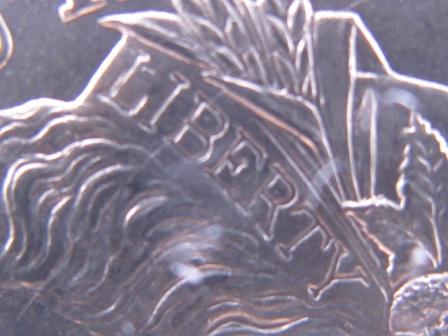 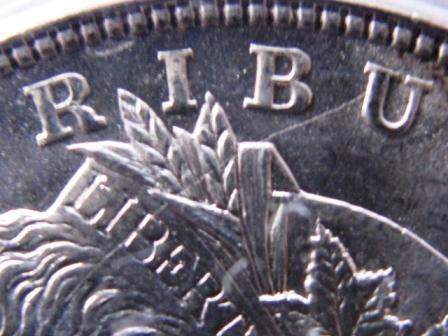 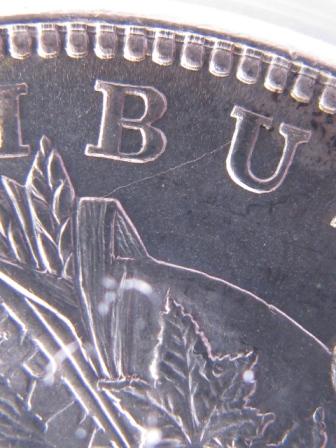 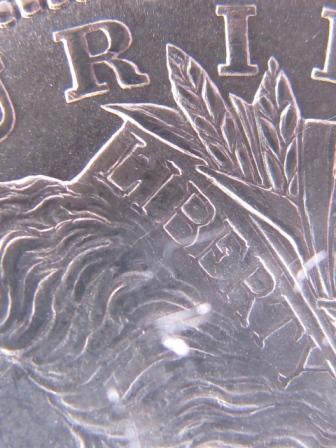 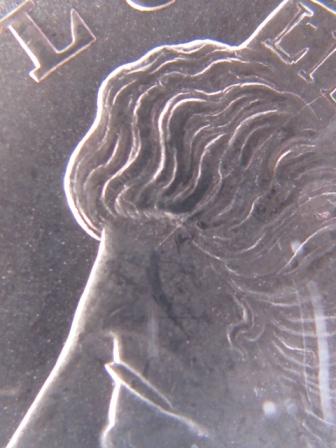 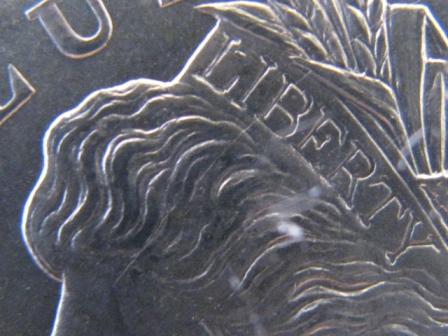 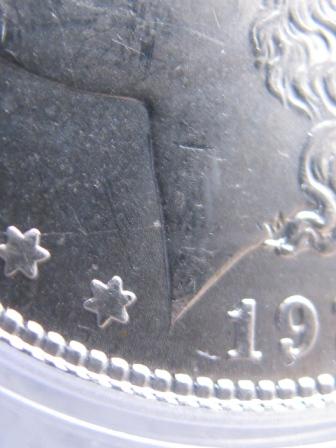 Pic below - LOOKs like a clash ( Below N from feather top) but there is NO counter clash 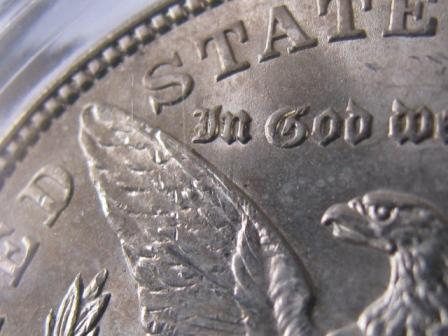 |
|
|
|
Moderator
 United States
23522 Posts |
Just got back from the grocery store. Give me a little time to digest all the information and we'll talk. One thing, though - dies get switched out regularly, and a reverse clash doesn't guarantee there'll be a corresponding obverse clash. Maybe the obverse got hit hard enough so they decided to pull it and polish it, leaving the reverse in place.
|
|
Moderator
United States
23522 Posts |
Here's the problem, as I see it. The information you and I have both been referencing is *all* the information available for VAM-3ED2. There isn't even a picture of the scribbles. I have no way of knowing if the additional information you've presented here is further confirmation, or indicative of something else entirely.
Keep in mind, there are well over 100 different varieties of these scribbles defined for 1921-P alone, and those are only the ones which aren't already known for some other feature. Also, these scribbles are so fine that my 12x loupe and my best macro imaging cannot resolve them well enough to identify them. You'll need a minimum of 20x to attribute by scribbles alone, and that's only if images are available.
Another thing to keep in mind. Actual counter-clashed Morgans are extremely rare, and almost always found only at the lips and back of the cap on the obverse. I can't think of any Morgans with reverse counterclashes off the top of my head. Think of where the clash details are strongest on the most heavily-clashed Morgan you've ever seen, and those are the only real places to look for counterclashing.
This is the frustration of VAMming. Unless you can find a person who owns a VAM-3ED, and unless they can provide images clear enough for you to conclusively match your coin, it's a question you may never be able to answer.
|
|
Pillar of the Community
 United States
1285 Posts |
The counter clash -- to clarify further. It is present at the back of the cap along with the clash at the wreath. My obverse clash looks similar to the pic posted on VW for 3ED2 visible at 10X. I do not see anything around the lips.
Only in the last few days did I realize that in some of these cases that there is a VAST diff of what you see between 10X vs 16X when looking for these scratches etc. Now you say 20X..... so moi has to go look for another.
I'll see if I can work on getting better pics of the word "trust" and "liberty". The ST in trust may lead somewhere on this coin. Unless, the equal sign looking thing in between ST has already been noted somewhere...
Silly question -- Without all the detail images of all these scribbles etc... How did you guys end up with these different vams for 1921? OR is it considered proprietary and folks have not posted / shared them?
|
|
Pillar of the Community
3660 Posts |
Quote:
Silly question -- Without all the detail images of all these scribbles etc... How did you guys end up with these different vams for 1921? OR is it considered proprietary and folks have not posted / shared them? Oh it isn't a silly question..... but the answer probably is..... Yours is a question that has been asked many times, and there are conspiracy theories concerning disinformation for personal gain. Some vammers may feel that they have an obligation to put back into the hobby a measure of what they have gotten out of it.... (through information and photos).... many other vammers are takers only though.... still others would like to contribute info and photos, but are hesitant because they are unsure as to proper etiquette and procedure. --------------------------------------------------------------------- Counterclash is a notion that is new to me..... As Dave implies, I might not think that this would be a common occurrence..... While I certainly do not discount the exchangeablity factor, it would not be irrational to think that one die might also be inherently harder than the other..... the harder die being more susceptible to cracks while the softer die being more prone to clash marks.... |
|
Moderator
United States
23522 Posts |
Quote:
Without all the detail images of all these scribbles etc... How did you guys end up with these different vams for 1921? OR is it considered proprietary and folks have not posted / shared them?
Datamining and data interpretation, plain and simple. My memory is all but nonexistent; over the years it's forced me to develop the ability to find and digest new information quickly and efficiently. This is especially true with coins, augmented by my extensive experience with interpreting coin images. If I attribute your VAM when you've been unable to, it is only because I found something in the same data you have access to which for some reason you didn't. That "something" might be a tiny crack, a whisper of detail that stands out for me as a "smoking gun" because I've done it so darn many times before that I know what counts and what doesn't. Once you've done this same process one million times, you'll be able to pick up on the small stuff too.  I've been unable to find that "smoking gun" with this coin, Ceylon62. At least, I hadn't when I made my last post in this thread, but that must be chalked up to the painkillers I'm currently enjoying. This morning, things are a little clearer, and I see what will probably allow an attribution for this coin. First, the cracks near the sixth right star. There are varieties with a crack from that star to the hair, but yours, with the crack extending directly from the point of the star, is possibly definitive. Second, the intersection of two cracks in front of the neck - one to the rim, one up into the head. What I do with that information is go to VAMworld, and start clicking links. I look for cracks in those specific locations. The size/length/depth of the crack doesn't matter - the pictured coin might be an earlier or later state than yours - just the location. Cracks are like fingerprints. I won't say they're unique, but the chance of a precise match between two different sets of cracks is infinitesimal, especially if you can make both obverse and reverse matches. Case in point, and an indication of my memory: I just did this for nlp coins in another thread. I found what I was looking for on the 23d link I clicked. It nailed the attribution. And I'd already photographed another example of that same VAM in excruciating detail, with the coin in-hand, 4 months ago. I didn't remember the pickups. It's the same phenomenon as a blind person forced to develop finely-honed hearing, with me and interpreting data. I'm about to do the same for you with this coin. Another post in a few minutes is coming, on the subject of counterclashes. |
|
Moderator
United States
23522 Posts |
Let's consider what a counterclash requires.
A counterclash happens when an initial clash transfers very strong details to the opposite die. Then, a second clash happens, strong enough to transfer those details back onto the first die. A lot of stuff has to come together precisely for this to happen.
Both dies have to be hard enough to transfer details; I imagine that some varieties which have clashing on one face but not the other are due to one die being harder than the other.
Both clashes have to be more than normally strong, the first one to create clash details deep enough to transfer a second time, and the second one to transfer details that by definition won't be in as great of relief as the die's original features.
The press operator has to allow both of these to happen without stopping the process to fix the clashed dies. Not unlikely, but we know of enough varieties with polished-away clashes to infer that they were on the lookout for such stuff.
Most importantly, between the first and second clashes, the dies have to offset relative to each other enough for the counterclashed details to be visible. Otherwise, the second clash just strikes the first in the exact same place, and no details are transferred because the original die features are deeper than the counterclashed features.
And in any event the resulting counterclash is going to look very much like run-of-the-mill doubling, unless the offset between the two is radical.
A whole lot of things have to come together for something we can accurately refer to as a counterclash. It ain't common.
|
|
Pillar of the Community
3660 Posts |
Quote:
A counterclash happens when an initial clash transfers very strong details to the opposite die. Then, a second clash happens, strong enough to transfer those details back onto the first die. Thanks for the definition Dave... I was completely in the dark about what a counterclash was....  edited to add: Wait a minute..... is that even possible? Is there an example somewhere? Are you sure those painkillers have worn off?  Edited by zeewool
04/11/2011 12:28 pm
|
|
Moderator
United States
23522 Posts |
Quote:
Wait a minute..... is that even possible? Is there an example somewhere? Are you sure those painkillers have worn off? I won't say the concept has been clearly proven to my absolute satisfaction, Lou. Have a look at the 1882-CC VAM-2C and 1904-O VAM-35 families to see what are considered the clearest examples. The VAM-3ED discussed in this thread is, I think, the only 1921 demonstrating such characteristics. It's a pretty plausible explanation for the features being observed, but not necessarily the definitive one. Edit for question: Lou, with your greater knowledge of metallurgy than mine, can you speculate whether the event of a clash would have any bearing on the hardness of a field/device intersection? I could believe counterclashes more easily if I knew that, for instance, the field adjacent to the lip was softer as a result of being involved in a prior clash. |
|
Pillar of the Community
3660 Posts |
I have absolutely no metallurgy prowess.... none.... but I do have a big imagination... Quote:
the field adjacent to the lip was softer as a result of being involved in a prior clash. Yes, that makes sense to me, except rather than 'softer' I might prefer to say 'weaker', although I really don't know enough about impacts on specific metals to venture an intelligent comment on the distance that the resulting fissures may extend (if at all).... I can imagine a minute ripple in the surrounding field, which would be weak..... Would this raise the topography in this location above field level? Yes, that too, I can imagine..... Would that make it likelier to sustain such a 'counterclash' in the future? I might think so if the rim of this impression is now above normal field level, except.... This is still the softer (and now weaker) die..... as you say though, replacing the opposite (harder) die with one that is even softer than the clashed die could produce such results. (I imagine ). So how can a person tell if the impression is from a clash or a counterclash? Is this done by examining the mark to see if it is in reverse image of what a clash should be looking like? |
|
Moderator
United States
23522 Posts |
Quote:
So how can a person tell if the impression is from a clash or a counterclash? Well, a clash is a detail from the opposing side, while a counterclash will be a detail just like the adjacent "original" detail. Hence, the chance to mistake it for doubling. Quote:
as you say though, replacing the opposite (harder) die with one that is even softer than the clashed die could produce such results. (I imagine ).
All the counterclashes I know of, exist in the presence of original (first-generation) clashes. Then again, if they'd switched out an original die and the new one was then the victim of a counterclash, I'd guess there would be no way to tell it from doubling, be it die- or machine-. Like many other aspects of Morgans, it's only the strongest in a rather weak differential of explanations. |
|
Pillar of the Community
United States
1285 Posts |
Dave, did some data mining and found this at VW. Look at remmy's 2nd Post with links to pics. It takes a while to load (I saved it off to my pc). http://www.vamworld.com/message/view/home/15205162On the 1st post I am sort of lost with some of those pics. On my notes from above these ones stand out ST equal sign in trust. You can see one faint line on remmy's. Obverse cracks on mine are at a different stages (more visible). This leads to my question from last week - if coins like this (mine) go through circulation do faint cracks rub off and become invisible over time like remmy's coin? OR is it at a different stage of striking (both coins) You will see faint pitting at the second L in dollar or is it too small / trivial Remmy's clashes are identical to mine, unfortunately I cannot do pics like that. Now that you can see the full coin where is that scribble hiding? May be new Look at the top of left wreath (when viewing). See how the top of it is flat (circled). Mine has the exact same thing going on. Coincidence OR note worthy? pics of both coins below Remmy's coin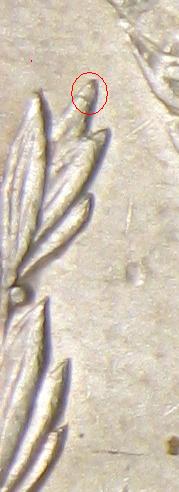 Mine Below Mine Below 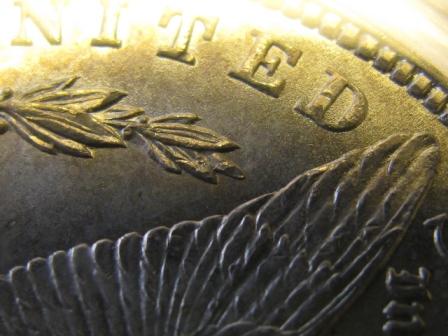 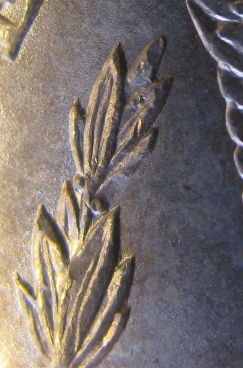 Thanks for all the info above Thanks for all the info above and will have some questions later. EDIT to add pics Below Finally got a good pic of the obv clash 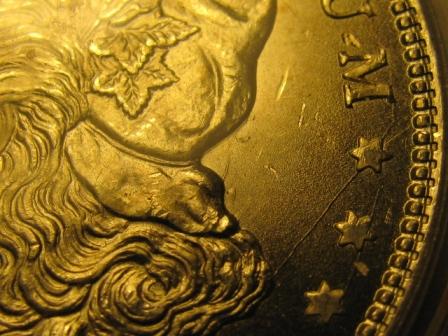 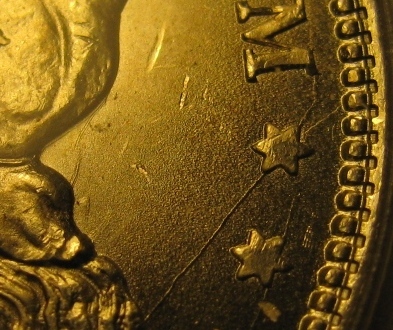 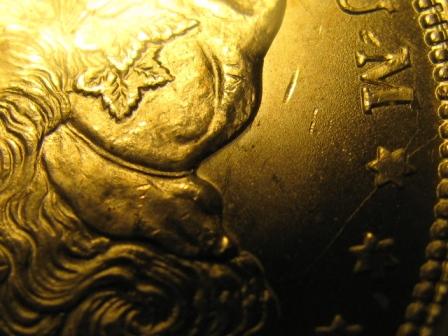 Edited by Ceylon62
04/11/2011 9:57 pm
|
|
Pillar of the Community
3660 Posts |
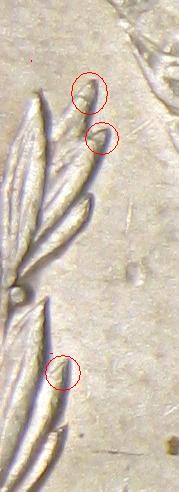 Looks to me like the beginnings of a filled die (small device nooks that retain crud).... like the letters in 'trust' on the reverse sometimes do. Quote:
I'd guess there would be no way to tell it from doubling, be it die- or machine-.
Like many other aspects of Morgans, it's only the strongest in a rather weak differential of explanations. I have seen many instances where the experts will differentiate between machine and die doubling (like it is the simplest and most obvious thing in the world).... interesting that they cannot determine the difference between a broken drop off ledge and doubling of any type, or a "counterclash". |
|
Pillar of the Community
United States
1285 Posts |
I found these 2 to be really good examples of counter clashing over at vw.
1902 O -- 26A counter clashed leaf tips (one before the last pic)
1880 P -- 50A doubled lips.
|
| |
Replies: 13 / Views: 1,993 |
|









 Posted 04/10/2011 11:25 pm


