| Author |
 Replies: 11 / Views: 2,759 Replies: 11 / Views: 2,759 |
|
|
Pillar of the Community
Canada
1166 Posts |
I found this a couple of years ago while searching through some rolls of '67 cents. It caught my eye because the surface of the coin was textured. I posted it on coppercoins and there was some discussion about it. No real conclusion. It might have been acid damage or possibly rusted dies. It also contains a struck through (wire or thread). Any other ideas? Textured: 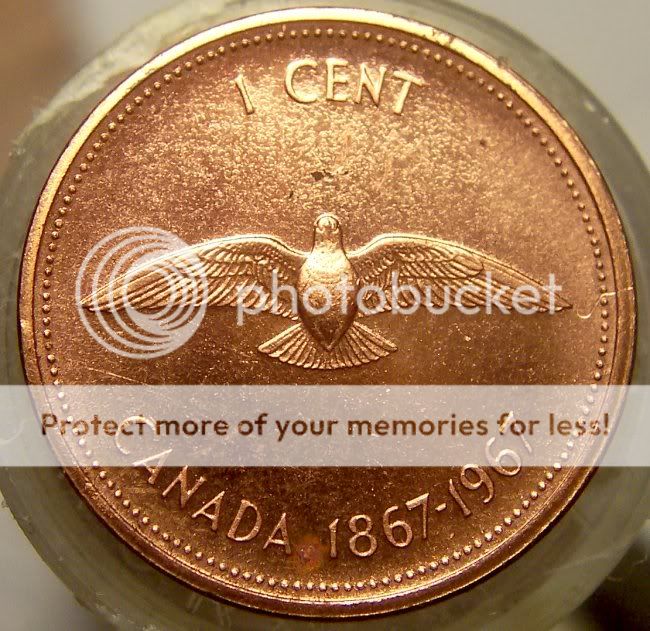 Normal: 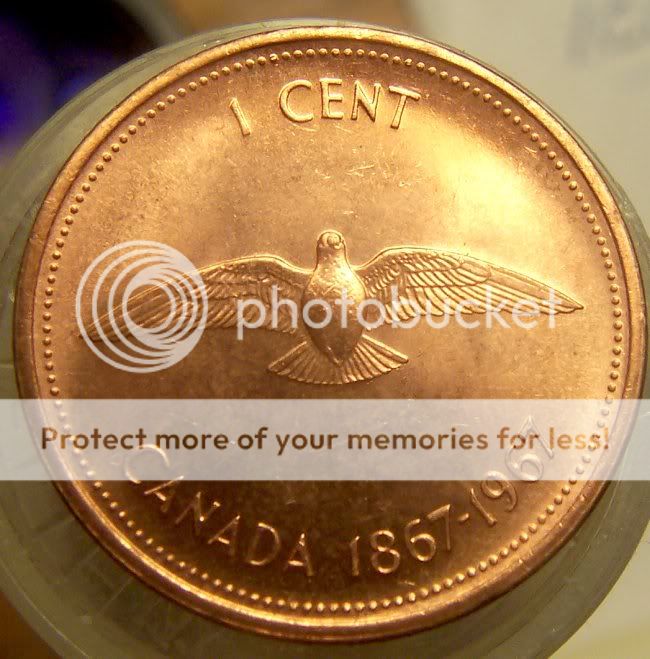 Details:     In this one you can see the mottled surface from a different angle and different lighting:  |
|
|
|
Pillar of the Community
Canada
1733 Posts |
My best thoughts are that there's no way that I can reasonably think of that this was caused during the strike. A rusted die.. really? I thought these dies were all nickel plated by then to extend life. Further the texture seems consistent even inside the struck through string element and that indicates to me this texturing probably happened after it was struck.
I once saw a penny struck through sand and another struck through iron filings. This doesn't match up with what I recollect of either. I've also seen a nickel struck through cotton cloth and boy did that ever leave a uniform pattern. This surface seem totally random and the high points are too high for a struck though something or other..
As to an acid dip... I suppose, I don't know though honestly. If you've ever used a copper anode for plating, this is something like the surface looks like on copper when you stop, seems a tad more "pebbly" though, not sure. Maybe it was cleaned of patina using an electroplating method which is really just an electrically enhanced acid dip.
|
|
Pillar of the Community
 Canada
1166 Posts |
I think the rusty dies suggestion was just part of the brainstorming session that was going on.
One thing I didn't mention, and I don't know if it would change anything, but there's no "pebbling" on the edge, just on the obverse and reverse faces.
|
|
Valued Member
United States
260 Posts |
The surface is interesting. It compliments the image I think.
|
|
Pillar of the Community
Canada
1733 Posts |
I honestly don't know... can't even guess. The fact that the rims are nice makes it even harder to figure out.
Once the warm weather comes, I'll lay a penny on the floor and hit it with the sandblaster both sides... that wouldn't affect the edges of the rims... might be able to replicate this with fine grit. I'm just not sure.
Love these little puzzles.
|
|
Moderator
 Canada
10477 Posts |
Check out a random sampling of the 1961 and 1962 proof-like 1-cent coins sometime. You will find two distinct 'textures' (for lack of a better word) in the fields of these coins. One will be mirrored (more common), with fine die polishing marks, and the other will be matte-like, which looks like the pebbled surface not unlike the surface of ice at a curling rink. I am going to take examples of these coins to work sometime next month and photograph them under the SEM (scanning electron microscope) to really see what the heck the mint did to the dies, prior to striking these coins. You mentioned acid Ugly, were the dies not etched with acid prior to being used a the mint (creating the cameo effect)?
"Discovery follows discovery, each both raising and answering questions, each ending a long search, and each providing the new instruments for a new search." -- J. Robert OppenheimerContent of this post is licensed under a Creative Commons Attribution-NonCommercial 3.0 Unported License. See: http://creativecommons.org/licenses...0/deed.en_USMy eBay store
|
|
Pillar of the Community
Canada
1733 Posts |
Acid etching dies is rapidly neutralized though while they are right in place otherwise it spreads and etches the fields, etches the copper planchets and continues corroding it even after the acid was partially neutralized to the point where it no longer affected the nickel on the dies. Any transference onto the planchet gets everywhere even between the collar and rim at those pressure ratings. I guess it's possible, but the clean rims still puzzle me. I just don't know. Our choices for PMD are mechanical or chemical. If mechanical, it's pretty selective that's why my mind went to sandblasting. If chemical, what does that and not touch the rims, it would have to be something that protected the rims or was carefully painted on and washed off. If MD, what at a mint does that while leaving the strike with such a high relief and clean rims? So many more questions than answers. There's never a mint engineer around when you need one. |
|
Pillar of the Community
Canada
695 Posts |
The texture reminds me of damage caused by non-archival flocking in a case. One more theory!
|
|
Pillar of the Community
Canada
1733 Posts |
What kind of flocking would corrode copper like that in only ~40 years? Shredded Guncotton hit by a hammer is about all I can think of  ... unless you mean some flocking idiot who didn't value the durability of shredded teflon came by and ...lol Seriously, if something corroded it, where's the corrosion? Damaged as it is, it doesn't really look dipped and there doesn't appear to be any hairlines and the weird bits that move out of the sides of the devices with acids are not present.. I think I'll stick with sandblasting or other physical damage as a working theory for the moment. I still don't know though. In a few weeks we'll come back to this after I sandblast one(s) just like it with a few different grits. |
|
Moderator
Canada
10477 Posts |
I think the coin was struck that way. It is not an unusual texture for coins struck in the 1960s and even early 1970s. Not common, but not rare... I think it has to do with the treatment of the dies, perhaps newer dies, because coins with that texture in the fields tend to be fully struck.
"Discovery follows discovery, each both raising and answering questions, each ending a long search, and each providing the new instruments for a new search." -- J. Robert OppenheimerContent of this post is licensed under a Creative Commons Attribution-NonCommercial 3.0 Unported License. See: http://creativecommons.org/licenses...0/deed.en_USMy eBay store
|
|
Valued Member
Canada
248 Posts |
Seeing that we are trowing questions and working theories, I have a thought! --- Maybe this works! (MD) IMO the simplest.   Not back yard mechanics! Not back yard mechanics!---I will agree with you -SPP-OTTAWA-! ---Ive seen this in small patches and believe like freshly pressed through lubricant / grease on the die or blanchet not been washed or rinsed.  This penny just looks like they sprayed / coated the entire die. ---Here's a example I've seen that was repeated. Looks sort of the same just more coverage. ---If not lubricant then what is this? [URL="http://img827.imageshack.us/i/pressedthroughgrease.jpg/]  [/URL] Edited by commoncents13
04/19/2011 05:57 am
|
|
Moderator
Canada
10477 Posts |
The radial pattern seen on that 50-cent is a different animal altogether. You can see it on almost all nickel coins near the rims, if well struck, and especially on the newer plated coins and the nickel rims of the two dollar coins. I think it is how the metal is formed, or flows, from excessive pressure or heat.
"Discovery follows discovery, each both raising and answering questions, each ending a long search, and each providing the new instruments for a new search." -- J. Robert OppenheimerContent of this post is licensed under a Creative Commons Attribution-NonCommercial 3.0 Unported License. See: http://creativecommons.org/licenses...0/deed.en_USMy eBay store
|
| |
Replies: 11 / Views: 2,759 |
|








 Posted 04/17/2011 6:38 pm


