| Author |
 Replies: 9 / Views: 2,297 Replies: 9 / Views: 2,297 |
|
|
Valued Member
United Kingdom
114 Posts |
The silver 2d was struck for circulation in the West Indies, dated 1838 and 1848 (I have an example of both of these). The problem year is 1843. Some listings give it, others show only 1838 and 1848, others say "some years for West Indies" (or similar wording). Please note that I'm referring to circulation strikes, not Maundy. Quantities given by KM are: 1838 Est. 1,045,000 1843 Est. 903,000 1848 Est. 261,000 I've never seen other than what are obviously Maundy examples on ebay. Put simply, does the 1843-dated circulation strike exist? Or were they dated 1838 which seems to have many examples remaining? Bill. |
|
|
|
Moderator
 Australia
17000 Posts |
Quote:
Or were they dated 1838 which seems to have many examples remaining? I suspect you may be right. My latest Spink does not list 1843, but lists the other two. I'd trust Spink over Krause for accuracy any day. Don't say "infinitely" when you mean "very"; otherwise, you'll have no word left when you want to talk about something really infinite. - C. S. Lewis
|
|
Valued Member
 United Kingdom
114 Posts |
I will be putting the question to my contact at The Royal Mint, but their records for the period are rather sketchy and tend to record the dates of despatch of an order from the mint rather than how many were struck with a particular year on them. I have even been able to add to their records of overstruck dates on quarter-farthings by lifting illustrations from ebay! He has told me that they are hoping for a new website (separate from the sales one) aimed at serious collectors. I'm looking forward to that and have offered to assist in any way that I can. If anyone contacts The Royal Mint on a historical matter, it is best to head the message "Historic Coins" so that the sales staff pass it direct to one of the museum staff for action. Also, don't be surprised if it takes a month to get a reply, but that reply will come. Some of the enquiries they receive take a lot of research (= time), but once you have made first contact you will have a direct email address to send to in future. Bill. PS - For Star Trek enthusiasts: remember that "First Contact" appears as a title twice, as one of the full-length films and also as an episode in one of the series (Voyager?). B. |
|
Pillar of the Community
Australia
2830 Posts |
now I'm curious: was this tuppence visually different from the Maundy 2d ?
|
|
Moderator
Australia
17000 Posts |
The circulation types were identical in design to the Maundy coins, except for what the Coincraft catalogue calls "inferior strike". I certainly haven't seen enough of these coins to tell them apart at first glance. Coincraft lists the existence of the 1843 circulation issue, too.
Don't say "infinitely" when you mean "very"; otherwise, you'll have no word left when you want to talk about something really infinite. - C. S. Lewis
|
|
Valued Member
United Kingdom
114 Posts |
But interestingly 1843 is not in 'Coin Yearbook 2010' (our "Local Bible" on a day-to day basis), nor in 'The English Silver Coinage from 1649' although both show 1838 and 1848. Numismaster lists them but I suspect an error here.
LITTLE KNOWN FACT: They are still legal tender here for two decimal pence, being "considered as Maundy" as it would be impossible to differentiate between a circulation strike and a Maundy one well worn.
Bill.
|
|
Valued Member
United Kingdom
114 Posts |
Is there anyone out there who has an 1843 twopence? If so, please would you look at it carefully and try to decide whether it is a Maundy issue (Proof) or a circulation issue. Unless it is worn in which it is probably a circulation issue, the difference in strike might be apparent. Better still  Thank you all. Bill. |
|
Valued Member
United Kingdom
114 Posts |
Someone wants illustrations! To illustrate the differences, here (top) are the 1838 and 1848 Circulation strikes. The lower coin is an 1844 Maundy (Proof or Prooflike) strike, which unfortunately has been used as jewellery at some time (traces of solder). The greater depth of strike of the Maundy coin is very apparent when the coins are "in hand". If you possess an 1843 dated 2d (twopence) coin, please would you examine it and let us know whether you consider it to be a "Proof/Prooflike" Maundy strike, or whether it is the weaker Circulation version. After thinking further on this subject, I still think that the elusive 1843 Circulation coins might have been dated 1838 using the old dies. A further possibility is the the Maundy (Proof or Prooflike) dies were re-used for Circulation coins after the Maundy coins had been produced, which could make them appear "Prooflike", although quantities advertised do not appear to support this latter theory. Please, more infomation on your 1843 twopences. Bill. 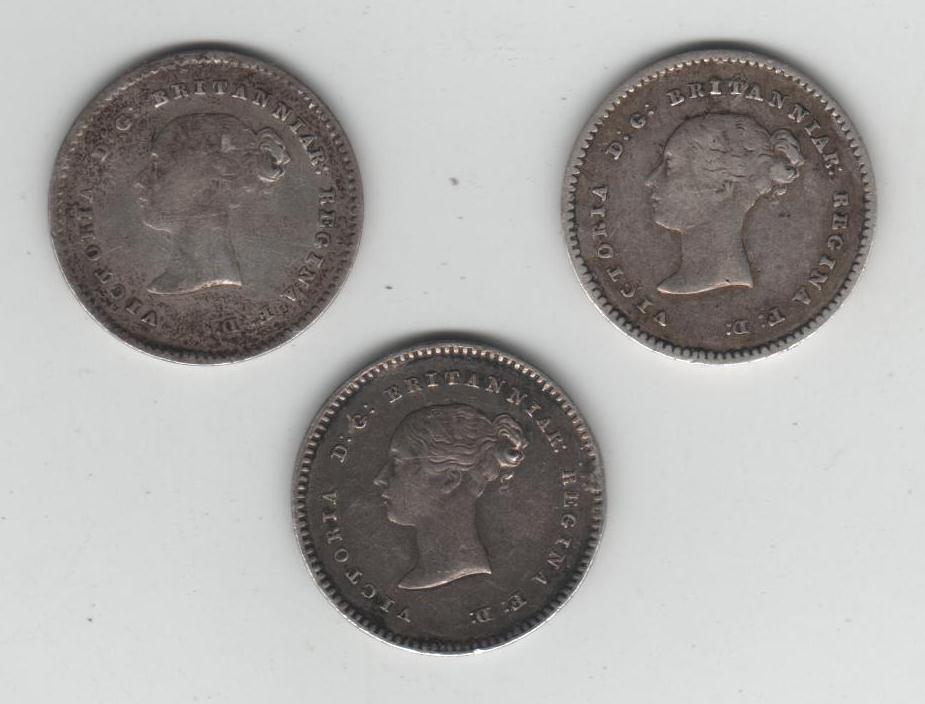 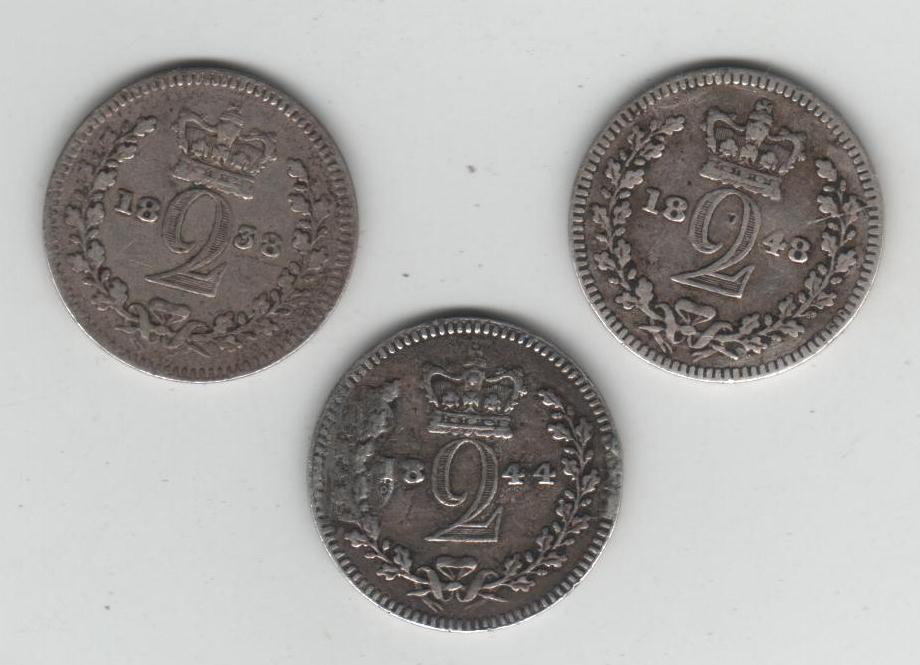 |
|
New Member
United Kingdom
1 Posts |
hi.I am new to the site as I have just discovered a 1843 twopence in a collection my great aunt left me 25 years ago.Haven't really looked at them closely before.I dont know much about coins,but this has sparked an interest because it's quite old.Any info would be much appreciated.How could I tell if it is a circulation strike.
|
|
Valued Member
United Kingdom
114 Posts |
Hi and Welcome,
Your 1843 2d - first, DO NOT CLEAN IT, because if you do it will lose the surface finish in some way. I would even avoid 'silver dip'. A lot of the interest in these coins is how well they have weathered the storm.
If you can put the coin on a scanner and scan both sides for us, that could be useful. Set the scanner to just scan the small coin, not a whole page. We may then be able to make an educated guess as to which it is.
Maundy coins are usually struck with greater pressure than 'everyday circulation' ones. The edges can be quite sharp when new, almost sharp enough to cut. If you look at my pictures above, you will see that the lower (Maundy) one is a lot clearer than the other two, even allowing for wear and tear. But a worn Maundy one will look almost like a circulation one if it has been used as a coin and spent. An unused circulation one in exceptionally good condition could well pass as a Maundy one. It's all a case of condition when struck versus condition now.
That is about as clear as I can make it.
They do not rate as 'rare', but a really excellent example might make £50 and a poor one £5 - those figures are just guessing but realistic.
Bill.
Edited by bilnic
09/21/2011 2:18 pm
|
| |
Replies: 9 / Views: 2,297 |
|










 Posted 06/06/2011 2:18 pm


