



Coin Community Family of Web Sites Join Thousands of Coin, Bullion, & Money Collectors
300,000 items to help build your collection! Royal Estate Auctions - $1 Coin AuctionsCoin, Banknote and Medal Collectors's Online Mall Specializing in Modern Numismatics Royal Canadian Mint products, Canadian, Polish, American, and world coins and banknotes. Join Thousands of Coin, Bullion, & Money Collectors Vancouvers #1 Coin and Paper Money Dealer


Username:
Password:
Save Password
Forgot your Password?


This page may contain links that result in small commissions to keep this free site up and running.

Welcome Guest! Registering and/or logging in will remove the anchor (bottom) ads. It's Free!

Canadian Blank ?

To participate in the forum you must log in or register.
Author Previous TopicReplies: 4 / Views: 2,096Next Topic  
Pillar of the Community
Indian1's Avatar
United States
3640 Posts
 Posted 06/17/2011  7:20 pm Show Profile   Bookmark this topic Add Indian1 to your friends list Get a Link to this Message Number of Subscribers
I posted here because I thought that this blank may not be
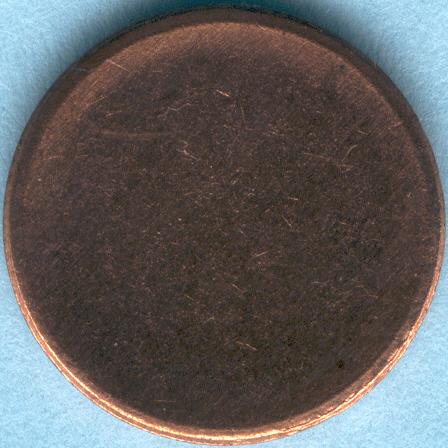
of U.S. origin. Reason being is I found it mixed in with some other coins that my step dad had in his collection of both U.S. and Canadian coins and the fact that he was french canadian. Anyway, weight is 2.4 grams, diameter is 18.8 m.m., thickness is 1.5 m.m.
The image is a scan and the actual color of the complete coin on both sides is the same as the southern edge of it. It is unc. and very nice copper color. There is no raised area on either surface of the blank (that's why I did not call it a planchet) near the rim but there is a raised and recessed ridge around the outside edges with kind of a gully (concavity) in it. You can see the slight raised area in the image. The concavity is centered along the outside edge perimeter. Closest one I could find that matched the specs. was a 1982 - 1996 copper 12 sided as far as canadian small cents go. Sounds strange to me as I have no idea if the 12 sided coin is collared like it is or if it was shaped during the stock punch. not a big deal blank/planchet anyway but curios and any help would be appreciated. Thanks.

Canadian-Blank-?
Pillar of the Community
Wild Bill's Avatar
United States
744 Posts
 Posted 06/18/2011  6:29 pm  Show Profile   Bookmark this reply Add Wild Bill to your friends list Get a Link to this Reply
as we know the US copper plated zinc cent 1982 to present has a weight of 2.5 grams and a diameter of 19mm

the Canadian copper plated zinc cent from 1983 to 1996 also weighs 2.5 grams with a diameter of 19.1 mm

IMHO I think that what you have here is a type 2 (planchet) not a type 1 (rim-less blank)

I have read somewhere that the Royal Canadian Mint contracted the United States Mint in Philadelphia to strike a certain amount of cents.....the amount I don't recall, but in closing....I feel it would be impossible to determine if the planchet had US origin or Canadian......

Edited by Wild Bill
06/18/2011 6:34 pm
Pillar of the Community
dialog_gvf's Avatar
Canada
1581 Posts
 Posted 06/18/2011  9:03 pm  Show Profile   Bookmark this reply Add dialog_gvf to your friends list Get a Link to this Reply

The 12-sided was collared. That means the planchet must fit in the collar for striking. Hence, the smaller diameter (18.8 mm versus 19.1 mm for a struck coin).

Wild Bill: AFAIK the RCM has only used the US Mint once for striking: The 1968 nickel 10c run was half-produced in Philly.

But, they've sourced blanks from US companies constantly. For the last few years the business 1 cent strikes have been using US plated zinc-core blanks, instead of the RCM's patented steel-core. Probably because the US meltdown has made the price of those blanks too good to pass on.


Valued Member
Bowfin's Avatar
United States
296 Posts
 Posted 06/18/2011  10:54 pm  Show Profile   Bookmark this reply Add Bowfin to your friends list Get a Link to this Reply
Couple of questions.

1, Have you determined what the composition is?
2, How did you weigh it?

The '83 through '96 Canadian cent is copper and weighs 2.5 grams.
The '97 and up cents if they are zinc weigh 2.25 grams.
The '00 and up steel cents weigh 2.35 grams.

Up through '96, the RC mint gave a Weight Tolerance of ±.02% I do not know for the newer coins.

Up through '82, the U.S. mint had a Weight Tolerance of ±.12 grams. Again, I do not know about the newer coins.

You stated your planchet weighs 2.4 grams. Does your scale go 1 or 2 places to the right of the decimal point?

Assuming both mints kept the same tolerances for the newer coins..,

If it is zinc, a Cdn planchet could weigh as much as 2.295 (± .02%) grams. A U.S. planchet could weigh as little as 2.38 (± .12) grams.

If it is steel it could weigh as much as 2.397(± .02%) grams.

If your scale only goes to tenths, it will be rounding up or down. If a magnet sticks, I would say it could be Canadian, if it doesn't, I would say it could be U.S.

Or I could be totally wrong.

Pillar of the Community
Indian1's Avatar
United States
3640 Posts
 Posted 06/19/2011  3:38 pm  Show Profile   Bookmark this reply Add Indian1 to your friends list Get a Link to this Reply
Weighed on my jewelers scale. Pretty accurate but only to the tenth. Bounced a bit between 2.3 and .4 but then settled down at 2.4 Non magnetic. Compositon is a guess because of the color and the fact that no zinc etc. is showing through the ridges/channel around the edge perimeter that were formed/cut into it. I also posted it over at the U.S. variety/error forum. Wish I could draw an accurate picture of the outside edge. Never saw this effect on any blank. Best description:
1. Both surfaces (both sides) smooth all across the faces.
No upset to form a raised rim/edge.
2. Using a fictional size of 1" on the coins thickness
and looking at it as it is standing up on edge. A groove formed/cut 1/4" in on both sides. Then a 1/2" wide gap in between that resembles a trough, indent ( you shaped ) The 1/4" cuts are then raised to make the final diameter of the blank as stated earlier. Adding a total of about 1/2 of a m.m. (actual) to make up the final diameter. If it was, lets say a normal U.S. blank then the edge would be sort of rounded around the perimeter but smooth. So with this weird edge that would add at least one 1/2 of a m.m. to the overall diameter of that coin. That's about the best way I can explain how it looks under 10X
  Previous TopicReplies: 4 / Views: 2,096Next Topic  

To participate in the forum you must log in or register.


Disclaimer: While a tremendous amount of effort goes into ensuring the accuracy of the information contained in this site, Coin Community assumes no liability for errors. Copyright 2005 - 2026 Coin Community Family- all rights reserved worldwide. Use of any images or content on this website without prior written permission of Coin Community or the original lender is strictly prohibited.
Contact Us  |  Advertise Here  |  Privacy Policy / Terms of Use

Coin Community Forum © 2005 - 2026 Coin Community Forums
It took 0.24 seconds to rattle this change. Forums