| Author |
 Replies: 9 / Views: 2,017 Replies: 9 / Views: 2,017 |
|
|
New Member
United States
2 Posts |
|
|
|
|
Moderator
 Australia
17032 Posts |
That's a Dutch "lion dollar" (or half-dollar, depending on how large it is). The reverse legend actually starts with the "C" next to the date - reading CONFIDENS DNO NON MOVET. The province of issue is determined by the obverse inscription, which should read MO ARG PRO CONFOED BELG (xxx), with the (xxx) being the initials of the issuing province; looks like GEL on yours, which would make it province of Gelderland. CV in the 1600's Krause catalogue is $30 for the ½ dollar, $25 for the dollar, in VG, the lowest condition given in the catalogue. Yours looks "shipwrecked", and I probably wouldn't grade it that high. Edited to add: How rude of me.  I forgot to say, "Welcome to the forum!"  Don't say "infinitely" when you mean "very"; otherwise, you'll have no word left when you want to talk about something really infinite. - C. S. Lewis
Edited by Sap
11/10/2006 02:26 am
|
|
Bedrock of the Community
United States
14454 Posts |
Sap I have to ask, are you some sort of super coin man that just has a photographic memory or do you have a book the size of a LosAngeles phone book that just has every type of coin known to man? The reason I ask is I have a hard time keeping up with Morgan dollars (and I dont do it very well, I just have to stick to one date, one mint mark at a time) and yet you seem to know every world and ancient coin and most of the time by description alone Edited by Bryan1315
11/10/2006 07:21 am
|
|
Moderator
Australia
17032 Posts |
 Actually, it's four phone books (all four Krause catalogues) plus a couple dozen other references... But it's always easier to identify a coin when you've already got an example in your own collection: 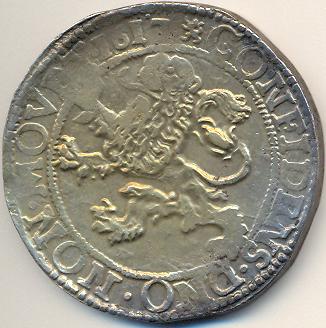  Dutch leeuwendaalder (lion dollar) 1617, province of Friesland. No, that's not an artifact of the scanner - it really is that funky yellow colour. The Dutch were in a hurry and used whatever alloy came to hand to belt these coins out; it often wasn't very high quality, or very well mixed. Still, they were a popular trade coin in their day. Large quantities of them ended up in Eastern Europe; a fact attested to by the names of the Romania and Bulgarian units of currency, leu and lev respectively, both named after the leeuwendaalder. They weren't popular in Britain, though - locals called them "dog dollars". Don't say "infinitely" when you mean "very"; otherwise, you'll have no word left when you want to talk about something really infinite. - C. S. Lewis
|
|
Bedrock of the Community
United States
14454 Posts |
all I know as soon as I see someone has asked to identify a coin I usually see if its something I know about and if it isn't I dont bother clicking on it again until after I see that you have answered
|
|
Pillar Of The Community
3147 Posts |
Well Sap has already given you the answer as I was hoping to say 4 phone books myself. One has to see the Krause catalogs to see the HUGE amount of coins that have been struck throughout our world. From 1600 to now is an astonishing collection of coinage that is BEYOND BELIEF! Throw in the coins prior to 1600 and the number is unconceivable!!!
|
|
New Member
 United States
2 Posts |
Thank you very much for the ID! Yours looks much better than mine Sap. 
|
|
Pillar of the Community
United States
5362 Posts |
That Lion Dollar looks very bad to me. The edge seems too well preserved for a sea salvaged item. Looks more like a modern white metal casting like the tourists pick up on flea markets.
Edited by swamperbob
11/12/2006 01:00 am
|
|
Bedrock of the Community
United States
14454 Posts |
whichen? saps or the othern?
|
|
Pillar of the Community
United States
5362 Posts |
Bryan1315 - I was referring to the initial post. The second coin looks fine to me.
|
| |
Replies: 9 / Views: 2,017 |
|







 Posted 11/10/2006 07:18 am


