|
This page may contain links that result in small commissions to keep this free site up and running.

Welcome Guest! Registering and/or logging in will remove the anchor (bottom) ads. It's Free!
To participate in the forum you must log in or register. | Author |
 Replies: 12 / Views: 3,500 Replies: 12 / Views: 3,500 |
|
|
Pillar of the Community
United States
509 Posts |
Received it today and WOW what a huge disappointment ! I was expecting a big improvement in focus/clarity/definition/sharpness and macro capabilities. My Nikkor 75mm seems to do just as well if not better. I really can't see any difference. I'm not concerned so much in these images with color and lighting as I am in focus, definition and clarity. I know the lighting and colors are off aned there are variances in ISO and exposure times due to the differing apertures. Best at f/5.6  Best at f/8  Best at f/11  Best at f/16  Suggestions? Am I doing something wrong? Is there another nut loose in the cockpit? Were these enlarging lenses really designed for this type of photography or should I just bite the bullet and go for a Nikon-L? |
|
|
|
Pillar of the Community
 United States
4048 Posts |
Something must be wrong with the lens. The 105EL is one of the better enlarging lenses, technically better than the 75EL. It should give a result that is nearly as sharp as a 105VR Micro-Nikkor in the middle, and sharper on the edges at equivalent apertures. Is it clean and clear all the way through? If you shine a flashlight through it do you see any haze, lots of dust, fungus, etc? Could the lens be loose on the mount, or one of the lens elements be loose and moving around when you take the picture? Your pics look like they are just a bit out of focus. The whole surface of the coin is out of focus, so it's not a field flatness issue like would be the case if it had been disassembled and reassembled incorrectly. Does your setup have sufficient travel to focus properly? Can you post a focus sequence, ie at f/5.6 focus a little above the high points of the design so all is a bit out of focus on the high side, then directly on the highest points of the design, then on the lowest areas of the coin surface, then a little lower so all is a bit out of focus on the low side? These 4 pics may help with debugging. This image was taken with a 105EL, so I know in general the lens should be capable of good results:  |
|
Pillar of the Community
 United States
509 Posts |
That's a really sharp image Ray. Far more so than I've been able to get with the same lens. This image is back on the 75mm at f/5.6 You can see it's sharper than the 105mm shot I posted at f/5.6 Thanks for your suggestions -- yes my setup has the travel room to focus and then some. Cleaned the outside of the lens again with cleaning kit but there does appear to be some haze on the inside but no dots or specks. Could have some minute dust in there that's not apparent. As to fungus, I wouldn't know what to look for even though I did shine a flashlight through it. Watched the aperture blades as I went through all the settings. They appear to be working just fine. Nothing appears to be loose that I can tell. Is there a way to tell if one of the lens elements is loose? Don't seem to have anything rattling around. Would you suggest opening it open to try and get rid of that haze? I'm more than a bit hesitant to do it as I may damage it even more not knowing what I'm doing. Maybe a camera shop could take a look at it.  Edited by Sidekick-CA
07/03/2011 2:35 pm
|
|
Rest in Peace
United States
1729 Posts |
Maybe it's obvious - and I'm missing it - but are you shooting "raw" pix of coins via this lens attached to a camera body (4x5 plate film? film camera? digital camera?), or are you projecting pix via film images onto enlarging paper?
I agree that the images are slightly out of focus, and of course if you're shooting film images, the original setup could be to blame, or if digital, the focal plane of the lens might be just far enough to project an out-of-focus image onto the imaging apparatus but in-focus on your screen and eyepiece.
|
|
Pillar of the Community
United States
509 Posts |
Quote:
pls - if digital, the focal plane of the lens might be just far enough to project an out-of-focus image onto the imaging apparatus but in-focus on your screen and eyepiece. Can you explain that in "cameras for dummies 101" language? I'm just getting to know this stuff. I'm using a Canon digital in .jpg format. The lens is mounted to the camera via a bellows with which I do the focusing. The whole thing is tethered to my computer but I don't have the "live preview" option. The only way I know I'm at optimum focus is to adjust it as much as possible through the viewfinder, take the shot then see how it looks on my screen. If necessary I adjust the bellows for focus and repeat until I have the clearest possible image. The viewfinder is rather small and really doesn't give me the definition I need. Edited by Sidekick-CA
07/03/2011 4:01 pm
|
|
Moderator
United States
23522 Posts |
Just a guess: I note you're at ISO 200 and 1/6sec exposure. You gotta speed up that exposure and get more light onto the coin. By comparison, rmpsrpms' Lincoln image was shot at 1/60 with ISO1000, which will gather a heckuva lot less light than ISO100 at 1/6. Go to ISO100 to minimize the possibility of noise, hood the lens in some fashion so that only light coming from the coin reaches it, and get some more candlepower into the setup. Don't forget, though, you're learning on the most difficult of all possible coins - lustrous silver. Here's your last image after 30 second in the Gimp: 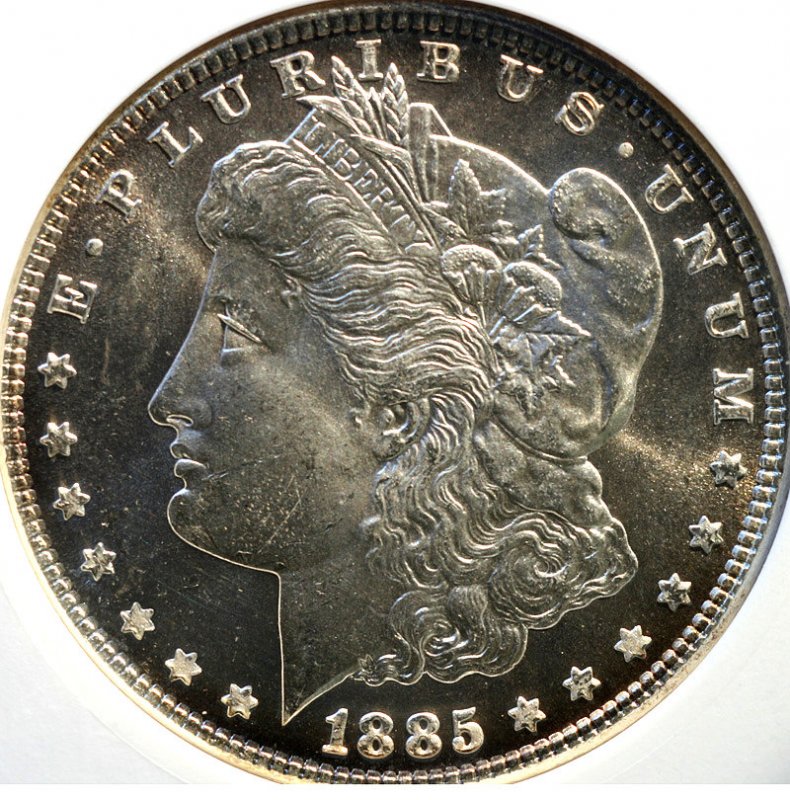 |
|
Rest in Peace
United States
1729 Posts |
Quote:
pls - if digital, the focal plane of the lens might be just far enough to project an out-of-focus image onto the imaging apparatus but in-focus on your screen and eyepiece. Quote:
Can you explain that in "cameras for dummies 101" language? I'm just getting to know this stuff. I'm using a Canon digital in .jpg format. The lens is mounted to the camera via a bellows with which I do the focusing. The whole thing is tethered to my computer but I don't have the "live preview" option. The only way I know I'm at optimum focus is to adjust it as much as possible through the viewfinder, take the shot then see how it looks on my screen. If necessary I adjust the bellows for focus and repeat until I have the clearest possible image. The viewfinder is rather small and really doesn't give me the definition I need. Ha - sure. I suspect that you simply cannot see the image clearly enough to tell when it's in focus. And SuperDave has provided the solution - more light, faster shutter speed, and if you can get enough light on the coin to shoot it at a smaller aperture than f/5.6 (say, f/8 or even f/11), you will increase your focal depth, or in other words the area that is in clear focus. At 1/6 of a second shutter speed, camera shake/lens + bellows shake may be a problem, and a faster shutter speed will reduce the shakes. |
|
Pillar of the Community
United States
4048 Posts |
Quote:
I note you're at ISO 200 and 1/6sec exposure. You gotta speed up that exposure and get more light onto the coin. By comparison, rmpsrpms' Lincoln image was shot at 1/60 with ISO1000, which will gather a heckuva lot less light than ISO100. As you can tell from the image data and from previous comments on other threads, I am much more conscious of camera movement causing problems with resolution than I am on light gathering. I am even considering moving away from Nikon and toward Canon due to their Electronic First Curtain Shutter which reduces effects of shutter vibration. Nikon's Live View reduces the mirror bounce issue, but there is still some latent vibration due to the shutter itself. Sidekick-CA, what camera are you using? If Nikon, are you shooting in Live View? Since the problem got worse with a longer focal length lens, this points toward camera shake as at least part of the problem. Longer lenses are more prone to camera shake issues than shorter lenses due to the longer working distance for same magnification (remember geometry class?). I have seen this effect on my setup going from a 105EL to 135EL and then to 150EL. I have never been able to get as sharp an image from the 150EL as the 105EL, even though technically the 150EL is superior. Whenever you have a clear image in the viewfinder or on the Live View screen, and your final image is inferior, camera shake is the most likely culprit. Because of the above, and contrary to popular wisdom, I always recommend going with the shortest lens you can get away with. You need to be able to get proper lighting onto the coin, but there are many ways to do this even with short working distances. I find that lenses like the 55mm Micro-Nikkor are a bit too short to be flexible enough with lighting, making it hard to take advantage of such a superb lens. they also shorten focal length at closest focus (as do most modern Macro Lenses) so the effective focal length when taking coin photos is even shorter. Enlarging lenses can't do this, so you will likely notice your working distance is much longer on a 105EL as compared to a 105VR for instance. The 105VR is more like a 75mm lens at 1:1. I am also concerned that you can see haze in the lens without shining a light through it. This is likely at least another part of the problem. If you like, you can send the lens to me and I can troubleshoot it for you. Is the lens the older or newer version? The older one has a chrome-plated mount and takes 34.5mm lens cap. Newer has all-black plastic casing and takes 40.5mm lens cap. I've found image quality to be similar on both, but the older ones are easier to clean. |
|
Pillar of the Community
United States
509 Posts |
Thanks for all that very good info. Think I'm going to hold off on trying to clean the lens internally until I can start playing with some of the options/possibile scenarios given here. It seems I've been under some misconceptions. First is using the higher ISO--I'd always read the higher the ISO, the more noise would be induced (digital photography) and could be a contributing factor in grainy photos. So I've always tried to keep it down as low as possible. I don't think I've ever shot above 400 but in looking at my 400D my ISO options jump from 800 to 1600 with nothing in between. The other thing I was mistaken about was camera shake. I thought it didn't exist as long as the camera was firmly mounted on a stable tripod/copystand and I was using a timer or remote shooting. Now it seems there's even lens and bellows shake, shutter vibration. So using more candle power, speeding up exposure time and using a smaller aperture would seem to make sense.
|
|
Moderator
United States
23522 Posts |
It occurs to me that I didn't word some of my last post cleanly enough; I've edited it slightly as a result. My main interest in asking you to go to ISO100 was to minimize any possibility of noise, and sort of edge you in the direction of maybe too much light instead of too little.
Even going to ISO800 won't improve that 1/6 to more than 1/20, and every stop smaller of aperture costs you a step of slower exposure. I wouldn't take a Digital Rebel above ISO400 - noise is really noticeable at ISO800 - and I've always tried to stay at ISO100-200.
|
|
Bedrock of the Community
United States
10045 Posts |
Quote:
Since the problem got worse with a longer focal length lens, this points toward camera shake as at least part of the problem. What's the range of shutter speed for ~105-200mm macro lenses where this is a problem? Back when I had Nikon dSLRs with a 55 and 60mm micro, I found that I reduced shake greatly by getting an electronic shutter release. Of course, my photography never had the exactitude where I would notice shutter bounce.  In retrospect, I could have used a longer lens to reduce shadow effects on the coin. As the photos illustrate so well, camera technique has a huge effect on results.  Edited by DVCollector
07/04/2011 1:15 pm
|
|
Pillar of the Community
United States
4048 Posts |
You can gauge your setup's susceptibility to shake, both from the camera operation or external influences, by putting it in live view or equivalent and giving your setup a bump. The more things wobble around, and the longer they wobble, the worse off you will be. Even if you just sit and watch the image on screen or on a monitor, you will see occasional and random movements. You need to be at 100% magnification to see this clearly. These small movements really mess up the image when long exposures are used, and are a form of noise in the image just like shooting at High ISO. I can't tell you what kind of problem your setup will have for a given lens length, only that the shorter the working distance for a given magnification (ie shorter lens) the fewer problems you will have with this "motion noise". And for a given length of lens, the more you bolt the setup together so nothing can move around relative to anything else, the better.
|
|
Pillar of the Community
United States
509 Posts |
Well Guys, I'm just about ready to throw in the towel on this Nikkor 105mm. Have spent many hours experimenting--camera settings, lighting variations, camera mount, copy stand, bellows, leveling, camera shake, you name it I've gone through it but the results I'm looking for have not been forthcoming. Given the hours of effort, it's just not worth anymore time. This lens, on a good day just barely compares to my Nikkor 75mm, if that. I know what it's capable of as I've seen some of the images but obviously this one has problems. I'm somewhat happy with the Nikkor 75mm lens compared to the Canon 18-55mm lens I was using and it really has been an enjoyable challenge using it with the bellows knowing I'm going to get good results but....not good enough. So I'm absconding from the manual focus/bellows crowd to the point n shoot AF lens crowd. Just ordered this one today on ebay -- http://cgi.ebay.com/ws/eBayISAPI.dl...TRK:MEWNX:ITAs SD says, the glass costs more than the camera but that's just the way of it and not without reason. Both of you guys have more than bent over backwards in trying to help me and I've learned a lot. A LOT. And you can be sure I'll be back to avail myself of your expertise even if I am going "automatic". |
| |
Replies: 12 / Views: 3,500 |
|
To participate in the forum you must log in or register.
Disclaimer: While a tremendous amount of effort goes into ensuring the accuracy of the information contained in this site, Coin Community assumes no liability for errors. Copyright 2005 - 2026 Coin Community Family- all rights reserved worldwide. Use of any images or content on this website without prior written permission of Coin Community or the original lender is strictly prohibited.
Contact Us | Advertise Here | Privacy Policy / Terms of Use
|
| Coin Community Forum |
© 2005 - 2026 Coin Community Forums |
| It took 0.48 seconds to rattle this change. |
 |
|
| |
| |







 Posted 07/03/2011 2:32 pm


