| Author |
 Replies: 11 / Views: 1,699 Replies: 11 / Views: 1,699 |
|
|
Valued Member
United States
232 Posts |
I recently read a post, not real sure where but was on here. I was just scrolling for learning purposes, I do that when I can. someone posted a pic about a die chip and it was stated that die chips were easily noticed by a sharp edge? I was curiuos as to this post, Is this true? When I find a coin with an extra addition of metal on top of a strike ( something that is like a blob and not a DD or anything) I chalk it up to a die chip, but I have seen those that are smooth and rounded like a drop of metal that dripped or something. am I right on this or should I classify these as something else? I know this is probably a wasted post till I have a pic but was hoping someone would be able to clarify.
|
|
|
|
Valued Member
United States
366 Posts |
I think that you (or the post you read) may have confused a die chip and a die crack. A die chip is, as you have said, appears to be a bit of extra metal on the coin. The die crack is produced in the die in a similar fashion, but is more of a jagged line which may be said to be 'sharp'. I can't see any other die problems that would appear sharp, as after striking a few coins, the die imperfection would be rounded out with the pressure and metal-on-metal impact.
|
|
Moderator
 United States
56855 Posts |
Quote:
rounded like a drop of metal maybe a Cud? Also have you tried using the search box upper left of page? Type in a few key words and you may find the post you are talking about. John1  |
|
Bedrock of the Community
United States
62064 Posts |
Die cracks are usually uneven and not in a straight line. Die chips are from cracks and some material on the die is missing now making a raised area because the die is no longer complete and can't shape that area any longer. (Not extra material. The planchet only starts out a certain size. So the planchet is not formed in that area of the chip) Die breaks show a more complete lack of die material missing usually following the direction the die takes. Cud is where an area of the die breaks off. Coins that are struck show a larger area un-formed in that area. Also the opposited size of the coin is weak because of the lack of resistance from the missing part of the die on the opposite side. |
|
Valued Member
 United States
232 Posts |
I'm sure I was getting the two mixed up, I was just surfing and did not pay much attention to the post, but later found a coin that did not look like the normal die break that I usually find. I passed it on because I figured it was just a chip, but thought I should ask for future purposes. thanks for the info though. a Cud only appears on the rim though, right? another thing that has been bothering me is something like the pic below. Would this be PMD, a die crack that has deteriorated or something else? It may be hard to see in the pic, but looks like the surface is cracked and begining to chip away? 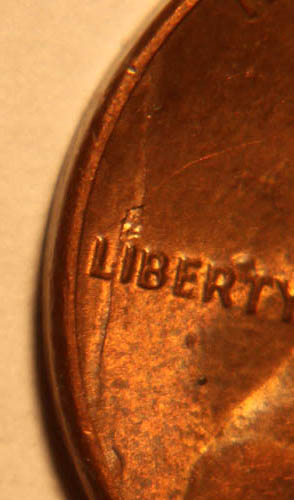 |
|
Moderator
United States
56855 Posts |
What is the date of the coin? John1 |
|
Pillar of the Community
United States
7629 Posts |
The post you likely read was mine. Die cracks and die chips are two different things. Your question was about die chips, so I will address that. Lincoln cents from 1982 to date have a tendency to exhibit bumps. Most of these are simply crud underneath the copper bath that reacts with the zinc underneath and swells. We call them "gas bubbles" and they have soft edges. In other words the edges blend in with the field. Die chips are pieces that break out of the die leaving extra cavity for the metal of the coin to fill in. They always have very well-defined hard edges. That's one of the easy ways to tell gas bubbles from die chips. Another easy way to tell gas bubbles from die chips is that die chips do not just happen in random places. They happen because of a specific weakness in some area of the die. For instance the "BIE" die chips in LIBERTY. Those happen because the little stump between the B and E is a weak point and tends to break. Die chips always have some "reason" to form. Gas bubbles can happen anywhere on the surface of the coin without regard to the design at all. So many people were getting the two confused (not sure how, they look completely different) and I used the hard edges as one of the main determinants to support detecting dies with breaks - whether it be die chips, die cracks, or broken dies and Cuds. Edited by coppercoins
08/14/2011 08:37 am
|
|
Rest in Peace
United States
9104 Posts |
tershaffer-
looks to me like a lamination cused by bad alloy mix on the planchet.
|
|
Pillar of the Community
United States
7629 Posts |
looks to me like a lamination cused by bad alloy mix on the planchet.
Except there are no alloys on a zinc cent. They are pure zinc bathed in pure copper.
|
|
Rest in Peace
United States
9104 Posts |
OK, bad term. Even in a non-alloy metal, there can be imperfections causing such a splitting, tho you're right, it's more likely to occur in an alloy being mixed.
|
|
Valued Member
United States
232 Posts |
thanks for breaking down the differences. I'm assuming since these are imperfections they carry no premium so just move on when I find one, whether crack, chip or bubble? As for the coin posted it is a 1985D. Is this an example of a lamination error and do these carry a premium? just trying to figure out what I should hold onto and what to take back to the bank. I personally would prefer collecting RPM's and DD's for my persoanl collection, but anything that I can sell off to fund my own collection would help.
|
|
Rest in Peace
United States
9104 Posts |
You never know what something like that will bring on ebay or when you can sell on ccf. A rule of thumb is the more glaring the error, the better the price. |
| |
Replies: 11 / Views: 1,699 |
|







 Posted 08/09/2011 06:08 am


