


 Posted 08/09/2011 6:43 pm


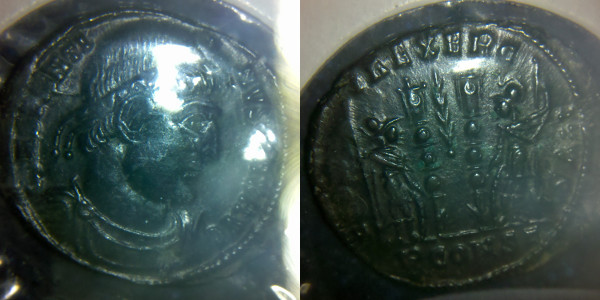
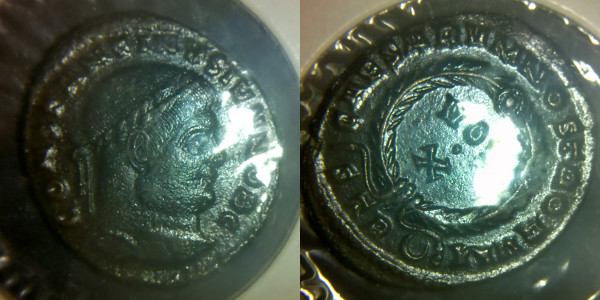
Neither are Roman.
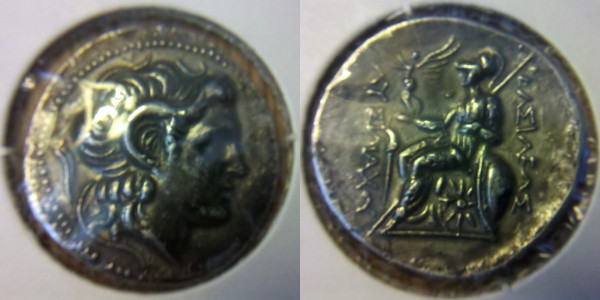
The top one says "BASILEWS LYSIMAChOY" in Greek - King Lysimachus of Thrace, one of the successors of Alexander. The seated figure is not Zeus/Jupiter; he's always bearded and bare-chested, never armoured and helmeted. This is Athena.
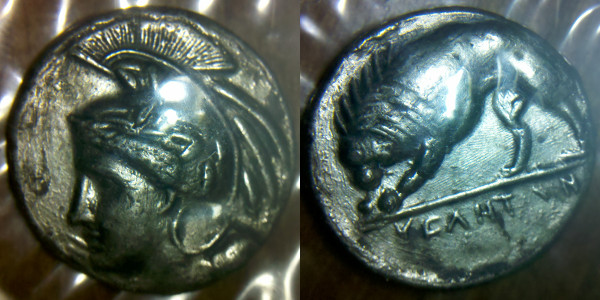
The second one is a design I'll never forget, thanks to this old thread - a silver numos from Velia, a Greek colony in Italy not far from Rome.
Unfortunately, like the Velia example in the above thread, I believe both of these coins may be cast fakes. Is there any trace of a seam around the edge?
The top one says "BASILEWS LYSIMAChOY" in Greek - King Lysimachus of Thrace, one of the successors of Alexander. The seated figure is not Zeus/Jupiter; he's always bearded and bare-chested, never armoured and helmeted. This is Athena.
The second one is a design I'll never forget, thanks to this old thread - a silver numos from Velia, a Greek colony in Italy not far from Rome.
Unfortunately, like the Velia example in the above thread, I believe both of these coins may be cast fakes. Is there any trace of a seam around the edge?
Don't say "infinitely" when you mean "very"; otherwise, you'll have no word left when you want to talk about something really infinite. - C. S. Lewis