












 Posted 08/10/2011 4:53 pm


nicolashsing The white color could simply be a re-plating with a metal of a different color. I have seen many examples of older silver coins that were at some point re-plated with a thin silver coat or Antimony or even tin. The color of the electro-plate is always incorrect because it is a deposit of pure metal and an 8 Reale was made of an alloy of silver AND COPPER. Since you can not electro-plate with an alloy - that is why electroplates stand out like sore thumbs.
It could also be a paint application or a dip. I have seen several coins painted to cover toning and dirt. In one case, from ebay, about 8 years ago, I purchased a cast 8R for about twice the silver value. It was rather obvious in the pictures that it was a sand cast copy - perhaps a Sinaloa coin. The sand grains were clear. When it arrived - I found that what I had been sent was an original cull 8R dipped in a thin glue - rolled in sand and spray painted silver. I got a real kick out of being fooled like that.
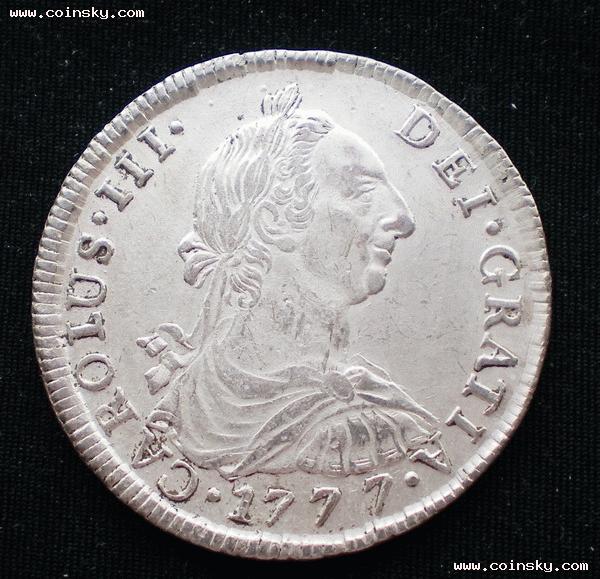
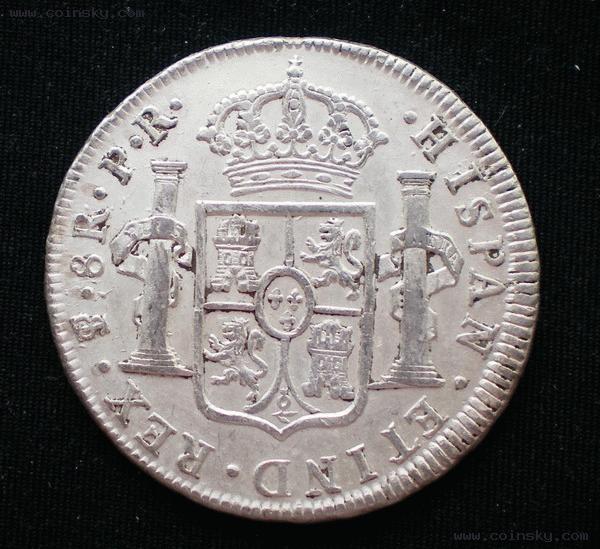
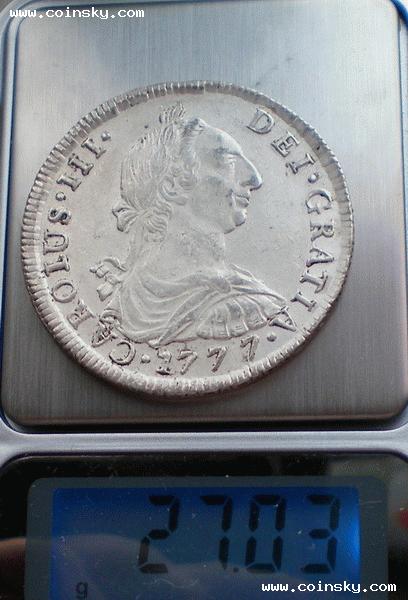
But back to the 1777 coin in question, I am not an expert on the Bolivian mint and the way they made dies - but if this were from Mexico City I would conclude it was a FAKE beyond virtually any doubt.
The reason for this conclusion is the application of the dentils. The dentils do not form a good circle. The dentils were an early device used to make clipping or shaving of a coin more obvious. They were punched into the die in SEGMENTS. The punch used to apply segments was cast in the die shop from a standard "punch block". The punch block that is shown in Gilboy's book (near the end) shows clearly that there was a short arc segment of dentils used to impress several dentils at ONE TIME. I have confirmed this with the coins from the mint at Mexico City but I have never undertaken a study with any of the other branch mints. The punch block illustrated was from Spain at the conclusion of the Pillar series and die making did not change rapidly in that time period. The Mexico City mint DID use the mainland technique for die creation - including making element punches from standard die blocks. I can not believe that Bolivia (being part of the same administrative entity) did not use similar punch blocks. They were used to insure UNIFORMITY of the coins.
To create the circle of dentils the procedure was as follows. A lightly scribed circle was used as a pattern and the dentil punch was used around the edge. The application was side to side with the arc line near the tips of the inner end of the dentils. Some dies show traces of this arc. The dentils began and ended at one point BUT the seam is often difficult or impossible to locate. At Mexico City this arc segment is I believe 4 dentil segments long. (I am not at home so I can not check). But it was definitely a SERIES of dentils punched as a group.So what you really have are a series of 4 segment "chunks" punched to make a circle. The arc line was usually polished off the finished die along with all other setter's marks before the die went into service.
But on this coin if you start at the first 7 and work toward the third 7 you can see clearly that the dentils were punched in variable lengths. I count 2-2-6-2-1-3-2-4 etc - a variable pattern of dentils that may in fact point to a die that was finished incorrectly and may be a forgery. Remember, if the design was transferred from a coin missing the dentils or if the dentils did not transfer well - the forgers would have simply added dentils to their die by engraving. That is what this looks like to me.
I am not saying that they always did a great job in aligning the segments - BUT the arc length of the punch DID NOT CHANGE. If there were oddly aligned segments 4-4-4-4-4 or 3-3-3-3-3 I could accept it, but not a random mix of lengths.
I am sorry to once again throw a wet blanket so to speak on a posting. But where many people see originals, I check details of die manufacture and striking technique and see forgeries.
Perhaps that is why I spot a greater number of forgeries on ebay than other spotters.
In this case, as in all cases, I stand to be corrected. If anyone can find a photograph or record of a different punch being used for Dentils at Bolivia - please let me know. I am always finding small references hidden in letters and old books that revise (and refine) my understanding of die manufacture.
It could also be a paint application or a dip. I have seen several coins painted to cover toning and dirt. In one case, from ebay, about 8 years ago, I purchased a cast 8R for about twice the silver value. It was rather obvious in the pictures that it was a sand cast copy - perhaps a Sinaloa coin. The sand grains were clear. When it arrived - I found that what I had been sent was an original cull 8R dipped in a thin glue - rolled in sand and spray painted silver. I got a real kick out of being fooled like that.
But back to the 1777 coin in question, I am not an expert on the Bolivian mint and the way they made dies - but if this were from Mexico City I would conclude it was a FAKE beyond virtually any doubt.
The reason for this conclusion is the application of the dentils. The dentils do not form a good circle. The dentils were an early device used to make clipping or shaving of a coin more obvious. They were punched into the die in SEGMENTS. The punch used to apply segments was cast in the die shop from a standard "punch block". The punch block that is shown in Gilboy's book (near the end) shows clearly that there was a short arc segment of dentils used to impress several dentils at ONE TIME. I have confirmed this with the coins from the mint at Mexico City but I have never undertaken a study with any of the other branch mints. The punch block illustrated was from Spain at the conclusion of the Pillar series and die making did not change rapidly in that time period. The Mexico City mint DID use the mainland technique for die creation - including making element punches from standard die blocks. I can not believe that Bolivia (being part of the same administrative entity) did not use similar punch blocks. They were used to insure UNIFORMITY of the coins.
To create the circle of dentils the procedure was as follows. A lightly scribed circle was used as a pattern and the dentil punch was used around the edge. The application was side to side with the arc line near the tips of the inner end of the dentils. Some dies show traces of this arc. The dentils began and ended at one point BUT the seam is often difficult or impossible to locate. At Mexico City this arc segment is I believe 4 dentil segments long. (I am not at home so I can not check). But it was definitely a SERIES of dentils punched as a group.So what you really have are a series of 4 segment "chunks" punched to make a circle. The arc line was usually polished off the finished die along with all other setter's marks before the die went into service.
But on this coin if you start at the first 7 and work toward the third 7 you can see clearly that the dentils were punched in variable lengths. I count 2-2-6-2-1-3-2-4 etc - a variable pattern of dentils that may in fact point to a die that was finished incorrectly and may be a forgery. Remember, if the design was transferred from a coin missing the dentils or if the dentils did not transfer well - the forgers would have simply added dentils to their die by engraving. That is what this looks like to me.
I am not saying that they always did a great job in aligning the segments - BUT the arc length of the punch DID NOT CHANGE. If there were oddly aligned segments 4-4-4-4-4 or 3-3-3-3-3 I could accept it, but not a random mix of lengths.
I am sorry to once again throw a wet blanket so to speak on a posting. But where many people see originals, I check details of die manufacture and striking technique and see forgeries.
Perhaps that is why I spot a greater number of forgeries on ebay than other spotters.
In this case, as in all cases, I stand to be corrected. If anyone can find a photograph or record of a different punch being used for Dentils at Bolivia - please let me know. I am always finding small references hidden in letters and old books that revise (and refine) my understanding of die manufacture.
Edited by swamperbob
08/10/2011 4:55 pm
08/10/2011 4:55 pm


