| Author |
 Replies: 13 / Views: 5,636 Replies: 13 / Views: 5,636 |
|
|
Pillar of the Community
Australia
3839 Posts |
|
|
|
|
Pillar of the Community
United States
1064 Posts |
Very cool! Can't say I've ever even heard of Antimony - guess it never caught on!
|
|
Bedrock of the Community
Australia
21789 Posts |
gxseries: How did you get this coin?
I like to collect coins that are unusual, but for me to qualify for my collection, they must have been actually used as or intended to be used as money, not NCLT.
|
|
Moderator
 Australia
16963 Posts |
The Kweichow antimony 10 cents has been on my wantlist ever since I first wrote a wantlist. Excellent score!  Don't say "infinitely" when you mean "very"; otherwise, you'll have no word left when you want to talk about something really infinite. - C. S. Lewis
|
|
Pillar of the Community
United States
1388 Posts |
Wow, a coin on Saps' wantlist is a score indeed  ... Nice find |
|
Valued Member
United States
286 Posts |
wow those are quite pricey!
|
|
Bedrock of the Community
United States
10045 Posts |
What an interesting coin! Antimony/lead alloys are a common "base metal" for plated objects.
I wonder if any replica coins use this same alloy?
|
|
Pillar of the Community
 Australia
3839 Posts |
sel: these did circulate but obviously they weren't popular. You can tell that mine is a rather worn condition. I know at least six other people that want an example of this coin (including you Sap) and hence had to fight out in an ugly price war.
Thanks everyone!
|
|
Pillar of the Community
United States
819 Posts |
gx series, you are probably well aware of this fact, but others may not be.
Antimony is in fact a toxic chemical. Wiki gives the name as stemming from the French which means "Monk Killer." Interesting tidbit!
|
|
Rest in Peace
United States
1729 Posts |
gxseries - I'd be interested to know what qualities of the coin in the pic (besides what you mentioned) convinced you that it was genuine. I would think that these would be heavily counterfeited. Maybe even in China, lol.
|
|
Pillar of the Community
Australia
3839 Posts |
Actually I wasn't well aware of it Ellekitty until I was given warning by other people. Joke is on me.
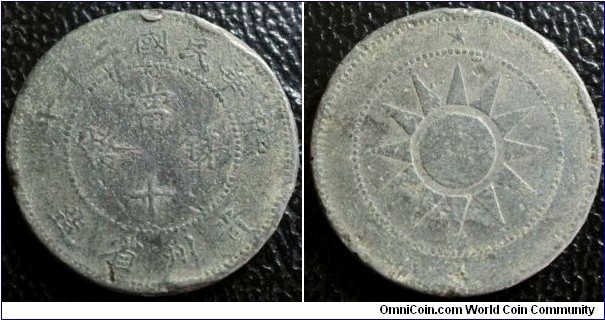
pls, if this was a lead coin, it should have make some kind of metallic noise when I did the light knock test. Like how silver gives a sharp noise when you drop it, and other metal gives some kind of distinct noise, this, this was nothing like I know, hence a "metalloid" coin even though it does look like one. It's just odd by all means.
There's another forum member here that furiously bid against me on this coin. He reckons from the die design alone, it matches known genuine coins. This coin has also matched the density of antimony from simple calculation that I did the other day. I didn't have a caliper but it should be pretty close.
Thickness: 2mm - I'll say 2.1mm
Diameter: 21mm - Maybe 21.1mm here as well.
Edge: Smooth, one part is banged up.
Weight: 5.02g
Antimony's density: 6.697 g·cmâˆ'3
Lead's density: 11.34 g·cmâˆ'3
(From Wikipedia)
Volume of coin: ~0.734cm3
Weight of coin: 5.02g
Density of coin: 6.84g/cm3 - pretty close to the density of antimony (!)
Of course, the last thing I need to do is to send it for XRF to show a detail analysis of the alloy. The seller was selling panda coins that were easily thousands of dollars and they were all genuine.
Would be interesting but I still need to find a lab to do it for me as well as not losing this expensive coin.
My partial coin collection http://www.omnicoin.com/collection/gxseriesMy numismatics articles and collection: http://www.gxseries.com/numis/numis_index.htmRegularly updated at least once a month. |
|
Pillar of the Community
United States
5362 Posts |
Antimony mixed with lead is a staple metal alloy used in counterfeiting (especially in the early 1900s).  But it is toxic (in the same family as arsenic) and handling a coin made from antimony can be hazardous. Wash your hands if you handle that coin or any counterfeit for that matter it. They can make you ill.  In the 1960s one of the techniques used by some counterfeit detectors was to taste the coin. NOT A JOKE. But the ANA published warnings about that practice because of antimony and arsenic found in forgeries - especially contemporary counterfeit coins. Based on my limited testing of Mexican coins using XRF - arsenic is also a trace contaminant found in most Mexican silver deposits and I did find a few original coins with readings approaching 100ppm. Counterfeits can run 10x that much. As a toxin antimony behaves a lot like arsenic and builds up over time in your body. So be careful. I suppose if you licked your coin once a day you might develop an immunity to antimony like the killers do to arsenic in the old movies  That was a joke.  |
|
Pillar of the Community
United States
1691 Posts |
|
|
Rest in Peace
United States
1729 Posts |
  The above is one of two coins under discussion and in my possession, or at least in my safe deposit box. The other has just been adjudged as a "contemporary counterfeit" by one of the big three grading companies (I forget which one - a friend who has a membership sent it in for grading.), and by association - the fact that I found them in the same bag - I suppose this one is too. Now you know the rest of the story - why I've been so interested in this particular coin's authenticity. I really hope yours is the real antimony, gxseries. |
| |
Replies: 13 / Views: 5,636 |
|











 Posted 08/16/2011 09:52 am


