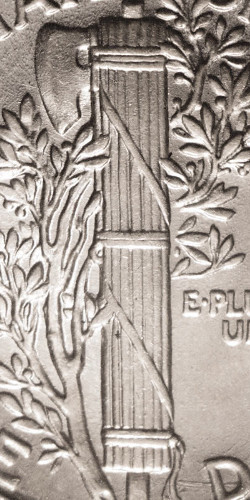
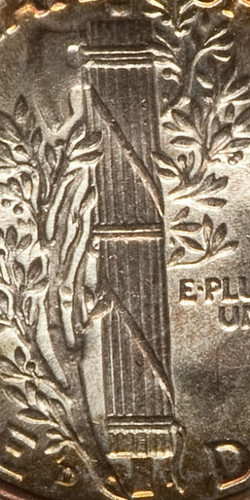
Your answers are very interesting! My own answer would be that the one on the left is a nice strike, but not quite full bands. The one on the right is full bands, but a later die state.
In fact, the white one on the left is a 1945 graded PCGS MS-66 FB, and
it went at auction for $17,250. The toned one at the right is a 1945-D graded NGC MS-66 but with no FB designation, owned by me and purchased at an entirely reasonable price. In hand, it is a very nice looking coin and clearly full bands (it's the one I posted a little while back on the grading forum).
1945 is a date known for really poor strikes, and 1945-D and other later date Denver
Mercury dimes are known for really nice strikes. I searched on heritage for full-band 1945 dimes, just to see what such a notorious rarity really looks like and goes for. I was blown away that borderline cases like this went for so many thousands of dollars. There are some very similar coins (maybe 95% separated bands) that did not earn the FB designation and went for the same price as any common, poorly-struck 1945 dime. It's a very nice looking dime (it also has a neat die clash), I think MS-66 is conservative even, but $17k is completely bananas!
On the other side, I am not going to complain about two missing letters on a slab. It just meant that I got a better price on my coin than I would have otherwise.
A common piece of advice I've seen and tried to abide by since I started collecting is "buy the coin, not the slab". I've looked at a lot of uncirculated
Mercury dimes lately, raw and slabbed, and have really started to understand the truth in that advice. It's particularly important given that so many auctions on
ebay and whatnot only have pictures of the slabs, or very poor pictures of the coins.
Even if you could rely on the technical grades as accurate, you can't get a good idea of just how nice a coin is without getting a really good look at the coin itself. A coin could have a high technical grade, but be flat and lifeless. It could have a lower grade, but a really nice strike. It could have a poor strike from a worn die but lots of luster and eye-appeal.
I thought these two coins were a good example of how important that advice is.









 Posted 08/20/2011 8:25 pm





