| Author |
 Replies: 13 / Views: 2,720 Replies: 13 / Views: 2,720 |
|
|
New Member
Canada
16 Posts |
In the many dozen posts I`ve read I`ve seen a few posts with holes in coins. Here is my contribution to that: 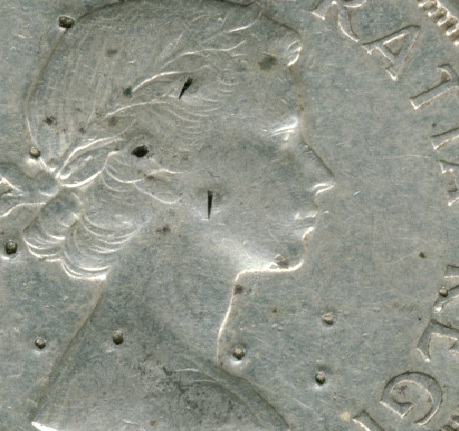 As you can see more and more holes were exposed as the coin was worn away. Seen one like this before? Frank |
|
|
|
Pillar of the Community
Canada
2303 Posts |
These appear to be centre punch marks. Man made.
|
|
Moderator
 United States
56855 Posts |
My thought is PMD. John1  |
|
Valued Member
Canada
456 Posts |
With the raised (displaced metal)rim around the punctures, it certainly appears that they were done to the coin after it left the mint.
|
|
New Member
 Canada
16 Posts |
No, if you look at the marks in the hair and cheek, you can see that holes from under the surface are beginning to be exposed as a result of wear. No one could have used a punch from the inside.....
|
|
New Member
Canada
16 Posts |
Thanks for the feedback, but you have this one wrong. I don`t how you guys get some of these great pictures. My wife says I have to spend a grand Here is a bit more of a blow up that might help a bit. Each of the holes you see is bigger under the surface. There is no metal displacement above the surface. What you are mistaking for metal displacement are the thin outside edges of the bigger holes under the surface. There are two big holes not yet fully opened and exposed on the head. These are the triangular lines. Frank 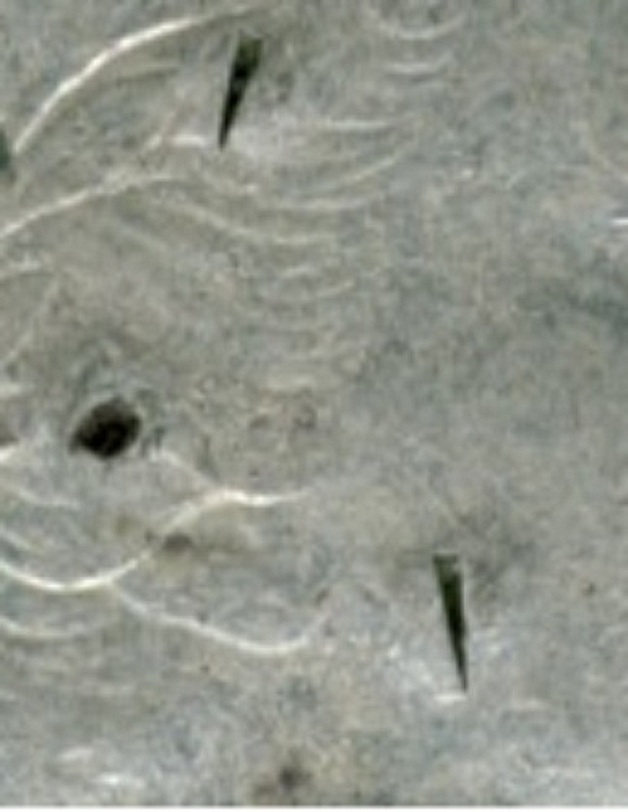 |
|
New Member
Canada
16 Posts |
Would it be so rare to have bubbles like this in the planchet? I hope so, because that is what these are. Thanks for looking everyone. Anyone seen this? Frank 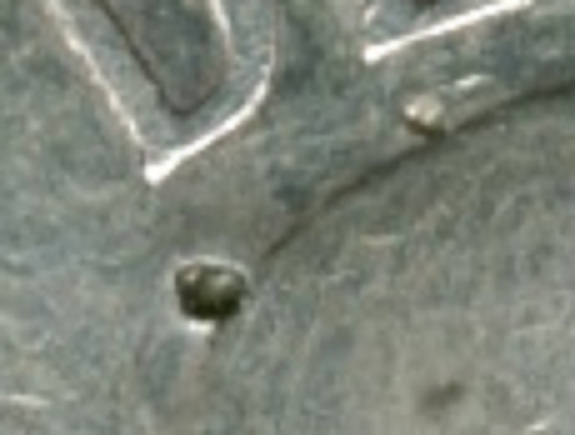 |
|
Bedrock of the Community
United States
12437 Posts |
The triangular marks are stabs from the tip of a knife blade.
|
|
New Member
Canada
16 Posts |
When I blow the pictures up, they lose all detail and you can`t see the way these marks open up under surface.
A knife or a punch cannot make a triangular opening that opens up into a bubble below. I am almost certain that this is what I am seeing. I need a microscope or better photo software. I can see it better on my computer.
I will see what I can do.
Frank
|
|
Pillar of the Community
Canada
2303 Posts |
This non error has been seen hundreds of times before. The problem is that once someone believes something......that thought can be substantiated to themselves endlessly. Sorry, I stand by the
"Centre Punch" and knife having caused the damage.
|
|
Bedrock of the Community
United States
10045 Posts |
Something to consider is how these surface features would be represented on the die (inversely). If struck this way, the raised areas around the circular pits would must be depressed in the die. Even if a planchet had sub-surface bubbles, then was struck under enormous pressure, those defects would conform to the die profile. In other words,  with the rest--it's post-mint damaged, particularly since the tools are easily identified. Edited by DVCollector
08/27/2011 10:51 am
|
|
New Member
Canada
16 Posts |
Really, thank you everyone.
I just don`t understand why the holes appear bigger below the surface. Like they open into a cavern.
A lot of knowledgeable people are telling me otherwise and I have to doubt what I am seeing.
I am going to try to get this under a scope.
Thanks for all the feedback!
Frank
|
|
Moderator
Canada
10477 Posts |
What is the denomination of the coin? If it is nickel, in the right environment, you can get corrosion which causes the coin to 'blister', you see that sometimes on George V 5c coins that have lived a hard life. It us somewhat analogous to rust blistering on the quarter panel of a car.
I think you are both right. Corrosion is causing the coin to deteriorate, and it is post-mint damage. It looks like someone poked a few corrosion blisters. Defective planchets with bubble eruptions can occur, as the gas is heated rapidly under great pressure, but they almost always occur as a single large blister, and you can see the effect of that on the other side of the struck coin.
"Discovery follows discovery, each both raising and answering questions, each ending a long search, and each providing the new instruments for a new search." -- J. Robert OppenheimerContent of this post is licensed under a Creative Commons Attribution-NonCommercial 3.0 Unported License. See: http://creativecommons.org/licenses...0/deed.en_USMy eBay store
|
|
New Member
Canada
16 Posts |
Thanks for the reply. It is a 62 50 Cent. The only thing visible on the other side is a couple of more holes.
My mind is open to all possibilities, but have to put a lot of stock in what every here is telling me.
Man made, very well could be I guess. But a Centre punch? These holes are not much bigger than pin pricks and I`ve not seen a Centre punch that small. The holes are rounded and variable on the inside, where you can see them. The holes get bigger, not smaller the deeper they go and that is not possible with a punch. The holes are also of various sizes and shapes. Sizes could be various levels of tool penetration, but that does not explain the different shapes. There are round and square edges. I also am uncertain that there is the metal displacement that some think they see. Some does really look like it but not all. THere shouldn`t be any if there was a bubble as the die pushed it.
Thank you again everyone.
I`ll put this one to bed.
Frank
|
| |
Replies: 13 / Views: 2,720 |
|







 Posted 08/26/2011 06:23 am





