| Author |
 Replies: 9 / Views: 5,037 Replies: 9 / Views: 5,037 |
|
|
New Member
United States
3 Posts |
|
|
|
|
Pillar of the Community
India
1996 Posts |
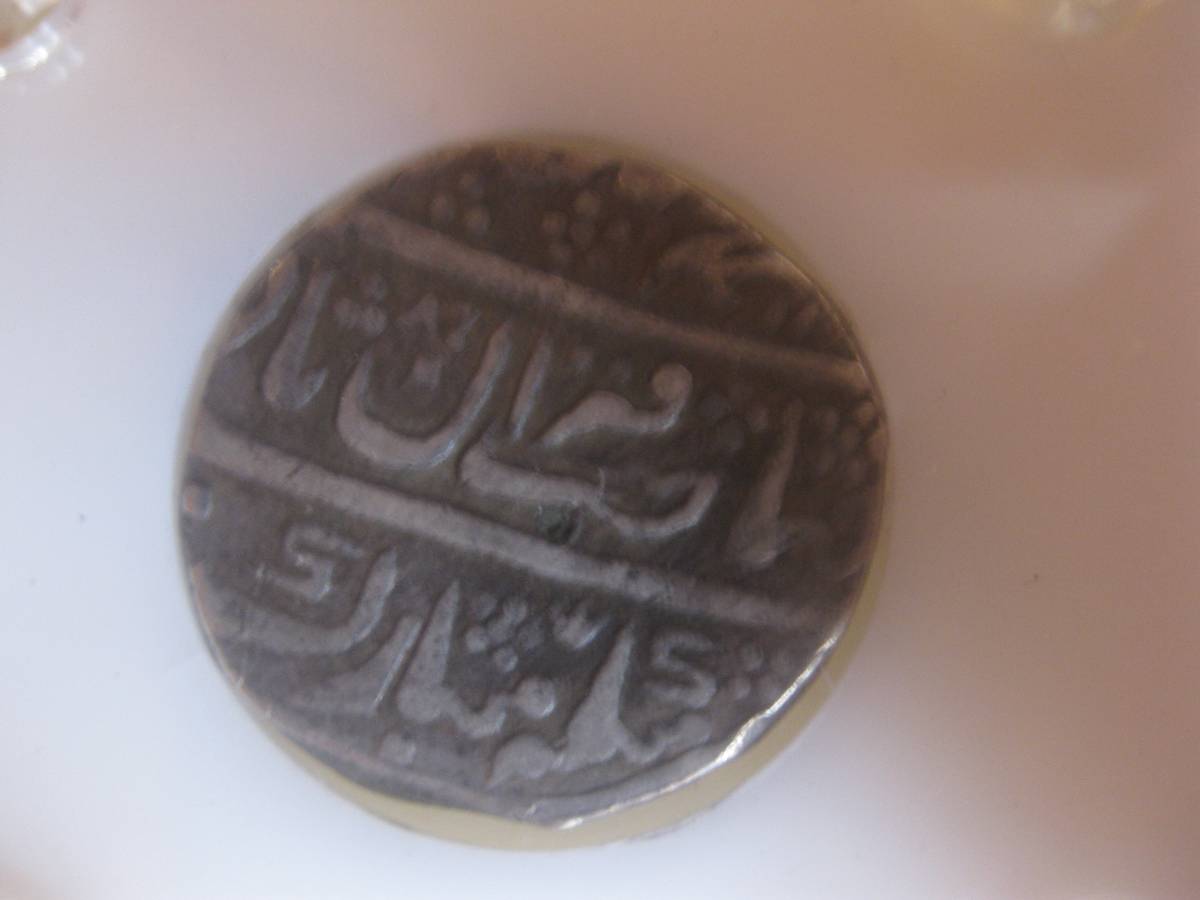
The second coin is an issue of the Princely state "Bharatpur",India. Rupee,Regnal year 22 of Shah Alam II,Ref:KM#106, Krause publications.
|
|
New Member
 United States
3 Posts |
Thanks so much, I really appreciate it! Is all that information written on the coin itself? Based on what I read, this coin has some amazing history! Can you tell me anything about the rarity or value of the coin?
|
|
Pillar of the Community
India
1996 Posts |
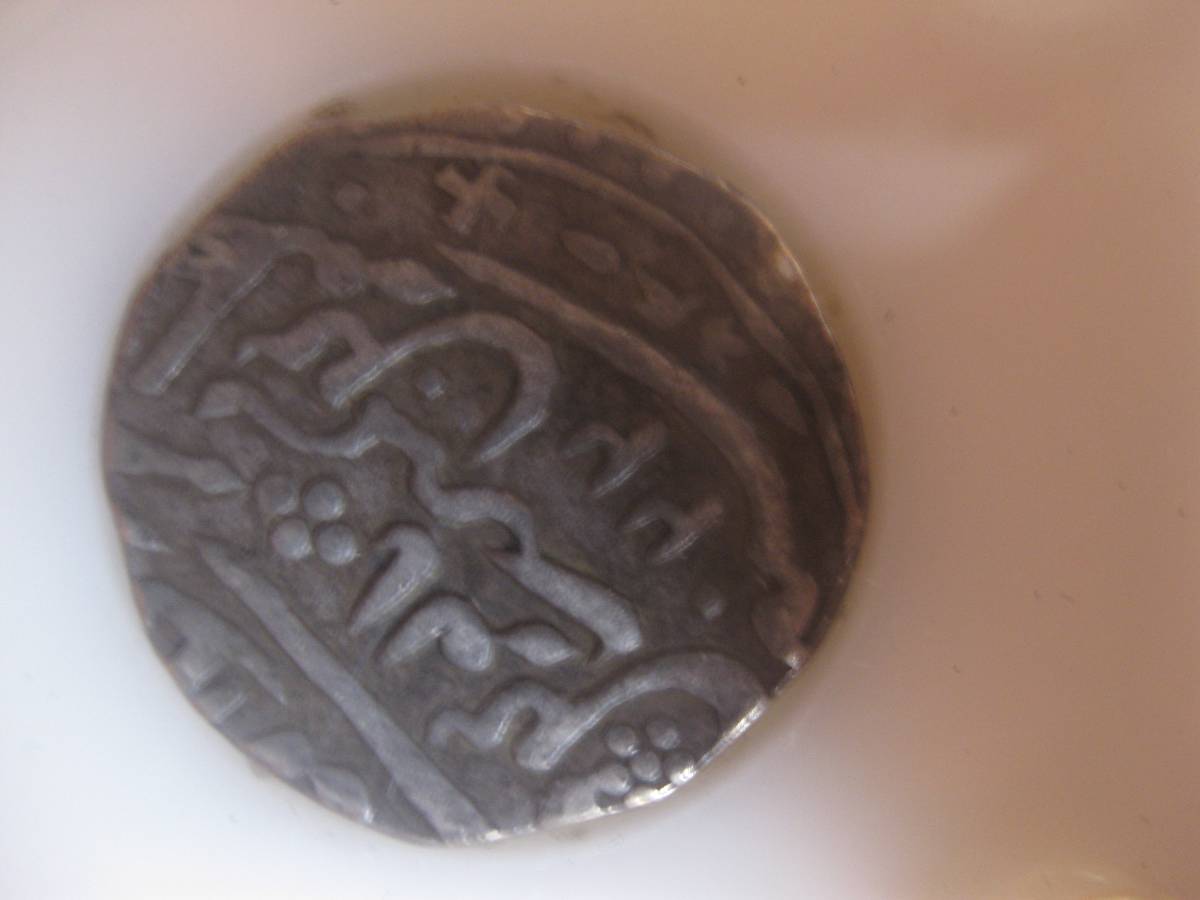
I am trying to provide some clues. Krause illustrates a coin issued in the name of the Mughal ruler, Muhammad Akbar-II.(اکبر=Akbar) But the traces of the legend on the top row of the obverse of this coin resembles Shah Alam-II (1759-1806.AD) (شهﻋﺎلÙ. = shah Alam) who preceded Akbar. 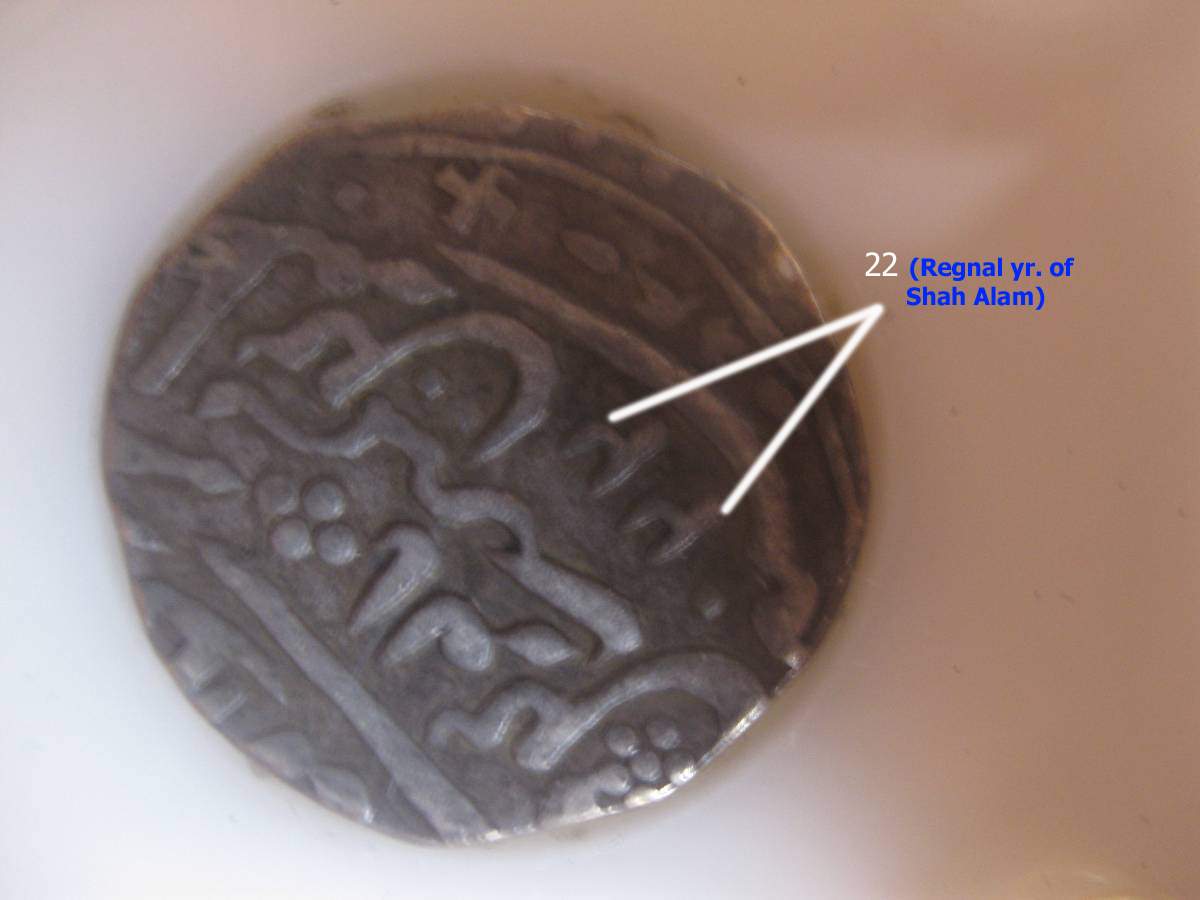 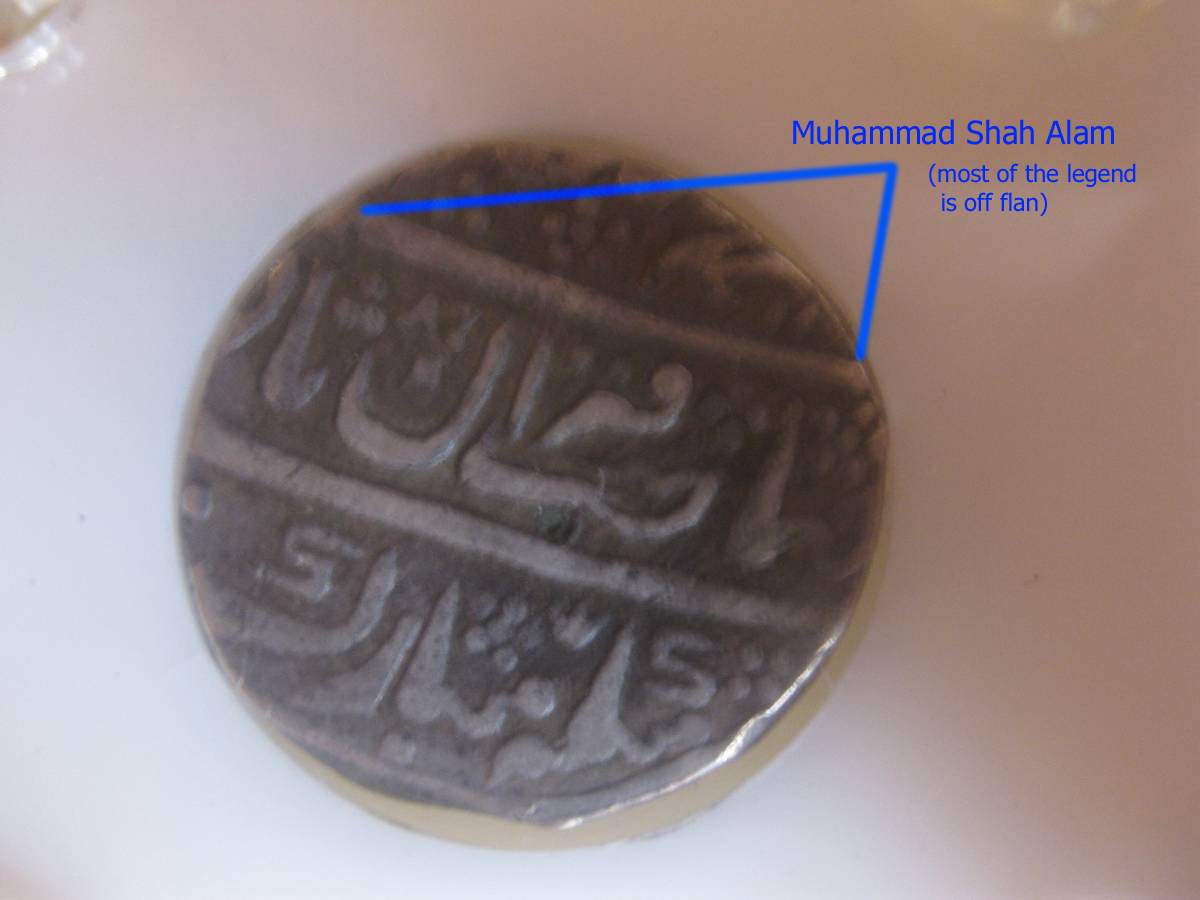 Bharatpur was a Princely state in the Northwestern India. At the end of the 17th century, Balchand, a Jat Zamindar took advantage of the weakness of the Mughal Empire to enlarge his territory. His descendents continued as Rajas. Regarding the availability of the coin, they are still available in small numbers. I am not an expert in valuation, but still I will put it near $30/- in this condition in India.  Edited by drnsreedhar
08/30/2011 11:17 pm
|
|
Pillar of the Community
United Kingdom
1324 Posts |
|
|
Pillar of the Community
India
1996 Posts |
Hi ! andyg, Jaisalmer is indeed a very high probability esp. since the dagger-like mint mark of Bharatpur is absent and the fixed date is there with the dot. Similarly, the swastika also is said to be indicative of Jaisalmer. But the style of execution of Jaisalmer coins is crude and that of Bharatpur is finer. The posted coin seems to have a finer execution. In the following link the last image is of a coin of Jaisalmer with reg.yr.21 and with different marks in place of the swastika which can be found on coins of Bharatpur. http://www.onsnumis.org/articles/mu...lingen.shtmlThose marks are found on coins of Bharatpur earlier during the late 17th Century while Aurangazeb was ruling. That pattern might have later been followed by Jaisalmer, after Durrani invasion in 18th century. This means that Bharatpur and Jaisalmer coins share same marks. That is why I prefer the execution of the coin to attribute origin. May be I am wrong. Thanks for the post. Edited by drnsreedhar
08/31/2011 4:44 pm
|
|
Valued Member
Canada
480 Posts |
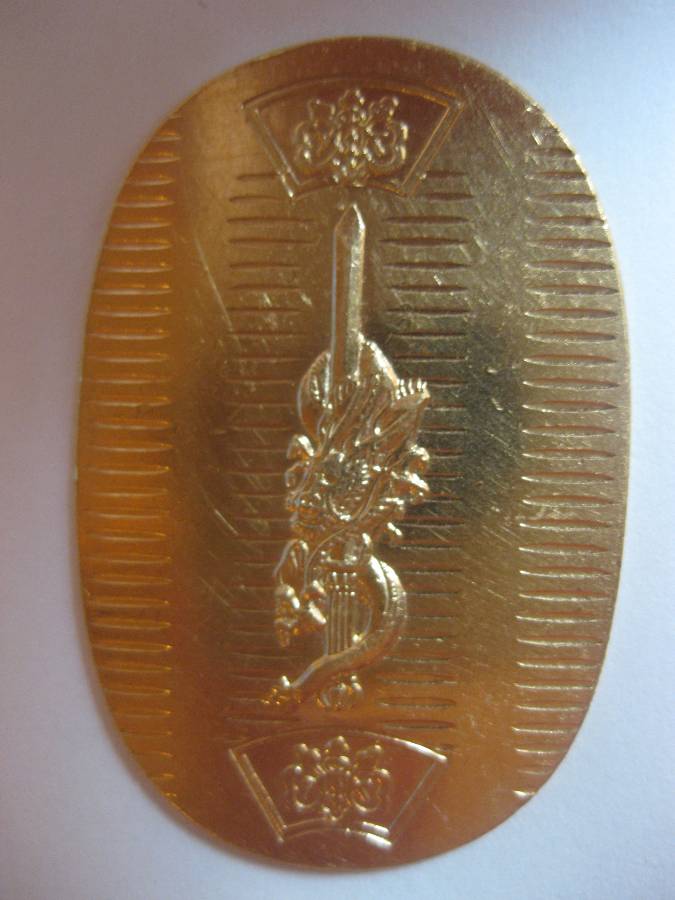
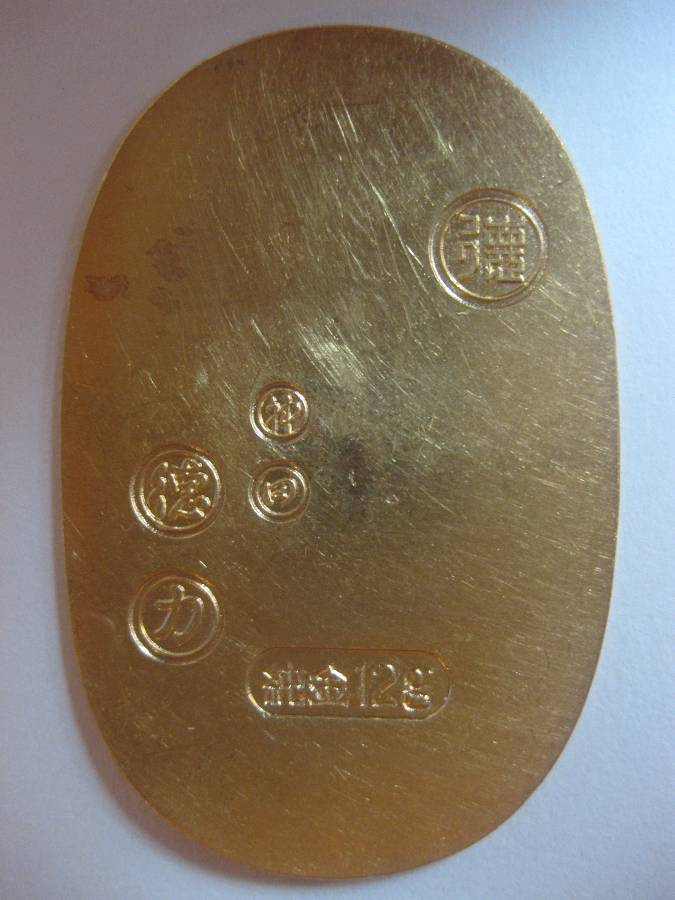
The Japanese piecce is not a coin. The original coins had a design struck into the oval piece- The Koban had 4 columns of "horizontal lines", and a semicircular design above a vertically-elongated box with leaves in the semicircular portion, and 2 characters in the vertica. The larger oban had 5 columns of horiozntal lines, circles with the leave design at top, bottom, right, and left, and a signature in ink down the face of the coin. There is also a goryoban which has a similar design to the koban, with circles containing leaves at left and right, and circles containing a charater at top left, and 2 at bottom right. The koban back had a single circle containing a character in the centre of the piece. Kause does not show the backs of the larger pieces, but I believe they also have characters in circles. Your piece has a modern design- raised, it look like, and Western numbers in the box at the bottom of the back (possibly 12 karat- .500 gold?. It is beautiful, but not a coin.
|
|
New Member
United States
3 Posts |
thanks for the reply coinsnpaper. however I think I'm missing something. are you saying that this is a replica of a japanese gold coin struck in (due to the western numbers as you pointed out, sometime after the meiji restoration? (typically given as 1868)) I also would like to put this to you: the number 12g is obviously referring to its weight in gold (and japan did not introduce western standards of measurement until after meiji). furthermore the direct translation of the lowest markings is "pure gold 12g." juunkin literally means 24k gold- .999% or higher. so given that information, what does that tell us about the not-coin?
|
|
Valued Member
United States
347 Posts |
I am not familiar with Japanese coinage. However, I can read Chinese and think I can help provide some information on your gold "coin". I did a search of the Chinese characters (kanji) and learned the following. The two vertical characters (德力) in the large circles at the far left represent the name Tokuriki Honten which is Japan's oldest gold and refining company. The company's name goes back to the 9th century and it began commercial operations in 1624. The two vertical characters (神ç"°) in the small circles represent Kanda which is a district in Tokyo. The single character (ç-†) in the very large circle at the top right is, as best I can tell, the logo or trademark symbol of Tokuriki Honten. Please visit this site: http://www.rarecoincollector.net/in...ucts_id=5968If you click on the image of the gold bar you will see that the reverse side is identical to yours with the exception that the "pure gold" weight is "5g" instead of "12g". Even though the obverse side is different from yours, I think this confirms that your specimen is a gold bar from this company. I have no idea what the design on the obverse of your gold bar represents. It may just be a design for a bullion gold bar. Again, I know nothing about Japanese coins and gold bars but hope you find the above information helpful. Gary |
|
Pillar of the Community
United States
1674 Posts |
The design is an hommage to the famous koban coins of the previous century. Same concept as US silver and gold bullion companies striking rounds that resemble Morgan silver dollars. |
| |
Replies: 9 / Views: 5,037 |
|











 Posted 08/30/2011 5:13 pm


