| Author |
 Replies: 14 / Views: 2,164 Replies: 14 / Views: 2,164 |
|
|
Valued Member
United States
447 Posts |
Not a World coin fan but this is a nice older pictorial; Sellers pics. 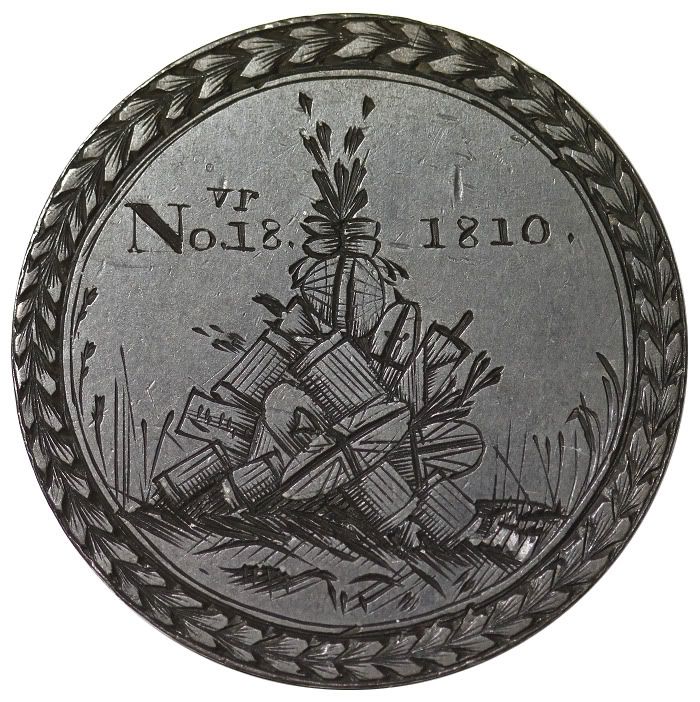 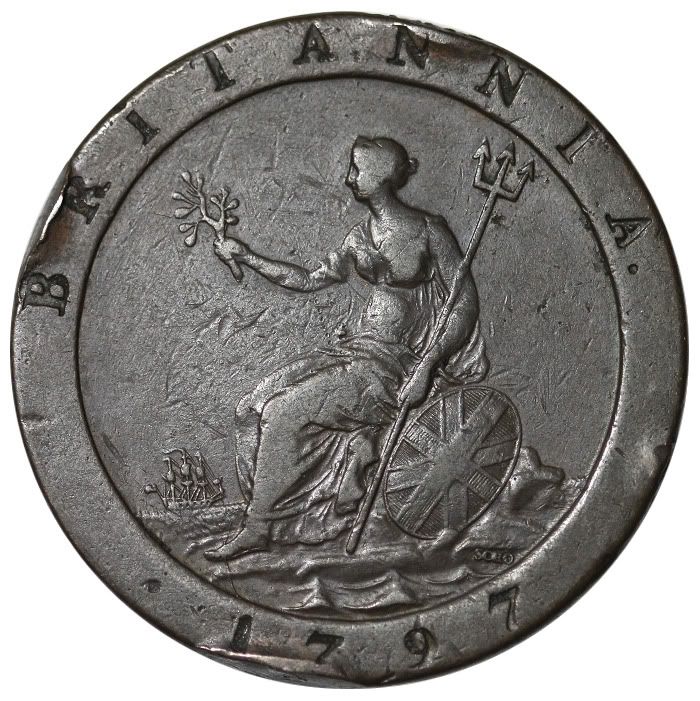 |
|
|
|
Pillar of the Community
United States
1064 Posts |
They are fascinating depictions - any idea what the first pic, the reverse, is supposed to represent?
|
|
Valued Member
United States
407 Posts |
It's surfboards and trashcans piled up on a beach. A beach in Hawaii because that's a pineapple on top.
That's actually the first thing my mind saw.
But seriously, interesting coin!
Steve
|
|
Pillar of the Community
United States
1080 Posts |
that took some time and effort. Very, very nice!
|
|
Pillar of the Community
United States
1064 Posts |
Maybe scrolls and shields? Is this an actual coin, or a token or copy of a token?
|
|
Pillar of the Community
Australia
2830 Posts |
November 18th, 1810: height of the Napoleonic Wars, in particular, the Peninsular Campaign.
The depiction appears to be military stores, &/or accoutrements, or perhaps trophies, piled in tribute: a symbol of a great victory, or a great defeat, depending upon your perspective. I can see two shields representing the United Kingdom of England and Scotland.
The other side is Britannia, and this is the reverse of a "cartwheel" penny, or perhaps twopence, of 1797. You will see that Britannia is holding a shield, similar to the two on the other side. Originally, the obverse would have shown an effigy of KG3.
This is the sort of item that is nowadays called "trench art": the handiwork of a bored soldier, using the materials readily available, in this case, a low-denomination coin. The soldier may have been a prisoner, but not necessarily so.
Now, here's the mystery: was this made by a Napoleonic soldier, utilizing a captured British penny;
or by a British soldier, using his own penny ?
Was it made by a prisoner, or a soldier relaxing after the battle ?
The answer might be found, if we can discover who the winners and losers on 18.11.1810 were ...
What an interesting piece !
Edited by Peter THOMAS
09/04/2011 8:59 pm
|
|
Valued Member
 United States
447 Posts |
November 10th, 1810: height of the Napoleonic Wars, in particular, the Peninsular Campaign. The depiction appears to be military stores, &/or accoutrements, or perhaps trophies, piled in tribute: a symbol of a great victory, or a great defeat, depending upon your perspective. I can see two shields representing the United Kingdom of England and Scotland. The other side is Britannia, and this is the reverse of a "cartwheel" penny, or perhaps twopence, of 1797. You will see that Britannia is holding a shield, similar to the two on the other side. Originally, the obverse would have shown an effigy of KG3. This is the sort of item that is nowadays called "trench art": the handiwork of a bored soldier, using the materials readily available, in this case, a low-denomination coin. The soldier may have been a prisoner, but not necessarily so. Now, here's the mystery: was this made by a Napoleonic soldier, utilizing a captured British penny; or by a British soldier, using his own penny ? Was it made by a prisoner, or a soldier relaxing after the battle ? The answer might be found, if we can discover who the winners and losers on 18.11.1810 were ... What an interesting piece ! Thanks PT. I feel that this is what the engraving is about. Was having a hard time with the date being Nov 18 1810.  |
|
Rest in Peace
United States
9104 Posts |
These "pictorials" are closely related to "potty dollars", "love tokens" and "hobo nickels", in that timeline order.
|
|
Bedrock of the Community
United States
12437 Posts |
Excellent engraving work  |
|
Pillar of the Community
United States
1144 Posts |
Early piece when you consider the inscribed date. Thanks for sharing.
|
|
Valued Member
United States
447 Posts |
Quote:
These "pictorials" are closely related to "potty dollars", "love tokens" and "hobo nickels", in that timeline order. Your ignorance is well noted; I challenge you to find an example of early 1800's hand engraving! I wish you Luck!  |
|
Pillar of the Community
United States
4422 Posts |
Quote:
These "pictorials" are closely related to "potty dollars", "love tokens" and "hobo nickels", in that timeline order. IMHO, that's not an "ignorant" statement. The point or interpretation may have been misread; perhaps even, better stated. As I see it, this artfully engraved piece certainly predates its American cousins, being love tokens, potty coins and hobo nickels; all of which rendered coins into canvases. It's quite likely that our stateside engravings were inspired by these arty "love tokens" from merry olde England. This thought occurred to me when I first acquired a similar piece to the subject of this thread; coincidentally, one that is signed "1810" on a 1797 cartwheel. The so-called Conder tokens from England greatly influenced our American tokens throughout the Hard Times era and into the Civil War years. The 1790's English design elements, sayings, political sentiments, etc. were often repeated here, stateside. Thus, one can logically look at the issue of tokens and engraved coins with respect to a timeline, methinks. From a personal standpoint, the artwork on the few early English coppers that I've seen is generally superior to that I've seen on the vast majority of American coins ... art for art's sake. Yet, the English coppers offer a much larger canvas and were cumbersome to carry about. The American coin engravings seem to have more of a personal intention behind them on the whole. With tongue in cheek, I trust that my personal observation will not render me as being judged overly ignorant on this topic; this, for my having concurred with the timeline scenario.  |
|
Pillar of the Community
United States
4422 Posts |
A few thoughts ... Might those be powder kegs and cannon with fuses protruding amid the pile?
In doing a Google book search, I see that Napoleon issued a decree on November 18, 1810. It basically said that the importation of British goods into France would be punishable by death. This decree must then have resulted in a stockpile of British goods mounting along the port cities. Might then this artist have been pointing, satirically, to a stockpiling of British weapons? I'm inclined to suspect that there's some satirical implication intended in this art.
Tuppence for your thoughts ...
|
|
Valued Member
United Kingdom
116 Posts |
Quote:
It's surfboards and trashcans piled up on a beach. A beach in Hawaii because that's a pineapple on top. Pineapples were highly prized and very valuable in England during this period. We actually culitvated them (in England!?) and they were accessible to only the super-rich. Wealthy Victorians would display such wealth when entertaining distinguished guests by using them as a centerpeice at the dinner table. Such was the popularity that not only were millions of pounds probably squandered on pineapple consumption, but also on castle renovations... 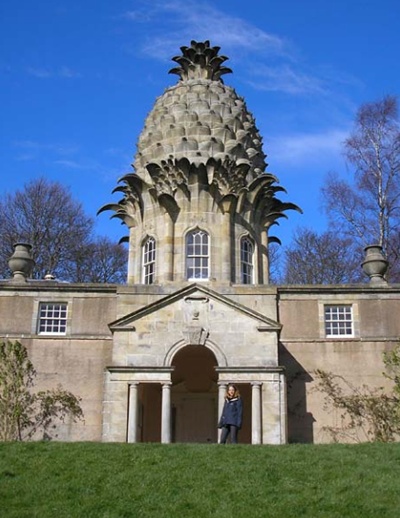 http://www.buildingconservation.com...neapples.htm http://www.buildingconservation.com...neapples.htmEdited by marz
05/08/2013 10:45 pm
|
|
Pillar of the Community
United States
4422 Posts |
I've long pondered the use of pineapple design in early bedposts ... now it's clear!
The Barbadoes coppers, circa 1788, prominently displayed the prized pineapples.
|
| |
Replies: 14 / Views: 2,164 |
|








 Posted 09/04/2011 5:07 pm


