| Author |
 Replies: 18 / Views: 2,591 Replies: 18 / Views: 2,591 |
|
Bedrock of the Community
United States
10635 Posts |
Sometimes I find it hard to judge FSB Mercuries... is this one? Les 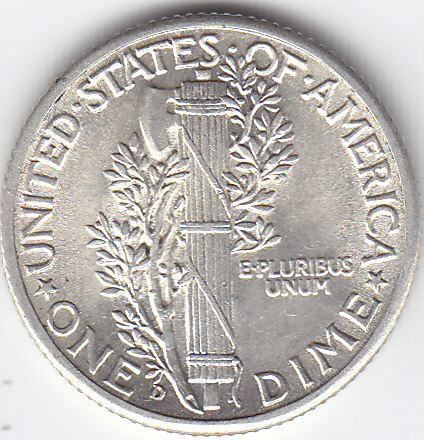 |
|
|
|
Pillar of the Community
United States
5854 Posts |
I think this just misses FSB.
|
|
Pillar of the Community
United States
4132 Posts |
This one falls short; it's bridged by about 20%.
|
|
Pillar of the Community
United States
5845 Posts |
David Bowers "The Expert's Guide to collecting and investing rare coins" puts it into a different perspective. The section with Mercury dimes as he states that beside having full band, it it also important to have FD (full details). A dime called FD would have full everything!And the truth is that I have seen dimes with full band within the same grade that are weakly strike in other areas. |
|
Bedrock of the Community
 United States
10635 Posts |
Ok then, how about this one? Les  |
|
Pillar of the Community
United States
4132 Posts |
It's hard to tell from that scan, and it's closer, but I think it still falls short. I agree with Mac's point though - there are other places to look for a full strike other than the bands. It's very common to have missing or weak details in the legends around the edge (the E in ONE for instance is a trouble spot on many dates, for example, and the last digit of the date), and other low-relief details often get almost polished right off the die, such as the motto on the obverse. Here's a comparison of two well-struck FSB dimes: 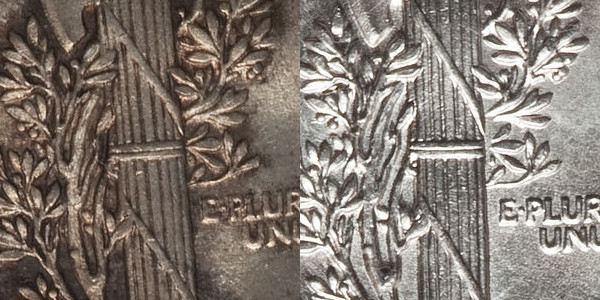 The one on the left is a 1916, the one on the right a 1944-D. There are detached, floating olive stems to the right of the fasces. This actually appears on all Mercury dimes after 1925, apparently due to damage to the master hub. But sometimes it occurs on earlier dates due to die polishing or wear. So, keep an eye out for these sorts of details too, even though they don't get a special label.  |
|
Bedrock of the Community
United States
10635 Posts |
Here's another one. I am asking about these because I want to learn, and I'd sure there are others here who would like to know also. I'd call this one FSB, although it has circulation nicks on the coin. It can be FSB and not be in MS condition, right? What's your thoughts on this one? Thanks, Les 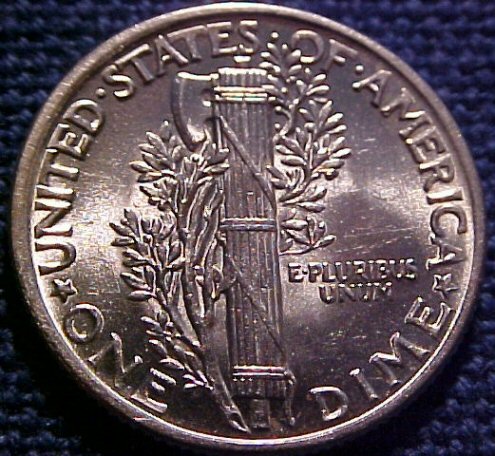 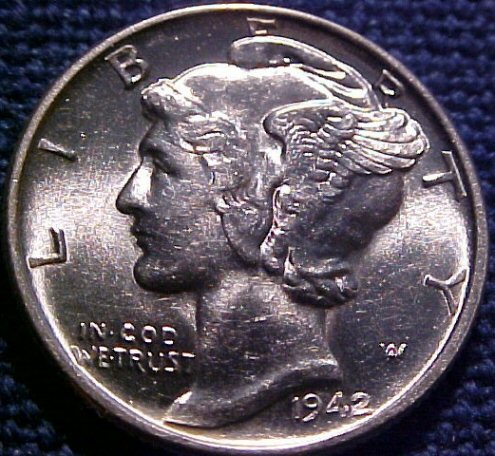 |
|
Bedrock of the Community
Australia
21789 Posts |
FD to me, means Full Details, BOTH sides.
I have seen quite a few FSB's, where the detail of the obverse has let to coin down. From the war years, so many have survived in nice condition that for the coin to be a standout, the quality of strike of BOTH sides must be considered.
Of course, the amount of wear and the quality of strike both contribute to the question of "FSB".
|
|
Pillar of the Community
United States
1151 Posts |
That one is a FB for sure!
|
|
Rest in Peace
United States
9104 Posts |
no, no, on the first two.
|
|
Valued Member
United States
54 Posts |
1. No
2. No
3. I don't think so. I'm pretty sure top TPGs want the center bands fully rounded with no signs of wear and no noticeable hits.
|
|
Pillar of the Community
United States
4132 Posts |
They don't have to be rounded necessarily to get the FB designation. And apparently they're more forgiving on years that tend to be poorly struck. On the third one it's hard to tell at this resolution. I'd lean toward yes, but a closer look might show some bridging.
|
|
Pillar of the Community
United States
3453 Posts |
I am new to mercs but think 1. no, 2 no, 3. probably for me but I think TPGs would say no. On 3, there is an area on the left of the middle band that is hard to discern from the scan that keeps me from saying yes.
|
|
Bedrock of the Community
United States
10635 Posts |
Interesting to see split opinions (no pun intended) on this third coin. Nice to know that I'm not alone in finding determining FSB difficult, especially with this third coin that appears to be well stuck and most likely FSB, but has coin nicks on it. Seems to me that a FSB Mercury shouldn't be penalised for post mint damage. I appreciate the feedback. Les |
|
Pillar of the Community
United States
6406 Posts |
The split opinions on the third coin are because of the fuzzy detail of the image. I can't tell whether the center band is fully split over the whole width so my answer is "maybe". I agree the first two coins don't qualify as FB. I also agree that the TPGs basically only look at the bands when deciding FB status which does not tell the whole story about strike. My 1931-D dime is graded NGC MS-65 FB but does not have a sharp strike everywhere. The legends especially seem rather softly defined while the center bands are pretty clearly fully split. The lesson seems to be that if possible you should cherry-pick your FB coins because overall strike quality can be pretty variable. 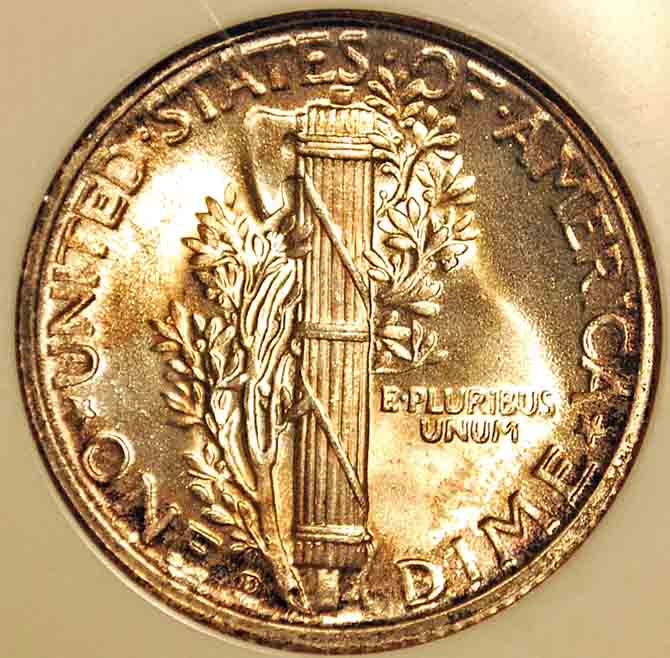 |
|
Bedrock of the Community
United States
10635 Posts |
So, what I'm hearing is there basically three variables here... a Merc could be fully well struck but not FSB, or have FSB but not well struck, or if you are really lucky, a coin that has FSB AND is fully well struck. Then there is a fourth, much more common variety among Mercury dimes, a coin that is not well struck and has no FSB (many filled in or flattened bands, not even close to FSB). And it's a shame (or scam) when most ebay sellers state that their Mercury dimes have FSB when in fact, they are not. Unless you're well educated on what a true FSB looks like, costly mistakes can and are being made. Education is the key. Les |
| |
Replies: 18 / Views: 2,591 |







 Posted 09/10/2011 11:36 pm





