Coin Community Family of Web Sites Join Thousands of Coin, Bullion, & Money Collectors
300,000 items to help build your collection! Coin, Banknote and Medal Collectors's Online Mall Vancouvers #1 Coin and Paper Money Dealer Royal Canadian Mint products, Canadian, Polish, American, and world coins and banknotes. Specializing in Modern Numismatics Shop for APMEX Bullion on eBay!Join Thousands of Coin, Bullion, & Money Collectors


Username:
Password:
Save Password
Forgot your Password?


This page may contain links that result in small commissions to keep this free site up and running.

Welcome Guest! Registering and/or logging in will remove the anchor (bottom) ads. It's Free!

Fake Italian 1876 R 5 Lire?

To participate in the forum you must log in or register.
Author Previous TopicReplies: 45 / Views: 6,186Next Topic
Page: of 3
Pillar of the Community
swamperbob's Avatar
United States
5362 Posts
 Posted 01/02/2021  11:55 pm  Show Profile   Bookmark this reply Add swamperbob to your friends list Get a Link to this Reply
Nice scale. I wish I could afford one like that. I still prefer a mechanical balance that I can zero manually and test with weights.

What is the accuracy of the electronic chip as a percent of total weight? Most of the newer electronic scales (less expensive type from China) indicate a 0.2% accuracy +/-. I think that is too big a range for the weights involved.
Pillar of the Community
United States
1913 Posts
 Posted 01/03/2021  04:23 am  Show Profile   Bookmark this reply Add Albert to your friends list Get a Link to this Reply
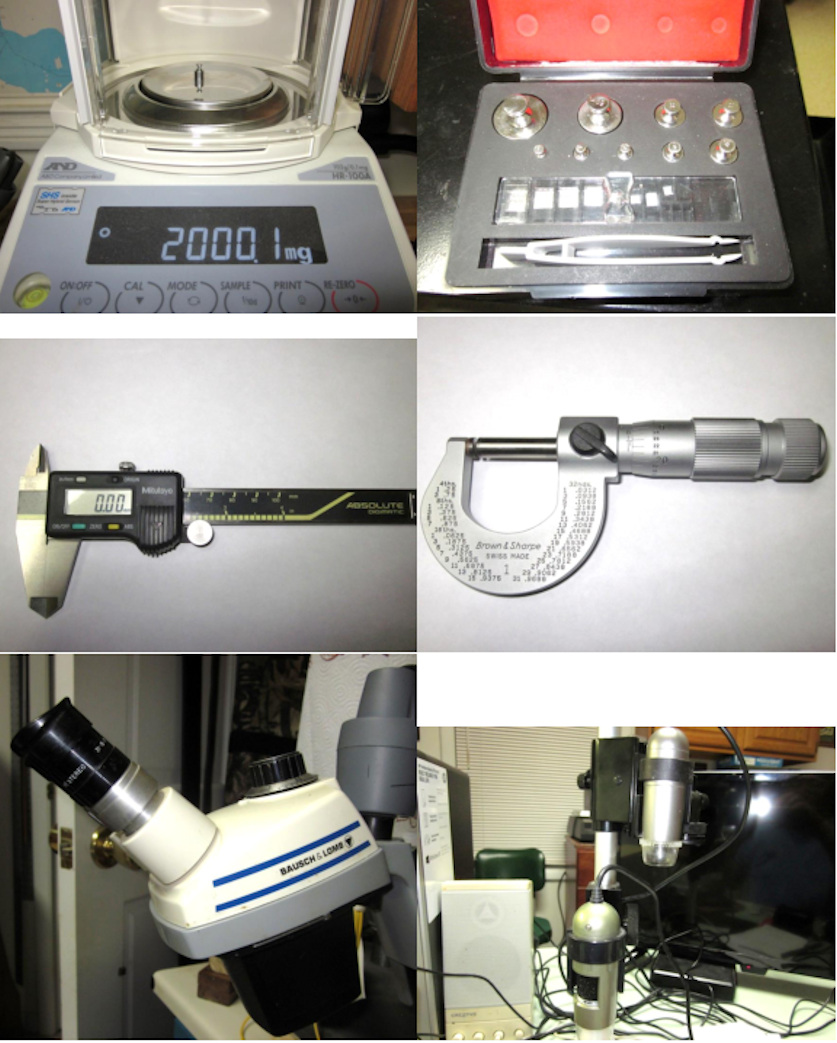
I gave up on mechanical balances in favor of better accuracy with the analytical balance with under-hook for my needs. Previous methods had too much uncertainty when it came to very small coins, but if limited to large coins in the ounce range, I could get by. It was not the lowest or highest cost at $1600 at the time and I think they can be bought for several hundred less. You can see 2 gram weight with a reading of 2000.1mg. 2000mg at .2% would show 2004 and I wanted that extra decimal place. Calibration weights are certified traceable to NIST at the time and I see no need to keep that up. Placing a 50g weight indicates 50.0000 while a .2% unit could show 50.1g. I'll pay for the four zeros instead of the .1 for my needs.Some other common tools are digital calipers to 0.01mm and .00005" good enough for my needs, micrometer if I choose to measure fields, rims & high points to .0001", several USB microscopes with measurement software and a few different B&L StereoZoom scopes having different eyepieces and other optics. Good enough to measure thickness of the nickel plating on counterfeit South African 5 Rand coins dated 1995. I enjoy the hobby and also do not charge. But in some cases a client will offer for me to keep a coin of choice. Right now I'm working on number 9 of 25 Chinese 20 cent pieces. None are genuine but they will all be photographed and documented.

Fake-Italian-1876-R-5-Lire?
Edited by Albert
01/03/2021 04:44 am
Pillar of the Community
Kopper Ken's Avatar
United States
3402 Posts
 Posted 01/03/2021  11:27 am  Show Profile   Bookmark this reply Add Kopper Ken to your friends list Get a Link to this Reply
If it was made of the same metal content, on what basis is the coin now being deemed counterfeit?

KK
Valued Member
Canada
242 Posts
 Posted 01/03/2021  12:27 pm  Show Profile   Bookmark this reply Add Loruca to your friends list Get a Link to this Reply
Swamperbob, In terms of my bringing up significant digits, I don't mean to question the math or the instruments - I assume those are quite accurate, I do question the assumption that the coin is a perfect metal cylinder, even without damaged (and potentially therefore raised) rims, the calipers can only be measuring the thickness of the highest point of the coin, comparing a worn coin to a decent grade one will surely show a decrease in thickness due to high point wear!
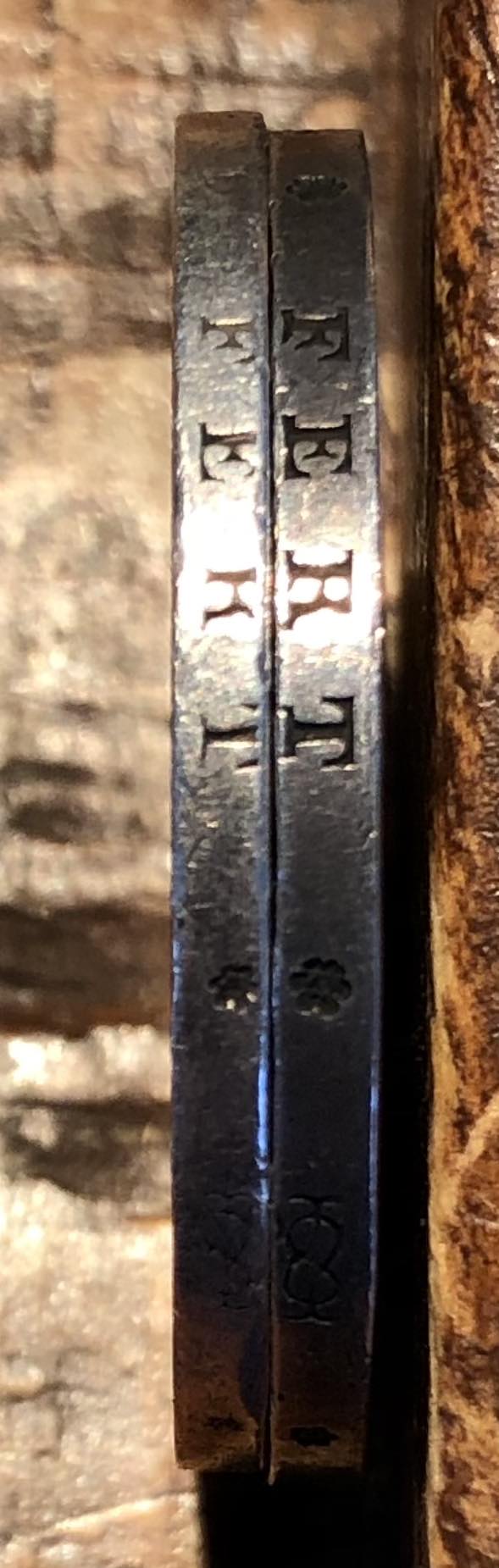
Here are two of my 1876s one an aUNC and one a low VF, very similar to the OPs, you can easily see the rim difference, but it isn't due to being thicker and therefore fake, only to good ol' classic wear!

Fake-Italian-1876-R-5-Lire?
Pillar of the Community
Kopper Ken's Avatar
United States
3402 Posts
 Posted 01/03/2021  2:20 pm  Show Profile   Bookmark this reply Add Kopper Ken to your friends list Get a Link to this Reply
Swampy:


Quote:
You use "Scientific notation" where I think you mean significant figures.


No I meant you need to switch your calculator out of exponents into decimals.


Quote:
You should not express the result in 4 decimals


Off the pedestal...do you really think thousandths and ten thousandths are making a difference here!!


Quote:
That difference is VERY significant


...first you say we should keep it to hundredths...now you say 6/1000 is significant...confusing...that's wear...look at the photo's just posted by Loruca...that's more than 6/1000's!!

I suggested to use a micrometer and take measurements internal from the rim...take three or more to get an average...reasonable.

This coin in no way shows any surgical features of being cast or counterfeited from any other process. It is a worn coin that has been tooled.

If I should say that this coin is real without putting it through an exhaustive scientific routine, then how do you justify saying it is "counterfeit" without doing the same. The coin needs to be in hand.

A US cent pre 1982 (some 1982s) has a listed weight is 3.11 grams, with a tolerance of .13 grams...13/100s!!!!....a gazillion times more than the variance you'd allow for thickness.

Johnny676767...what do you say to that?


KK


Pillar of the Community
swamperbob's Avatar
United States
5362 Posts
 Posted 01/03/2021  2:57 pm  Show Profile   Bookmark this reply Add swamperbob to your friends list Get a Link to this Reply
Albert Great set up you have there which is beyond my current budget capability. The scale accuracy is excellent. They seem to have licked the embedded accuracy problem still seen in the supposed 1/1000th scales from China (it is a chip issue from what I read.) Where was the scale made?

Kopper Ken I do not understand what you mean here.


Quote:
If it was made of the same metal content, on what basis is the coin now being deemed counterfeit?


The coin that began this thread is not the same alloy based on comparative density so am I correct that you are referring to the coins I mentioned in the final 3 paragraphs of my last comment?


Quote:
Silver counterfeits using the identical silver alloy as genuine coins were made and in many coin series that circulated in the 1890s and 1930s are in fact very common. You are unaware of them perhaps but they do exist in very large numbers. The reason - in 1893 world silver values dropped to about 30 cents an ounce (same thing happened again in 1933). A coin like the 5 Lira had a silver value of only 21.7 cents. In 1893 a dollar coin cost about 5 cents to make. So for 26.7 cents a counterfeiter could make and circulate a genuine silver coin at a profit of nearly 5 times more than cost. That is a cold hard fact.

Most collectors are unfortunately unaware of that fact and often own ccc coins believing them to be genuine.

Examples of this happening are US Morgan dollars, Spanish 5 Pesetas and Peruvian Sols. When discovered - ccc's of this type are melted to get them out of circulation (See historic records for Spain in 1895 and the massive redemption of millions of ccc 5 Pesetas that happened.) There are many other coins copied in a similar way in history.


All of the coins noted above as well as others known to exist are all identified by features seen on the coins themselves. The Spanish 5 Pesetas use (among other things) an incorrect Keystone shape over the doorway of the castle, an incorrect 5 font or an incorrect S font. The Morgan dollars were first noted by damage that was present on multiple copies of the micro-O mint mark dollars. Since 2000 the number of known silver counterfeit Morgan's has expanded to no fewer than 15 die pairs.

This group of "exact" alloy counterfeits often is found with trace contaminants like Cadmium which simply does not belong in some genuine coins but that test requires a lab level XRF to disclose.

I place the word exact in quotes because there are likely some nit pickers reading this post and identical alloy is not precisely what I meant. All of the above coins and others in the same silver counterfeit category are examples of alloys where the small differences in alloy are not detectable by the average bank or collector. These are the kinds of coins sold by dealers as real simply because they are genuine silver coins.

Loruca I understand and agree completely when you say:

Quote:
Here are two of my 1876s one an aUNC and one a low VF, very similar to the OPs, you can easily see the rim difference, but it isn't due to being thicker and therefore fake, only to good ol' classic wear!


It is very obvious that normal wear first eliminates the high rim on modern in collar strikes. That is why volume using Archimedes' principle is used to determine SG or density.

However, once wear across all the normal high points of the coin face takes place (which has happened in this case) the "high rim" is gone. So your example of differential wear is not what I see on the 1876 5 Lira in question. Neither coin is near MS both are worn to a similar grade. My comments were based on the comparative difference in thickness that was measured. That measurement across the face is not accurate enough to determine an accurate density (note the genuine coin would be seen as low alloy). I did not use that at all. My assessment was based on the relative loss of thickness and by extension density based on that differential thickness. A 5% difference in density would move a correct reading of 10.3 to an unacceptable reading of 9.8 (rounded using significant figures). That is the point I am trying to make here.

The only point where opinion enters this discussion at all is regarding the depth of wear of the two coins as seen in the calipers. I see them as BOTH worn into a similar grade range based on loss of high point details on the portrait and on the shield. The relief used on a genuine coin (from the period when wear actually reduced value - intrinsic) simply is not great enough to allow for a 3.5 thousandths difference in depth of wear on each face. I know that for US intrinsic issues the relief was shallow and intended to create (when the loss of silver content reached 5%) a very low grade coin in the AG-G range. That was the point at which coins were removed from circulation and returned to the mint for re-coinage.
Edited by swamperbob
01/03/2021 3:04 pm
Valued Member
Canada
242 Posts
 Posted 01/03/2021  3:40 pm  Show Profile   Bookmark this reply Add Loruca to your friends list Get a Link to this Reply
Swmaperbob, I think you seriously underestimate just how quickly wear brought down the 1873 5 lira coin's edge,
The likely almost 30% difference in thickness you see in my edge picture only translates to a 0.19 gram weight difference between the coins!
I'll need to go find an accurate pair of callipers to give you a couple measurements of my pieces, but given the metal removal from the rim, and therefore likely deformation combined with a weight decrease, I'm still very dubious about the applicability of a volumetric method other than by water displacement to this coin.
LRC

Pillar of the Community
United States
1913 Posts
 Posted 01/03/2021  4:08 pm  Show Profile   Bookmark this reply Add Albert to your friends list Get a Link to this Reply
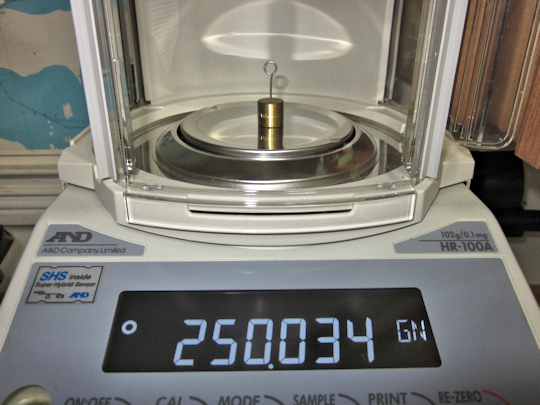
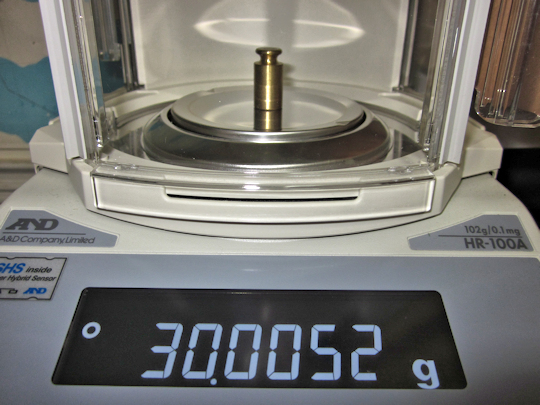
swamperbob: To answer your question mine was made in Korea. Since I determine SG for coins less than 2 grams, I really needed small capacity, high resolution and readability to .1mg. Here are a couple test weights I checked for other people. They just wanted know if their weights were accurate. One is marked 250 grains and the other is marked 30 grams- both from a set of scales they use to measure powder.

Fake-Italian-1876-R-5-Lire?
Pillar of the Community
swamperbob's Avatar
United States
5362 Posts
 Posted 01/03/2021  8:01 pm  Show Profile   Bookmark this reply Add swamperbob to your friends list Get a Link to this Reply
Kopper Ken You seem to totally misunderstand the concept of mathematically significant digits and then you mix up that discussion with the discussion involving a ratio of comparative thickness where the measurements are of the same order of magnitude. You are mixing apples and oranges and coming up with lemons. Are you aware that thickness of a coin was always a standard slot in old scales used to detect counterfeits in the age of intrinsic coinage?

In relation to my comment on significant figures you say:

Quote:
No I meant you need to switch your calculator out of exponents into decimals.


Where does that come from? I never said that I did. Do you realize that for instance 0.0056 is a figure with only TWO mathematically significant digits? Do you understand the difference between the expressions 0.003 and 0.00300 which are 1 versus 3 significant figures?

I believe you are confusing two completely different mathematical concepts. When I said that you should not express the volume of the coin to four decimal places that was based on the mathematically significant figures that went into the creation of the volume. Since the thickness and diameter were expressed to only TWO SIGNIFICANT DIGITS you simply can not express the resultant volume to 4 decimal places which is 5 significant figures.

You said:

Quote:
I refined your calculations and the volume of the "good" coin would be 2.5238 cubic centimeters. You need to change out of scientific notation for decimal numbers. I used the formula (V=pie x radius squared x h). for the "counterfeit" coin the volume was 2.6784 cubic inches.


The volume of the good coin is 2.5 cc and the bad one 2.7 cc. Those are the results expressed using significant figures only.

If you were creating a ratio of those two numbers you would hold off rounding until the final step is complete. The ratio would be 2.6784 divided by 2.5238 = 1.0612568 which should be expressed as 1.06. The difference in the areas has a relative magnitude of Six percent using this data. One coin is 6% bigger than the other.

As I indicated earlier a 6% difference in volume traces to a 6% difference in thickness. That alone proves both coins can not be the same alloy if they are similar in weight.

Then you also say:

Quote:
...first you say we should keep it to hundredths...now you say 6/1000 is significant...confusing


That statement indicates you are confusing the concepts involved and you are simply not following what I am saying. The first concept, rounding the volume to 2 significant figures is correct. All digits trailing a 1 decimal answer are insignificant by definition. I decided to use 1.06 as the ratio of size increase even though an answer of 1.1 was justified. I feared that the result indicating a 10% difference in size would be misconstrued.

However, when dealing with the relative thickness of the coin, a 6/1000 (0.006) is highly significant since it is based on direct measurements of 92/1000 (0.092) and 98/1000 (0.098). No calculation is involved. The difference between the thickness of the two coins is a firm 0.006 of an inch. Both measurements are done to thousandths (same order of magnitude) so the relative thickness ratio is significant. You are failing to take into account the relative orders of magnitude of the two expressions. Comparing a 6 thousandths difference in direct measurement has nothing to do with a one decimal estimation of volume based on a mathematical computation. The comparison is Apples and oranges. This concept is high school math but it is critical to understand.

You also say:

Quote:
This coin in no way shows any surgical features of being cast or counterfeited from any other process. It is a worn coin that has been tooled.


Have you any experience at all examining silver counterfeits - say micro-O Morgan dollars, Spanish 5 Pesetas or even Lima Sols which while beyond all doubt are counterfeit yet they have defied detection in some cases for decades? You are making assumptions in the last statement that are categorically untrue. Die duplication by 1876 could be accomplished which can not be detected by appearance alone even today unless you happen to examine several coins struck from the same forged dies at the same time. (That was the method used to detect the first micro-O dollar). Remember they were rare VAM varieties for nearly 30 years before they were shown to be counterfeits. Also remember that I knew they were counterfeits in the 1960's because I was told in person by a professional forger who actually made counterfeit Morgan dollars in the 1930s.

Your very last comments about a modern US cent are not germane. A bronze token US cent does not create one iota of doubt scientifically in my line of argumentation.

Loruca You are absolutely correct that water volume method (displacement) is far better and more accurate methodology when compared to calculating the volume based on diameter and thickness. However, the relative change in thickness of the coin observed by direct measurement is significant. A 6 percent change in thickness can not be accounted for by wear of the wire rim in this case. In the obverse picture of the coin with the reeded edge the high rim (wire rim) has worn down to the level of the dentil tops around the circumference on both sides. Wear has also reached all of the obverse high points. The same conditions apply to the coin with the FERT edge. So the two coins are indeed 6% different in relative thickness which is all that is necessary to support a decision of counterfeit.

I learned how to identify and authenticate coins scientifically when I was working in Boston in the early 1970's (1971-1973). I have been authenticating coins for over 45 years and I have always used the same procedure. It is accurate.

All of the counter arguments made so far are various combinations of "I just can't believe it because it looks too good" or "I suspect the edge damage somehow distorted the thickness of the coin" although none of the photo evidence supports that at all.

Nothing raised as an issue so far creates the slightest doubt in my mind whatsoever.

I would love to see the coin in hand but even if I did would that convince any of the nay sayers?

Edited by swamperbob
01/03/2021 8:11 pm
Pillar of the Community
Kopper Ken's Avatar
United States
3402 Posts
 Posted 01/04/2021  10:31 pm  Show Profile   Bookmark this reply Add Kopper Ken to your friends list Get a Link to this Reply
Yes...if the coin was in your hand and you could scientifically show that it was not silver, then yes I would believe you; it would be a counterfeit. If it was made of silver I would then listen to your explanation as to what the diagnostics are that you were basing your "counterfeit" decision on.

KK
Pillar of the Community
machine20's Avatar
United States
1277 Posts
 Posted 01/12/2021  10:34 pm  Show Profile   Bookmark this reply Add machine20 to your friends list Get a Link to this Reply
Assuming the damaged coin is a "perfect cylinder" to calculate volume is not fair. Really need to test using water displacement and a high precision scale
Pillar of the Community
swamperbob's Avatar
United States
5362 Posts
 Posted 01/12/2021  11:13 pm  Show Profile   Bookmark this reply Add swamperbob to your friends list Get a Link to this Reply
machine20 I agree with you precisely for the same reasons, however in this case we are not calculating an exact density.

Each coin is a cylinder with the same deformity (or deviation) from perfection because each coin has the same relief. So a simple ratio of calculated densities can be used in this case without making the results inaccurate.

A relative deviation in density of this magnitude can simply not be ignored.
Valued Member
Canada
242 Posts
 Posted 01/13/2021  01:06 am  Show Profile   Bookmark this reply Add Loruca to your friends list Get a Link to this Reply
Swamperbob - still greatly disagree with the argument that the deformity is similar - a tiny amount of wear changes a lot here.
Still waiting on calipers. Ontario being in total lockdown isn't helping.
LRC
Pillar of the Community
United States
521 Posts
 Posted 01/13/2021  09:33 am  Show Profile   Bookmark this reply Add johnny676767 to your friends list Get a Link to this Reply
Wow! I have to say I have become lost in the specifics of this discussion. How about I send the coin to someone to check it out in hand? I suppose I could do that. It seems to be the only way to settle this. I'm not on the forum every day, so perhaps a PM would work. Let me know.
Pillar of the Community
swamperbob's Avatar
United States
5362 Posts
 Posted 01/13/2021  4:31 pm  Show Profile   Bookmark this reply Add swamperbob to your friends list Get a Link to this Reply
I would volunteer to test the coin in hand.

Albert has more expensive equipment, but mine has accuracy that is more than adequate for this project. I would accept his results.

Loruca - The deformity is identical for the purpose here. We are NOT looking for a minor difference but a 6% difference in SG or density. I simply do not understand how you equate relative magnitude of density with accuracy of the measurement of density. Those are entirely different topics and as far as I can see it is a red herring line of argument.

  Previous TopicReplies: 45 / Views: 6,186Next Topic
Page: of 3

To participate in the forum you must log in or register.


Disclaimer: While a tremendous amount of effort goes into ensuring the accuracy of the information contained in this site, Coin Community assumes no liability for errors. Copyright 2005 - 2026 Coin Community Family- all rights reserved worldwide. Use of any images or content on this website without prior written permission of Coin Community or the original lender is strictly prohibited.
Contact Us  |  Advertise Here  |  Privacy Policy / Terms of Use

Coin Community Forum © 2005 - 2026 Coin Community Forums
It took 0.51 seconds to rattle this change. Forums