Coin Community Family of Web Sites Join Thousands of Coin, Bullion, & Money Collectors
Coin, Banknote and Medal Collectors's Online Mall Shop for APMEX Bullion on eBay!Vancouvers #1 Coin and Paper Money Dealer 300,000 items to help build your collection! Specializing in Modern Numismatics Join Thousands of Coin, Bullion, & Money Collectors Royal Canadian Mint products, Canadian, Polish, American, and world coins and banknotes.


Username:
Password:
Save Password
Forgot your Password?


This page may contain links that result in small commissions to keep this free site up and running.

Welcome Guest! Registering and/or logging in will remove the anchor (bottom) ads. It's Free!

Fake Italian 1876 R 5 Lire?

To participate in the forum you must log in or register.
Author Previous TopicReplies: 45 / Views: 6,182Next Topic
Page: of 3
Pillar of the Community
Kopper Ken's Avatar
United States
3402 Posts
 Posted 12/27/2020  6:06 pm  Show Profile   Bookmark this reply Add Kopper Ken to your friends list Get a Link to this Reply
Johnny676767...can you send swamperbob the coin...I volunteer him to do the SG test.

KK
Valued Member
Canada
242 Posts
 Posted 12/28/2020  01:38 am  Show Profile   Bookmark this reply Add Loruca to your friends list Get a Link to this Reply
Swamperbob brings up a good point about SG as a scientific method, but frankly, for this coin, I trust the toning to give me a good idea of the metal content.

After handling some hundred coins of any type, you start being able to tell just by a look if something isn't right, the specific alloy and finenessused in a certain date by a certain mint can tone in many ways, but all, to a certain level, similarly.
This isn't to say that I'd claim to be able to tell the fineness of a coin at first glance, sure, one might be able to ballpark a figure, but that isn't the point.
The point is that for this coin, the toning matches what it's supposed to be, and that's something fakes just haven't caught onto yet. -and they won't be able to unless they use accurate metals, which an SG test would then fail to identify as well.

In short, the coin looks good. And I'd bet on it.
Pillar of the Community
colonialjohn's Avatar
United States
1757 Posts
 Posted 12/28/2020  5:09 pm  Show Profile   Bookmark this reply Add colonialjohn to your friends list Get a Link to this Reply
Loruca you make a good point - whenever I chase down off-metal counterfeit 2 reales (Kleebergs) talked about in the Forgotten Book I NEVER purchase a counterfeit Spanish/American 2 Reale which has dark toning which means only ONE thing to me = SILVER OXIDE so debased silver counterfeits with copper are CRAP. The prime counterfeits worth the big bucks are brass, bronze and german silver. This is different for Swamperbob's 8Rs - debased copper if large with copper can be in his Class 1 - anyway not Chinese obviously so a defaced edge IMO. Just do a ring test and compare the ring tone to a U.S. Morgan dollar assuming these are ~90% Ag. Based on the net value in the end for this specimen ... just my 2 reales worth ...

John Lorenzo
Numismatist
United States
Pillar of the Community
United States
521 Posts
 Posted 12/30/2020  10:58 pm  Show Profile   Bookmark this reply Add johnny676767 to your friends list Get a Link to this Reply
I have been off the forum for a while. I missed all of these replies. I don't know about these tests, but I guess I should learn them. Let me see what I can figure out.
Pillar of the Community
United States
521 Posts
 Posted 12/31/2020  3:37 pm  Show Profile   Bookmark this reply Add johnny676767 to your friends list Get a Link to this Reply
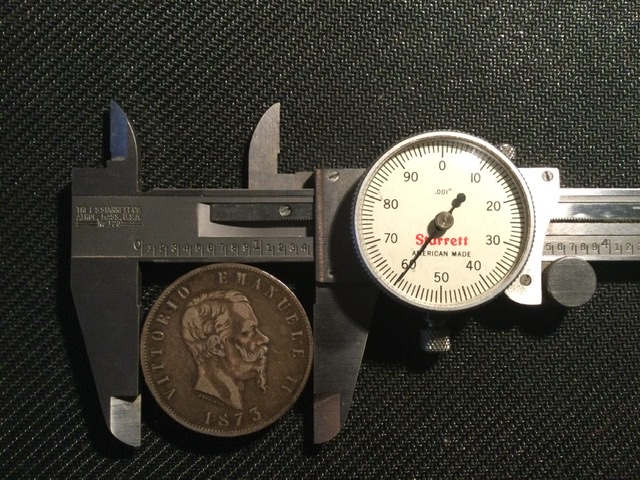
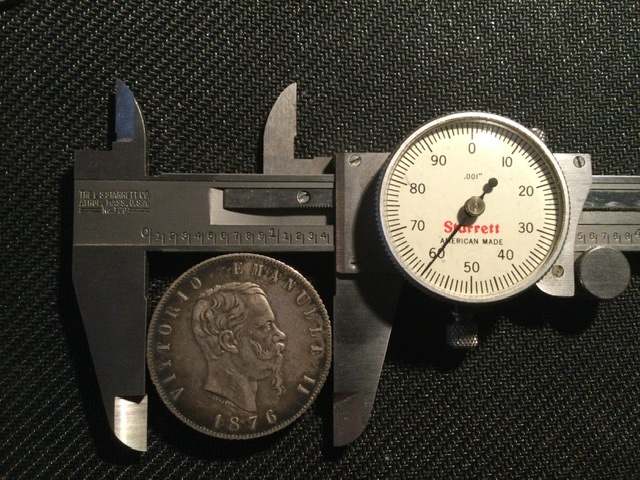
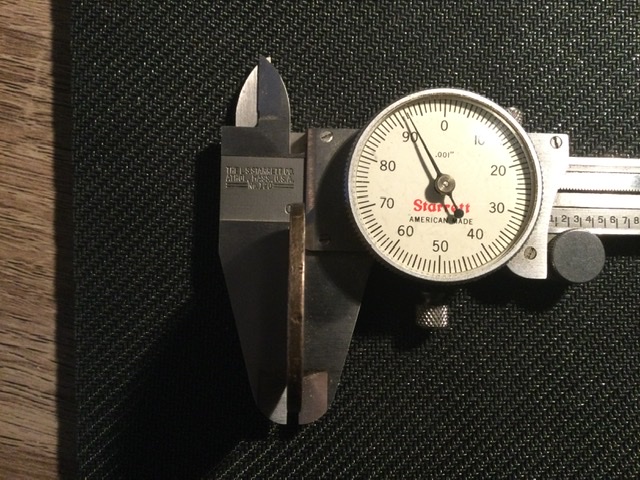
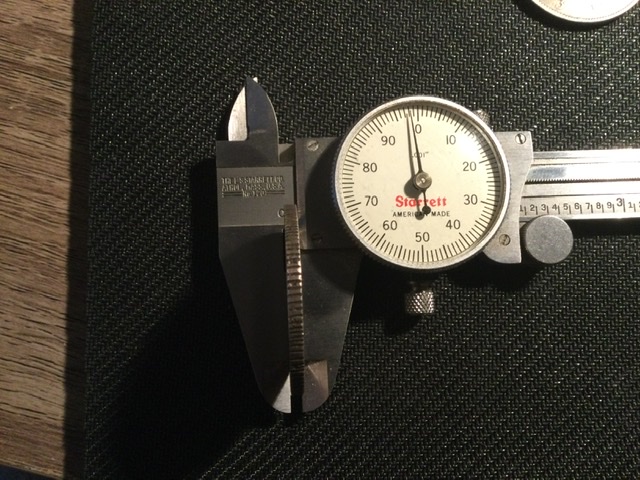
Ok- Here is what I am able to show. Does this help at all?


Fake-Italian-1876-R-5-Lire?
Pillar of the Community
Kopper Ken's Avatar
United States
3402 Posts
 Posted 12/31/2020  3:56 pm  Show Profile   Bookmark this reply Add Kopper Ken to your friends list Get a Link to this Reply
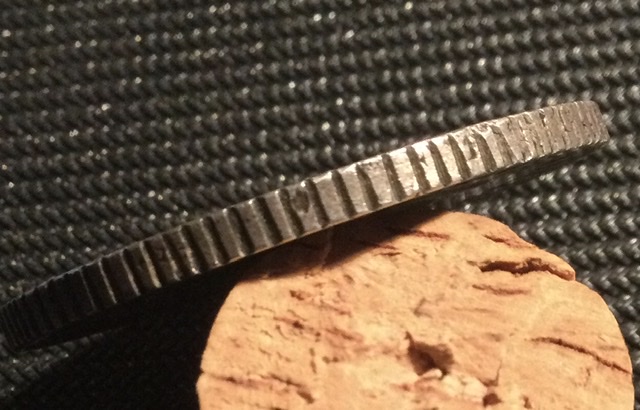
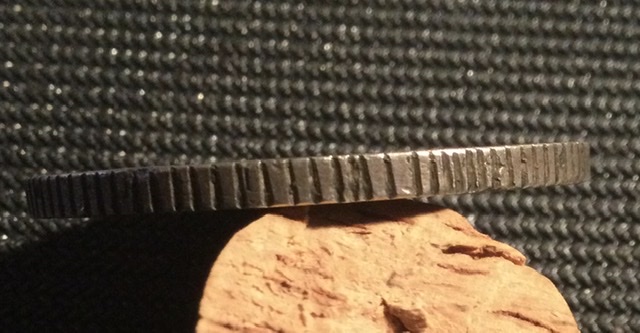
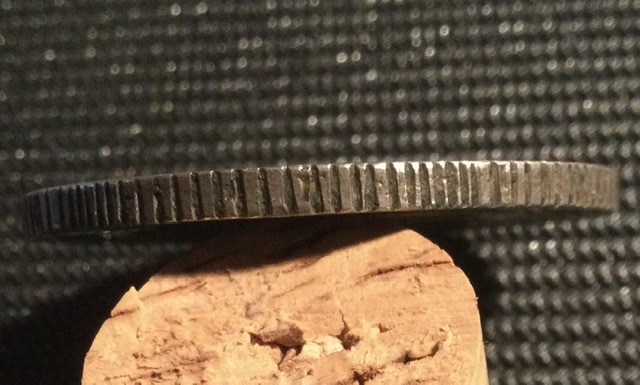
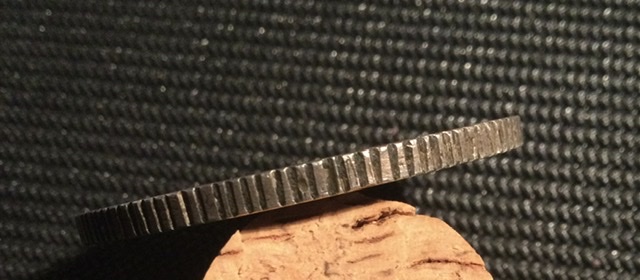
Nice effort...the tolerances are there...I'm still in the original coin, tooled rim camp. the extra thickness of .007" could be a result of the tooling.

KK
Pillar of the Community
swamperbob's Avatar
United States
5362 Posts
 Posted 12/31/2020  7:53 pm  Show Profile   Bookmark this reply Add swamperbob to your friends list Get a Link to this Reply
Johnny676767 Thank you for that effort.

I made the assumption that the measurements were in inches.

I did the calculations. The genuine coin (A) has a volume which calculates to 2.5 cubic centimeters (that is the best that you can use because of scientific notation.)

The coin with the grooves cut in the edge (B) has a volume of 2.7 cubic centimeters. The weight of coin (B) is 24.64 grams - the SG of the alloy is 24.64/2.7 or 9.1 plus or minus 0.5. The coin is a counterfeit.

This could also be surmised by the increase in thickness alone. The coin with the filed edge is roughly 10% thicker which is all that is needed to short the density by 10%.

If you have ever seen an old coin scale there were slots that a coin had to fit through for both diameter and thickness. This coin would fail any such test.

Pillar of the Community
swamperbob's Avatar
United States
5362 Posts
 Posted 12/31/2020  9:10 pm  Show Profile   Bookmark this reply Add swamperbob to your friends list Get a Link to this Reply
I would like to add a few other comments related to the topic in general.

The day before yesterday, I received a group of 50-60 coins in the mail to review. I actually never counted them so that number is an estimate. They came from a dealer that I have bought counterfeit Mexican coins from in the past.

These were all counterfeits. He was interested if any of them were CCC types and he wanted to know if I would be interested in any of them.

Included were gold, silver and copper coins both US and foreign.

I did a normal screening test by first looking at them with a 10 power loupe. All but 8 coins were obviously counterfeit from surface characteristics that I recognized.

However, for fun and to illustrate a point that I would like to make here, I did a strictly scientific review. I weighed each coin and measured the diameter and thickness in mm's. From that I calculated the SG of each and every coin. I used a mechanical 4 beam Ohaus balance to do the weights. It took me under two hours in all.

The coins did not all fail this test.

In fact all of the gold coins were actually gold. Just the incorrect alloy ranging between 30% and 75% gold. I checked SG's against two tables Au alloyed with Cu and Au alloyed with Ag. Those two metals silver and copper are normal alloys that are easy to work with. The coins alloyed with silver (Ag) had lower actual melt values than the coins alloyed with copper (Cu). That is a simple fact of physics. I calculated melt values both ways to establish a likely range and determined a total melt value near $800 for the lot. All the gold coins were Numismatic Forgeries except one an 1854 US Dollar. It was gilded copper and looked contemporary. An XRF test of the gilding should establish age based on the presence of Mercury which I would suspect to find.

Several of the silver coins (16) were actually silver within the tolerance for genuine hosts. So those I looked at more closely using a binocular microscope. All but one coin in that group was a Numismatic Forgery.

That one coin turned out to be particularly interesting.

That was a 1900 O Morgan dollar struck on near 900 fine silver with fantasy dies that were created from a transfer image taken from a genuine coin. The dies were recut to make the image more presentable. That I believe is actually a CCC type that I suspect will date to the 1930s once I can get around to doing a lab grade XRF test.

The alterations done to these coins covered a range of techniques. One coin had an embossed MM created by drilling into the side of the coin to allow entrance of a tool made to emboss a tiny D. This small D happened to be the correct shape for a 1916-D dime. The tell was the small repaired hole on the edge and a complete lack of a seam or any flow line discontinuity on the fields of the coin. That worn coin was a rather dangerous variety. One D mint mark was added to a genuine1914 cent by chasing metal from the field (creating a depression) and engraving the MM into the raised area. All the others were MM appliques - two using heat the rest using glue.

There were a few other CCC types including a Bust Half struck in German silver that is listed in Davignon's book. Most were off metal casts and strikes using different types of white metal including a few with tin crystals on the surfaces. Those are typical of the depression era silver copies made for circulation. It is proof they are casts.

It was a very nice "cover the waterfront" group of fakes. Three nice MS coins a Morgan dollar and two Mercury dimes were turned into culls by MM additions. A very nice near MS 1898 S Morgan was altered to read 1893. So there was melt value present. In my opinion only two coins were truly dangerous forgeries.

Finally there were the typical fantasy coins that were all modern. 1955 DDO, two 1909 S VDB cents, 1909 S Indian cent, 1853 Large cent, a decent 1793 Chain cent, a couple silver commemorative halves etc., etc.

So using science alone in a period of under three hours anyone with almost zero familiarity with coins themselves could isolate over 40 spurious coins. With just a few additional hints on what to look for, all but two coins could have been detected scientifically. The last two did need actual knowledge of forgery to detect.

I have a question.

Why are most collectors so reluctant to use science and still prefer to rely on appearance alone which is NOT always reliable?

Pillar of the Community
jgenn's Avatar
United States
1156 Posts
 Posted 01/01/2021  01:52 am  Show Profile   Bookmark this reply Add jgenn to your friends list Get a Link to this Reply
Perhaps, swamperbob, you would comment on some of the last posts in the porthole/keyhole thread, where we are at loggerheads about whether forgers could create a visually accurate Charles III 8 reales in the late 18th Century.
Edited by jgenn
01/01/2021 01:52 am
Pillar of the Community
swamperbob's Avatar
United States
5362 Posts
 Posted 01/02/2021  02:18 am  Show Profile   Bookmark this reply Add swamperbob to your friends list Get a Link to this Reply
jgenn Done
Pillar of the Community
Kopper Ken's Avatar
United States
3402 Posts
 Posted 01/02/2021  10:58 am  Show Profile   Bookmark this reply Add Kopper Ken to your friends list Get a Link to this Reply
Swamperbob:


Quote:
he weight of coin (B) is 24.64 grams - the SG of the alloy is 24.64/2.7 or 9.1]


I think you are confusing density with specific gravity. They are two different measurements. Originally you were talking about SG but your last reply with the numbers used the density formula...D=M/V. I will continue the discussion and switch over to the density formula also.

I refined your calculations and the volume of the "good" coin would be 2.5238 cubic centimeters. You need to change out of scientific notation for decimal numbers. I used the formula (V=pie x radius squared x h). for the "counterfeit" coin the volume was 2.6784 cubic inches.

So the Density of the "good" coin is 9.76 g/cubic centimeters while the Density of the "not good" (?) coin is 9.20 g/cubic centimeters. There is a difference..6%...but...let's look at the only variable that changed...the height (thickness) of the coin.

I believe that the "reeding" caused the increase in thickness (height variable) at the rim only, and that a truer reading would be gotten using a micrometer, taking a reading from the middle of the coin.

I still believe that this is a damaged original coin...there is not sufficient variation in the density. Which is what you have shown also.

You are definitely right about using science. I tell my students all the time to make sure you put the units on your measurements. Gotta know what we're talking about.

I would ask johnny676767 to get a micrometer and take a measurement of both coins at the center and a few places in the field.

KK
Pillar of the Community
United States
1913 Posts
 Posted 01/02/2021  1:17 pm  Show Profile   Bookmark this reply Add Albert to your friends list Get a Link to this Reply
A post about a coin like this generates much discussion due to a great divide between the holder of the coin in question and those that can produce an easy accurate determination.
If I had it, I'd probably know pretty quick. But like some others that may be able to do the same, we don't have the coin in hand to observe and test. And the OP lacks the right tools and skills to offer much help.
Somehow, apart from just being an online forum, there should be some way to promote a service where coins in question can be sent, evaluated and returned. I do that in my shop for some local people. Coin dealers and collectors in a number of states have also had me evaluate coins. We have a sticky note listing reference books. Could there not be a sticky note with contact info so some of the members could find a location, send their coins and get back the results. The observations, tests, results and conclusions could all be posted.
Valued Member
Canada
242 Posts
 Posted 01/02/2021  4:48 pm  Show Profile   Bookmark this reply Add Loruca to your friends list Get a Link to this Reply
With the greatest possible respect to Swamperbob's knowledge at the intersection of the fields of metallurgy and numismatics, this sort of calculation is exactly why significant digits are taught in high school, the alleged difference is irrelevant given the original standard of precision of the measurements.

These coins were worth their weight in silver, the only contemporary counterfeits I am aware of are made of base metals, a silver counterfeit would have defeated the purpose of faking the coin! Unless someone is alleging this is a modern numismatic forgery, artificially (but perfectly!) worn and toned, there would have been no point to its production.

I would also like to note that from the pictures, it seems a section of the edge was not reeded, and that, surprise surprise, there is a nice looking rosette on that piece of edge. I have yet to see a single example of a convincing Italian "Fert Love Knot Star" edge lettering.
This coin is original! I'd bet on it.

LRC
Pillar of the Community
swamperbob's Avatar
United States
5362 Posts
 Posted 01/02/2021  11:19 pm  Show Profile   Bookmark this reply Add swamperbob to your friends list Get a Link to this Reply
Kopper Ken When one is dealing with SG vs Density the "confusion" you point to is of no real consequence. Water the unit reference for Specific gravity in the metric system is 1 gram per cubic centimeter so the difference is merely terminology provided the conversion to g/CC is made in the calculations which I did. The answer is 9.1 either way. Density (weight divided by volume) is expressed as 9.1 grams per cubic centimeter and SG which is expressed as a number without units. However the units are only eliminated in last step where the density is divided by the reference to the standard unit. 9.1 g/cc divided by 1 g/cc which produces 9.1.

You say:

Quote:
I refined your calculations and the volume of the "good" coin would be 2.5238 cubic centimeters. You need to change out of scientific notation for decimal numbers. I used the formula (V=pie x radius squared x h). for the "counterfeit" coin the volume was 2.6784 cubic inches.


You use "Scientific notation" where I think you mean significant figures. I used the same standard formula for the volume of a cylinder and reached the same mathematical answer but we differ on how many digits are actually significant in the result. The mathematical answer may be 2.5238 but that is a false level of precision. You should not express the result in 4 decimals when the measurements were taken only to thousandths of an inch (two significant figures). So the result can be no more specific than Two significant figures 9.1.

Since the diameter of BOTH coins is identical by measure - the only true variable is the thickness measurement. One coin is 92/1000 ths and the other 98/1000 ths. That difference is VERY significant - you simply can not ignore it because it does effect density and makes the difference between 900 fine silver and some sort of debased metal.

You also say:

Quote:
I believe that the "reeding" caused the increase in thickness (height variable) at the rim only, and that a truer reading would be gotten using a micrometer, taking a reading from the middle of the coin.


There is no evidence in the photos that the thickness was increased by the application of reeding. That is a supposition without any actual evidence and should not alter the result.

What we ideally need is the actual volume of the coin not any single thickness. However, I still maintain that the difference between 92 and 98 thousandths is adequate to generate a conclusion that the coin is NOT genuine.

A ratio of the measurement taken at the rim will accurately describe the ratio of volumes if the contours and diameter of the coin match.

Your conclusion based on the above supposition is:

Quote:
I still believe that this is a damaged original coin...there is not sufficient variation in the density. Which is what you have shown also.


If one coin is 98/92 thicker - How does that actually effect the density?

The volume of the coin (B) using your numbers is 2.6784 cc.
The volume of the coin (A) is 2.5238 cc.
If the weight of both is identical then the density is reduced by the ratio of those two numbers. 2.6784/2.5838 or 1.0469 - 5%. So there is a 5-6% change in Volume, Density and ?.

Coin silver 900 fine has a density of 10.3 g/cc. Reducing that to 95% (average of ratios) reduces the density to 9.785 which is NOT 900 fine silver but something less than 650 fine silver IF IT CONTAINS actual silver. The alloy could be bronze coated with silver and achieve that density.

Anyone familiar with Riddell's 1845 book should recall that Riddell found that his melt averages were only 5% short in total silver, but that 5% difference led to his cataloging the first ever book on circulating counterfeits. Perhaps the coin that began this thread is actually a CCC type.

Albert
You make a great suggestion. I do the same thing for anyone asking and do not charge for it. In hand it is easier of course you can look closely at the coin and settle the open issues by accurately weighing the coin in air and immersed in water. The loss of weight in grams equals the volume of the coin in cc's. Density is weight in air - divided by the weight loss. Remove units and you have SG. Just that simple.

Loruca You say:

Quote:
this sort of calculation is exactly why significant digits are taught in high school, the alleged difference is irrelevant given the original standard of precision of the measurements.


You are right significant digits are critical but your conclusion is flawed. The use of significant digits actually supports my conclusion and can not be ignored without a valid reason. A change in volume of 5% is precisely what is often seen with counterfeit coins made for circulation. You ignore a 5% variance at your peril.

I would ask why you believe that the concept of significant digits applied correctly eliminates concern for a 5% change in volume? That is not something actually based in science.

The you say:

Quote:
These coins were worth their weight in silver, the only contemporary counterfeits I am aware of are made of base metals, a silver counterfeit would have defeated the purpose of faking the coin!


Silver counterfeits using the identical silver alloy as genuine coins were made and in many coin series that circulated in the 1890s and 1930s are in fact very common. You are unaware of them perhaps but they do exist in very large numbers. The reason - in 1893 world silver values dropped to about 30 cents an ounce (same thing happened again in 1933). A coin like the 5 Lira had a silver value of only 21.7 cents. In 1893 a dollar coin cost about 5 cents to make. So for 26.7 cents a counterfeiter could make and circulate a genuine silver coin at a profit of nearly 5 times more than cost. That is a cold hard fact.

Most collectors are unfortunately unaware of that fact and often own ccc coins believing them to be genuine.

Examples of this happening are US Morgan dollars, Spanish 5 Pesetas and Peruvian Sols. When discovered - ccc's of this type are melted to get them out of circulation (See historic records for Spain in 1895 and the massive redemption of millions of ccc 5 Pesetas that happened.) There are many other coins copied in a similar way in history.

Pillar of the Community
United States
1913 Posts
 Posted 01/02/2021  11:50 pm  Show Profile   Bookmark this reply Add Albert to your friends list Get a Link to this Reply
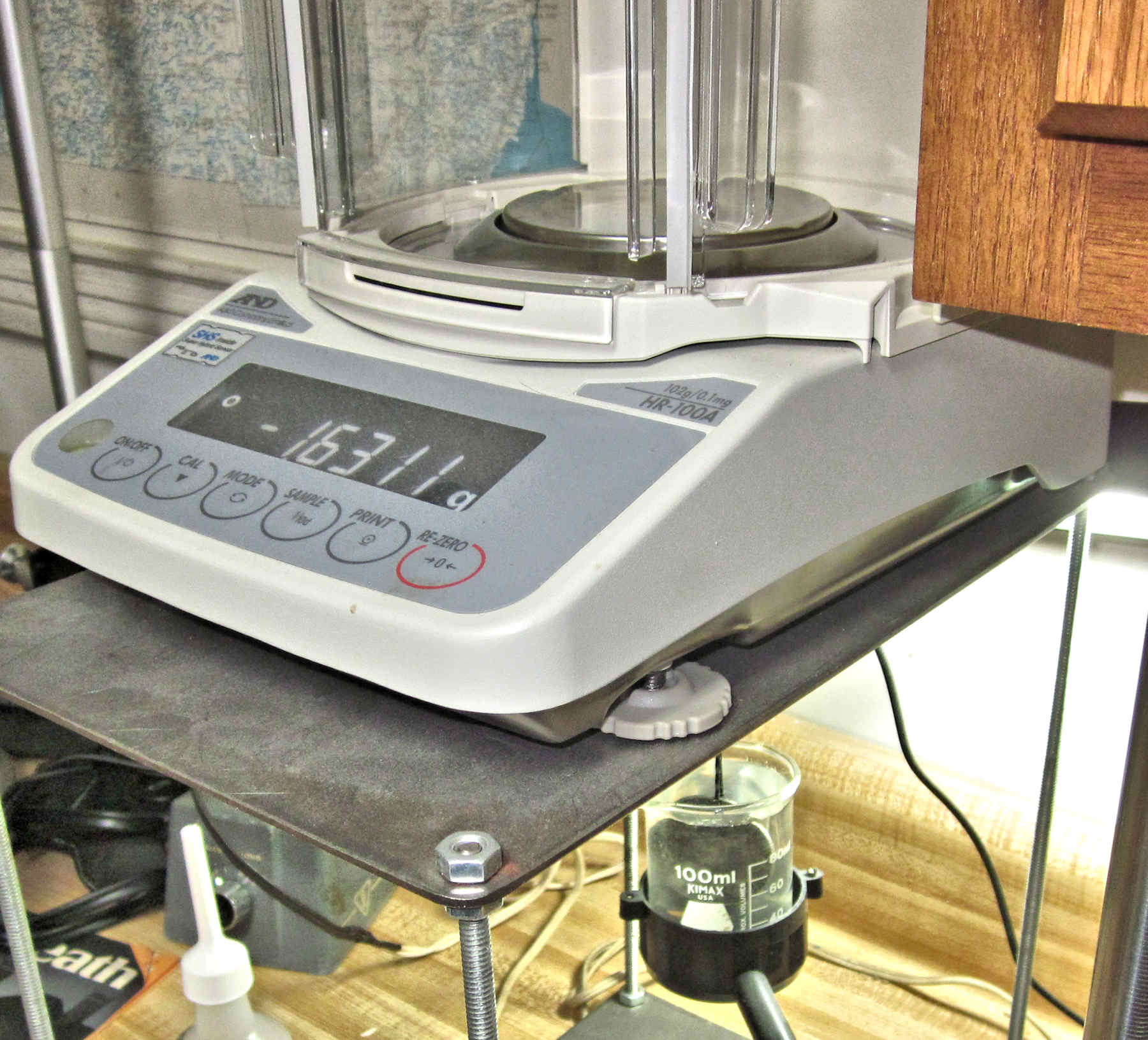
swamperbob I have a superb balance with all the specs to give accurate values. I mount it elevated on the bench to make use of its under-weigh capability. Your suggestion is one of the two methods I use. In this case there is a loss submerged of 1.6311 grams.

Fake-Italian-1876-R-5-Lire?
  Previous TopicReplies: 45 / Views: 6,182Next Topic
Page: of 3

To participate in the forum you must log in or register.


Disclaimer: While a tremendous amount of effort goes into ensuring the accuracy of the information contained in this site, Coin Community assumes no liability for errors. Copyright 2005 - 2026 Coin Community Family- all rights reserved worldwide. Use of any images or content on this website without prior written permission of Coin Community or the original lender is strictly prohibited.
Contact Us  |  Advertise Here  |  Privacy Policy / Terms of Use

Coin Community Forum © 2005 - 2026 Coin Community Forums
It took 0.68 seconds to rattle this change. Forums