| Author |
 Replies: 34 / Views: 3,240 Replies: 34 / Views: 3,240 |
Page 3 of 3
|
|
|
|
Pillar of the Community
 United States
3363 Posts |
Would you happen to have photos for these intentional rehubbings?
VERY INTERESTING!
|
|
Pillar of the Community
United States
3747 Posts |
Many of the 1941 rehubbed "T" with doubled four coins are listed in the Cherry Picker's Guide, Variety Vista, Copper Coins (search for 1941 Philadelphia and DDO), and the Wexler site with various numbering. Not all are listed on all of the sites, and many of the Wexler site listings for 1941 are apparently in the process of being updated with new or better photos. Here are a few of the examples where the doubled second "T" and lightly doubled four are in the photos: 1941 FS-102, DDO-002, 1-DO-002, WDDO-002 1941 DDO-007, 1-DO-035 1941 DDO-0091941 DDO-0121941 DDO-0211941 DDO-026All three of the 1949-S Doubled dies are listed in the Cherry Picker's Guide, Variety Vista, Copper Coins (search for 1949-S and DDO), and the Wexler site with confusingly different but similar numbering. They are: 1949-S FS-101, DDO-001, 1-DO-003, WDDO-002 1949-S DDO-002, 1-DO-002, WDDO-001 1949-S DDO-003, 1-DO-001, WDDO-003 After retiring, I was talked into going to three estate sales with bags of cents. I misbehaved, and bought many of the bags. Then I spent months sorting the first few dozen of the bags by date and mint. On a positive note, many of these bags were pulled from circulation in the 1960s, based on the names of the long-gone banks on several of the bags and the condition of the coins. Now, I'm going through multiple coffee cans filled with single dates to search for varieties. I've been going through far too many 1941 Philadelphia cents since May. (So much for "retirement.") Edited by fortcollins
10/01/2025 6:32 pm
|
|
Pillar of the Community
United States
3363 Posts |
THANK YOU!  |
|
Pillar of the Community
United States
3747 Posts |
When I come up for air, I'll post some of the coins I've found. I can safely say there are at least 25 unlisted minor 1941 DDOs and at least three that may be fairly significant. I'm holding off sending any of them in until the Wexler site is updated for 1941, because many of them may already be listed there.
|
|
Valued Member
United States
399 Posts |
Thank you for sharing this information, food for thought. I agree with coin collectors' fair improvements, and some transparency is needed. Current Situation: Minor Doubled Dies Coins. Current Issue: Minor doubled dies coins are undervalued/being perceived as "not a true doubled die". And some big resources are not recognizing these minor double dies and consider them as "worthless"? Currently, "The mint says," Subtle imperfections on circulating quality coins are 'inherent' in the coin-making process. So, I am thinking of subtle imperfections and visible flaws; these minor deviations should also be recognized as added value. On the other hand, "intentionally" doubled dies coins are much more complex. If a coin doubled die was done intentionally, how can we call this an error?" 1.) Desire Improvement Plan: A.) Establish a standard official tolerance chart for double dies coins. Like they did on coin Weight Tolerance. Thank you, coin community. So far, I have gone through several thousand Lincoln cents. This is my therapy.  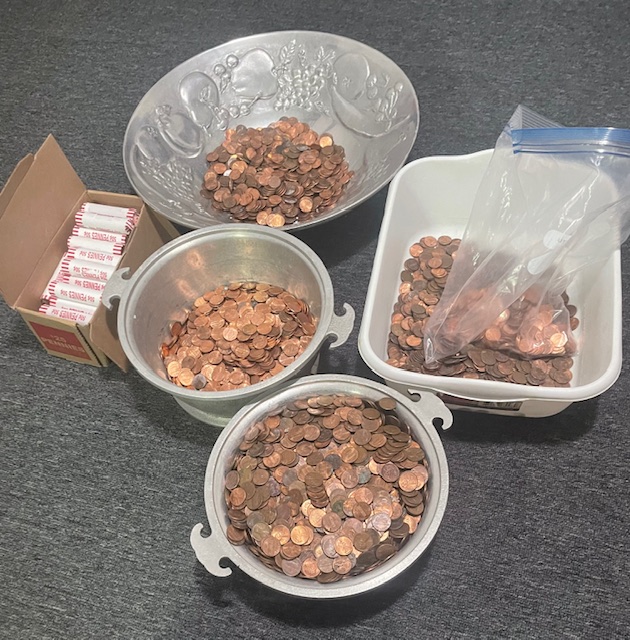 |
|
Pillar of the Community
United States
3363 Posts |
Quote:A.) Establish a standard official tolerance chart for double dies coins. Like they did on coin Weight Tolerance. That is an interesting idea. I am having difficulty understanding how a Doubled Die degree of minority/majority could be quantified for such a chart! If some one would like to attempt an example, I would like to see it! |
|
Valued Member
United States
399 Posts |
First, we have to consider that there are barriers to improvements. But I am not discouraging added value improvements. And should not allow other questionable practices to stop you from making improvements.
For example, coin grading companies have their own grading and opinions on coin values, etc. And some of their things of doing can be unfair and biased.
For instance, the same coin can be graded multiple times. This style of practice itself is complex. Because of this nature, it can potentially discourage current collectors and the future coin-collecting industry.
Coin/currency grading companies are not regulated and have the power to manipulate the value of our currency collection and create their own standard of doing things. This practice can potentially be a barrier to improvements.
These areas of concern should get the attention/address first, because they hold the last word.
Therefore, progress is needed, and the coin community can contribute added value improvements. Happy hunting and collecting. Thank you, coin community.
|
|
Valued Member
United States
399 Posts |
@pet2226
I did some research: Only the US Mint can reduce fraud schemes and add some transparency in the coin-collecting universe. US MINT sets its own coin production quality control protocol for its own use. Anything that is out of these tolerances is/are valuable. If the US MINT sets standards and tolerances for coin mint errors for collectors, this will help make coin-collecting transparent. Currently, the coin-collecting business is governed by an "expert" company that does grading and trading. They have control of coin coin-collecting business. Small guys will be out of sight. Till then, it works as usual.
|
|
Pillar of the Community
United States
3363 Posts |
Quote:
Anything that is out of these tolerances is/are valuable. I am curious: in the research you have been doing, did you find any source making this kind of statement? It certainly seems to me to be a reasonable conclusion, but I am uncertain how widely recognized it is! |
|
Valued Member
United States
399 Posts |
@Pete2226, A statement like standard quality control is so common for any manufacturer that produces products. In this case, US MINT would have policies and procedures set in place that track their productivity for their own use, not for collectors. Whether accidental/intentional, it would be obvious that the US MINT would not have records of coin/s mint anomalies, visible/magnifying errors, and their measurement. And I don't think US MINT will allow third parties such as PCGS, NCG, and other coin experts, share certain confidential information. Privacy Act.
It has been like this: Collectors relying on communication and information from the coin site/s and from the coin "expert," not from the US MINT channel.
The Big Question: Does anybody want changes? Yes, no, and maybe. Hopefully. US MINT and technology will eventually disrupt the current way of doing things in a more transparent, fair, and reasonable way for all current and future collectors. This is just my fair and reasonable opinion.
I can only prove to you my personal experience with these coin "experts" 1.) Here we have a "numismatic specialist" who has been in the coin business for over 40 years; they are a member of this and that, coin organization, club, etc. 1.) A Coin expert site that also has its own expertise of this and that. 3.) We have coin grader companies, and they also have their expertise in this and that.
These three experts have varying opinions about my coin. One expert saw my coin physically, and here we have two experts who saw photos of my coin. This expert, who saw my coin physically, told me their assessment. While we have two experts who only saw photos of the coin told me they are "firm in their assessment".
If we have an official standard of mint errors tolerances and varieties set in place, etc., we will not have these issues in coin collecting.
Edited by Dough101
10/12/2025 3:16 pm
|
|
Pillar of the Community
United States
3363 Posts |
Quote:
Whether accidental/intentional, it would be obvious that the US MINT would not have records of coin/s mint anomalies, visible/magnifying errors, and their measurement. As I mentioned in my paper, I have found a few clues about how the mint treats anomalies. One example from the 2014 Biennial Report is this from a table on experimenting with nonsense dies for a Baseline Die Life Determination for nickels. In this image, 10th refers to the 10th Die Pair of nonsense dies tested. 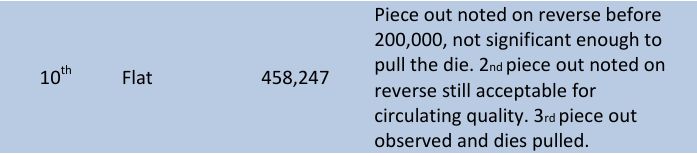 In this example, a second "Piece Out" (which we know is defined as a "piece out of engraving" is still acceptable for a circulating coin. It would have been more helpful for our purposes had they indicated sizes, but I will take what I can get! (this is from the Technical Report 2014 Biennial Report to the Congress United States Mint Department of the Treasury FINAL August 11, 2014) Page 109 Edited by Pete2226
10/12/2025 3:37 pm
|
|
Valued Member
United States
399 Posts |
@Pete2226, we can only hope that things like this should be considered; it is for sure will bring positive impact to the coin collecting universe. Also, and remember if it is not in their books, newly error coin discovery, "expert" would not want to deal with it. More likely they will just used coins comparison. It is all.
2014 information still good for references:: Keep in mind machine, technology tools, things of doing, etc are now different from 2014. So we can expect and sees different types and looks of mint error etc. Example: pressure, strikes, speed impact etc.
|
|
Valued Member
United States
116 Posts |
it would be a lot easier if the mint were to serial number coins like they do bills,
This would enable collectors to trace their coin to a specific die and to know where in the life of the die the coin was produced.
This would enable easer double die verification. When die #3724 is declared a doubled die there would be no question that if a coin can from die #3724 it is a doubled die
|
|
Valued Member
United States
399 Posts |
Good morning, coin community. Everyone's opinions do matter. Here is my contribution, and my opinion is not intended to alter your views on things. Story of Double Die Discovery: Some collectors, including John A Wexler, found double die coins. According to his online bio, he is a high school mathematician. The article explained: He "found his first double die error in 1971." The article did not specifically indicate what type of denomination or years of this coin, which was attributed by error/variety specialist Alan Herbert, known as "Answer Man". According to a Coin World article, Alan Herbert began his coin collecting when he was in his 30s. According to John Wexler, he continues his coin searching: in 1972, he said the US MINT produced various 1972 double dies. The article did not indicate what type of denomination it was, and the article did not provide US MINT confirmation of these findings. In his own words: During the 1970s and early 1980s, John Wexler served as "Hubbing Variety Statesian" for CONE and began writing for CONES club publication Errorgram". You can find this information on "Wexler's coins and Die Varieties. Here are my varied opinions on Types of Variety. According to the article, "counterfeit and altered Lincoln pennies were found during the 1960-1970s." The US. SECRET SERVICE warns about counterfeit coins created through plating, which was sometimes done for school science projects or other private purposes". Here are my varied opinions on so-called true Double Die coins. According to an online article, Infamous 1955 Doubled Die Coin: At the time of discovery US Mint did not officially confirm the existence at that time it occurred". It was the numismatic experts and collectors who publicized the error". The error was discovered by Mint employees shortly after striking had begun, but the Chief Coiner decided to let the coins circulate. According to the online source, the "US Mint confirmed that a Working hub was Misaligned". The most famous example is the "1955 Lincoln Cent." Mint non-confirmation: "At that time, the US Mint did not officially acknowledge the coins as a recognized error. They were simply viewed as defective and released into circulation". Happy hunting and stay informed. |
|
Valued Member
United States
399 Posts |
Good afternoon, Coin Community: I have been reading and spending a little time researching Production Error and Die Error standardized tolerances. This is going to be a lot of work. I believe that collecting should be fun and fair for all collectors, regardless of whether they or she just joined collecting games. Currently, our coin-collecting system is solely governed by big dealers and graders. Sometimes we feel like we are being cheated, taken advantage or simply just want to quit. This situation is of no value to coin coin-collecting community. So, I brainstorm what is best for the coin-collecting community. Please add positive input to these goals. Is there any guidance you feel should be provided in this area of collecting? I. Desired: Production Error and Die Error Standardized Tolerances. A. Currently, small guys collectors are relying on large dealers and third-party graders. B.) Small guys are often confused about what is valuable and what is not valuable. C.) Varying opinions from numismatic experts. Happy hunting and stay informed.  |
|
Page 3 of 3
|
Replies: 34 / Views: 3,240 |
Page 3 of 3
|
To participate in the forum you must log in or register.
- Publishing Toned Copper Coin Here
- 1988 Mexico - 50 Pesos, 10-15% Off-Center Strike
- 1990-D Dime Minor Greaser
- Are You Looking For A Steal?
- 1944-D Lincoln Cent Altered To Be A 1914-D Lincoln Cent - 100% Authentic
- How Far Back Can We Go? Ninth Edition!
- 1795 Liberty Cap Large Cent, PCGS AU-58+, S-76 Struck Over 1794 S-71, Jeff Garrett Discovery
- 1974 San Marino 20 Lire, PCGS MS-67, San Marino, Lobster
- 2026 P Nickel: Low Potential DDR
- All Members, Post Your Most Recent US Coin Purchases!
- Continuing List To Show Everyones Latest Acquisitions
- Post Your Coins With Coats Of Arms, Shields, Crests, Crowns, Etc.
- Around The World With Coins - A Coin Geography Game
- G L B 49's Random Silver Coins
- Post Your Bird Coins
- Yet Another Forum Game - Numismatic Go Fish!
- Post Your Coins With Stars
- Post Your Coin Or Medal With Flora
- Post Your Coins Representing The Animal Kingdom.
- Post Your Lion Coins!
Disclaimer: While a tremendous amount of effort goes into ensuring the accuracy of the information contained in this site, Coin Community assumes no liability for errors. Copyright 2005 - 2026 Coin Community Family- all rights reserved worldwide. Use of any images or content on this website without prior written permission of Coin Community or the original lender is strictly prohibited.
Contact Us | Advertise Here | Privacy Policy / Terms of Use
|
| Coin Community Forum |
© 2005 - 2026 Coin Community Forums |
| It took 0.38 seconds to rattle this change. |
 |
|





 First Page
 Previous Page


 Posted 10/01/2025 6:23 pm


