Chris - I got your note regarding
Trade dollar forgeries and I have checked the pictures you posted. I would ideally like to see the edge also. I am particularly interested in any irregularities in the size, shape or spacing of the reeds. On
Trade dollar originals these are ABSOLUTELY identical around the entire perimeter. Forgers quite often fail to take appropriate time on the reeds.
I authenticate coins part time for a Raleigh, NC coin dealer and do estate appraisals. I have previously done authentication for dealers in the Boston area. My specialty is
Counterfeit Detection. I have been studying that field for over 40 years and have spent thousands of hours with experts in the field.
Trade dollar forgeries are VERY common and the process of duplication has become excellent especially in the past 10 years.
Most
TPG's authenticate on the basis of surface appearance. ON low end material their check takes less than one minute. On higher value coins they spend more time and will SOMETIMES check the edges. How long they spend is a function of the potential loss if the coin is determined to be a forgery later. It is a very rare case where they resort to Specific Gravity or XRF to complete the evaluation.
The 1877 CC is a coin which unfortunately is known to be forged in a manner that will pass most cursory testing. The average coin dealer lacks the knowledge of the minting process to pick up on the errors which occur on these high end forgeries. The forgers spend more time in the manufacture of rare coins than they would on a lower value coin. So the end product is much closer to original. But most are NOT PERFECT.
I follow similar procedures to the
TPG authenticators, but because I am retired and love coins in general (counterfeits in particular) I will spend hours examining an interesting forgery. I operate on an accumulation of proof basis. I examine the manufacturing methods of a coin looking for clues as to how the coin was produced. I match the clues with the facts of how the originals were made. If I find a problem or concern (conflict) I evaluate whether that "error" occurs on real coins as well as on counterfeit pieces. Most clues visible on a picture actually happen in both cases. But the prevalence of how often they happen is critical. If a coin has a series of concerns that are each VERY RARE on originals but very common on forgeries - the accumulated probability pushes toward forgery. If there is a CLEAR manufacturing error - like ring die applied edge reeds - the coin is a FAKE PERIOD. Many coins, however, will end up in the "gray" area of suspect based on photos alone. A picture may be worth a thousand words but it proves very little.
Based simply on the pictures - I get a really BAD feeling about this 1877 CC. That is the Bad news.
Perhaps in large measure that is due to the weight issue which was presented at the outset. A
Trade dollar 1.5% underweight would NOT have been really acceptable to the target audience for this coin. The purpose of a
Trade dollar was the sale of silver bullion. Intrinsic value and the reputation for consistency was of paramount value. The weight deficit in this case is at or beyond normally occurring tolerance. VERY SUSPICIOUS.
The coin is very nearly FULLY STRUCK UP and there is no obvious post strike damage that would have REMOVED mass. So I see no "reason" for the deficiency other than the planchet was too light. If the coin had "weakly struck" areas in some sections, I could see a tapered planchet as being the reason for weight loss - but I see NO EVIDENCE of that at all. The dies were completely filled with metal and the strike is very uniform in appearance. This reinforces the SUSPICIOUS nature of the coin when weight is made part of the equation.
I see 8 perhaps more Obverse Chop marks and one large Reverse chop. The appearance of the chops is PRISTINE in some cases and I suspect most cases. There is only one corroded possibly worn(?) chop. I would normally examine the recessed areas of the chops looking for clues not visible on the photo, but in general I am struck by the number of chop marks versus the overall wear level. Chops were not normally put on in large numbers by multiple merchants at ONE time. There should be some time span between the application of the chops. The degree of surface discoloration of the coin points to it being stored in a reactive environment for some period of time, but does the discoloration extend to the bases of all the chops in a similar manner or Not? This is one of those gray areas where it does happen sometimes but is far more often seen on fakes. Chops can be used by forgers to obscure die defects. They are also aware that some TPGs place chopped coins in a "damaged" category and they (TPGs) may spend less time evaluating a chopped coin because of reduced value.
I am also bothered by the position of some of the chops. A chop used to test the coin relied on depth of impression versus force of impact (in one category of common test). The location chosen was invariably a smooth area of the coin (the field) or at least one where the chop face contacted the coin metal uniformly. A chop that crosses from a field to a main design feature is SUSPECT and draws my attention. What would that chop be used for? Other than identification of the merchant I can see no value to such a chop - so then the character of the chop involved is critical. A generic chop for "silver" or "Buy at Joe's" is a perfect chop to cross a design margin. But a very generic row of three lines? There are several of these poorly positioned chops here. VERY SUSPICIOUS.
There is also the issue of the deeply impressed "cutting" chops. There are at least two in this category. Chops done this way were used to detect mined (hollowed out) coins or very thick plates (like Sheffield Plate) - they are meant to be disruptive to the bond seams inside a counterfeit coin. A solid silver coin will just be damaged by such a chop. But a mined coin will come apart at the seams literally. I have a nice mined 8R from the 1870s which has a destructive chop used to dislodge the surface. The impression of the chop passes through the exterior layer and is clear on the central non silver plug. The presence of two such chops on this coin speaks to ORIGINALITY. It could also indicate knowledge on the part of the forgers that destructive chops were common in the late 1800's.
There are also some method of manufacture issues which are visible in the pictures that make me curious/suspicious as well. Most of these are better discussed after a microscopic exam but based on what I see we have the following issues:
1. There is a line on the obverse of the coin above Liberty's hand that is suspicious.
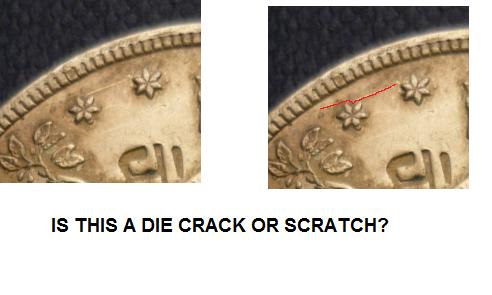
The feature appears to be a raised line from a die scratch or possibly from a die crack. The crack appears discontinuous. It looks like and may be a "soft crack" which develops in plastic transfer dies. It does not (at this level of magnification) look like a typical stress fracture in steel.
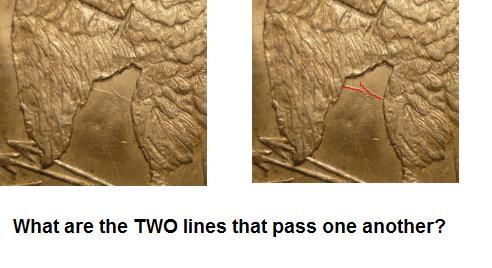
2. The second line seen below is similar to #1 but in this case there are two lines that do not meet under the eagle's wing. Once again the problem is the shape of the lines. They are odd because they are in an area of the die not noted for stress fractures and they point to two distinct foci of stress.
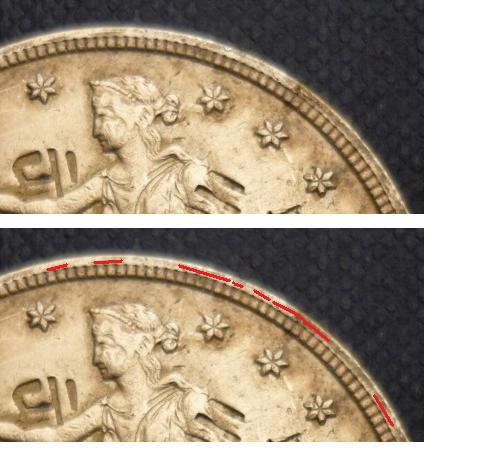
3. A distinctly different issue involves the area near the rim. If you notice on the obverse the top and bottom rims are distinctly different. The top of the coin is well struck which is an indication substantial pressure while the bottom rim is very weak struck up an indication reduced pressure. The most common cause for such an anomaly would be unaligned die faces. BUT in this case, I see only the rim as evidence for the poor alignment of die faces. There is no other evidence of a misalignment in the rest of the design. I am also concerned that when you compare obverse and reverse that this feature appears clearly on the obverse and far less clearly on the reverse. Suspicious. The cause here could be a poorly edged (dentils at the rim) die or a die surface that is warped at the edge. This happens quite often when a plastic transfer surface is peeled off the coin BEFORE it hardens. The edge is still too flexible and it bends while being removed. It then hardens with that slight bend in the rim area. The result is a coin that looks like this one.
4. I also noted the presence of several possible collar seam lines. While these are sometimes seen on real
Trade dollars they are far more common on forgeries. On an original they are usually seen when an older or well worn coining press is employed. But on a forgery they usually happen when the die face is slightly enlarged after a transfer impression is made which shrinks in the process of hardening. Many modern "plastics" which can be used to cast dies strong enough to strike a few copies of a coin are dimensionally unstable - they shrink slightly when they dry necessitating the addition of a small "extra" space at the rim to produce a coin of the correct diameter. I can't be sure from a picture BUT I am very suspicious that is what I am seeing here.
Where to go?
First check the reeding on the edge. Look for variations. The reeds MUST BE IDENTICAL in shape and separation. Overlaps or doubled reeds is a dead giveaway that the coin is forged. Look for filing or buffing lines on the tops of the reeds - forgers have to grind and polish off the effects of a ring die. Any evidence of mechanical abrasion on the edge SPELLS DEATH FOR ORIGINALITY.
I hope this is of some help. I hate to see people submit forgeries to TPGs because they get very little in return for their $20 or $30 fee. They never even disclose how they knew. I have a couple dealers who send me their
TPG rejects. I supply reasons why they are counterfeit so that in the future - the dealers are not taken again. If you can diagnose the coin yourself you are far better off when dealing with the TPGs. I have NEVER (so far anyway) submitted a client coin for grading that has been returned as a counterfeit. I have however submitted a few counterfeits that did get graded and authenticated. I also submitted a extremely rare die variety (new hoard coin) of a Oaxaca 8R on one occasion that had to be appealed to the Ponterio's before it was finally certified as original.
Good luck in your future buys but KEEP your eyes open and ALWAYS BE SUSPICIOUS of
Trade dollars.








 First Page


 Posted 09/12/2010 7:04 pm


 That is great. Send me your addy. Yes, you can photo it.


