| Author |
 Replies: 29 / Views: 11,917 Replies: 29 / Views: 11,917 |
|
New Member
United States
4 Posts |
I was looking at this 1880 Morgan dollar and noticed that on the back side the letters "D" and "L" are missing from the work "DOLLAR" at the bottom of the coin. Above the missing "D", the end of one of the branches is also missing. Is this due to normal wear or is this possibly a striking error? Thanks for you help and opinions. 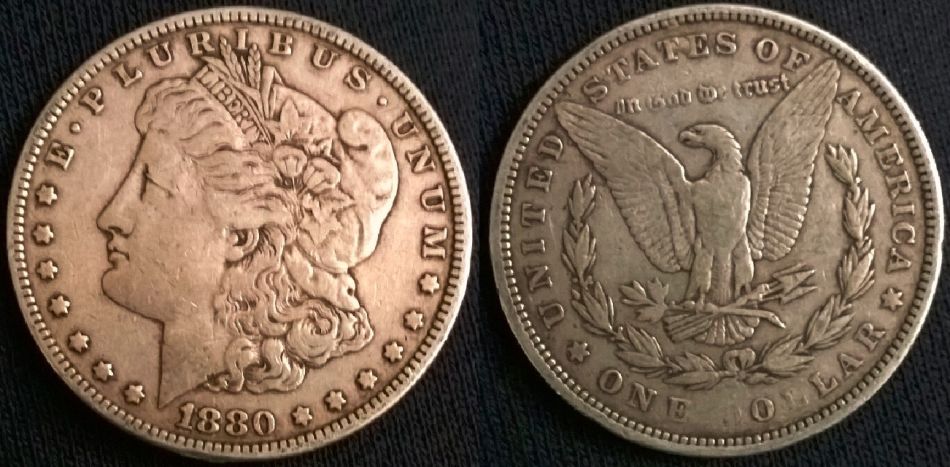 |
|
|
|
Valued Member
440 Posts |
|
|
Pillar of the Community
United States
2368 Posts |
|
|
Pillar of the Community
United States
4433 Posts |
I once read that the mints used wood chips/sawdust to periodically scrub the dies. Regardless, be it grease, wood debris or some other foreign matter, this coin does appear to have been struck through something. While only considered a minor error, Morgan dollar errors seem to be in demand nowadays. Cool find ... Edited by ExoGuy
09/27/2014 08:49 am
|
|
Pillar of the Community
Korea, Republic Of
1881 Posts |
|
|
New Member
 United States
4 Posts |
|
|
Bedrock of the Community
United States
17884 Posts |
The woodchips/sawdust was used for drying and lightly polishing the planchets after annealing and cleaning.
|
|
Pillar of the Community
United States
4433 Posts |
Thanks Conder for confirming the use of woodchips. Due to the comparative strength of the O in DOLLAR, appearing in stark contrast to the weakness flanking letters D & L, I'm inclined to suspect that it took more than grease to impede this strike.
|
|
New Member
United States
4 Posts |
It was odd that the "O" is still there when the surrounding letters are missing. Suggestions as what my next steps should be? Take it to a coin shop?
|
|
Moderator
 United States
23522 Posts |
It's a strikethrough. Not at all odd to see non-consecutive letters in a die filled. Uncommon, but hardly unknown.
|
|
Pillar of the Community
United States
4433 Posts |
What's odd to me about this strikethrough is folks claiming it was caused by grease. I would expect that grease would be more likely to spread upon impact, resulting in a more even blockage of the letters. It seems more logical to me that the impeding substance was less likely a liquid and more probably a solid, like wood particles ... Understanding that this phenomenon is a fairly minor error, the fact that it's on a Morgan makes it more desirable than if it was on a smaller denomination coin, methinks. BTW, welcome to the CCF, knockout192! If you want to sell it, I'd take it to a nearby coin show and see who the top error guy is there. Solicit his opinion and offer. I'm thinking that a serious collector of Morgan dollars would pay something of a premium for this coin. You could also visit a local coin club wherein there may well be some interested collectors. Edited by ExoGuy
09/27/2014 9:22 pm
|
|
New Member
United States
4 Posts |
Thanks for the info and the advice. I will definitely take it to have it evaluated.
|
|
Pillar of the Community
United States
8534 Posts |
Greasers are pretty common. Somebody here posted a Kennedy half one time that had just the bust showing. Incredible looking coin. I have no doubt whatsoever that grease caused this. Oregon coin geek.....*** GO BEAVS ! ! ! ***
|
|
Pillar of the Community
United States
1554 Posts |
Struck through grease...common and nothing special. No premium on this coin.
|
|
Pillar of the Community
United States
4433 Posts |
While some Morgan specialists would not pay a premium on this coin, I'd bet that it would fetch a 50% premium or more in most any coin auction. It has much appeal to the average collector; especially, as it's not a high dollar date. Also, Morgan errors are very popular. While not a major error, it is prominent, eye-catching.
|
|
Moderator
United States
23522 Posts |
Quote:
What's odd to me about this strikethrough is folks claiming it was caused by grease. I would expect that grease would be more likely to spread upon impact, resulting in a more even blockage of the letters. Keep in mind, all we're talking about here is a daub of grease the size of a large raindrop. That's all it takes to fill two or three letters in a Morgan die, and it's not inconceivable that those Victorian-era machines flung such droplets around occasionally in the course of their work. So it's a tiny amount of grease, randomly flung and possibly never even seen by the press operator. And you're right - 99 times out of 100 the first strike simply squishes the stuff out from between the dies at escape velocity. |
| |
Replies: 29 / Views: 11,917 |







 Posted 09/27/2014 07:11 am





