| Author |
 Replies: 41 / Views: 7,689 Replies: 41 / Views: 7,689 |
|
Pillar of the Community
United Kingdom
701 Posts |
Hi all, 1st time post here.
I have just received my coin back from PCGS Paris and much to my surprise it has come back as a " counterfeit " coin.
As you can imagine I was rather shocked and surprised by this as the coin has been tested several times and at the same time has been inspected by various dealers here in the UK, a discrepancy in the weight being the only point of conjecture.
I have e-mailed pcgs requesting a full explanation as there was no paperwork received with the coin on its return.
I was wondering if anyone has experience of this type of coin as I can find little but very conflicting opinions regarding this period of production. Some say they should weigh 8.33g others say 8.23g. From what I have found they range anywhere from 7.6g - 8.4g which includes the known platinum counterfeit coins.
Any info you have or opinions will be greatly appreciated.
I have tried to upload some pics but I cant get it to work yet, I will be back shortly with some when I've cracked it.
TIA all.
|
|
|
|
Pillar of the Community
 United Kingdom
701 Posts |
it wont let me shrink my pictures down to fit  Proper frustrating |
|
Pillar of the Community
United States
1512 Posts |
Hi,  ! Do you have a photobucket account? Then you could just link to the full size image.  |
|
Pillar of the Community
United Kingdom
701 Posts |
Hi Matt, sorry but I don't know what a photobucket is. The term " useless " best describes me & my pc unfortunately. I will have another go when I get 10 mins later.
|
|
Pillar of the Community
United Kingdom
701 Posts |
Sorry folks but I just cant figure out how to do the picture thing, asking me to do things I don't know about or understand  I fully understand that you cant give opinions without pictures of the coin so I will get someone in to sort it for me. A question that one of you may be able to answer though, Have any of you had a coin returned as " counterfeit " from pcgs ? If " yes " did it come with an explanation ? Surely a company like PCGS would offer an explanation or details to how they come to that decision. As you can probably imagine, I am so frustrated right now with pcgs for their lack of professionalism. Sorry for the mini rant, its doing my head in. |
|
Pillar of the Community
United States
1760 Posts |
I am working on a new book called "The Forgotten Coins of the American Colonies - Revisited." It will have a chapter on Foreign CCs. Realize that foreign gold CCs usually come in several forms:
1. Gold over brass or other debased alloy like copper or bronze. Underweight.
2. Brass alloys. Underweight.
3. Gold over platinum. Equivalent Weight.
4. Gold wash over a debased alloy. Underweight.
From above ONLY (3) is equivalent to regal weight issues and is normally reserved for South American issues since platinum was avaialble in the 19thC in S.A. as worthless metal as in Russia.
So what is its weight? If near regal it could be (3) so you have a valuable Gold/Pt CC which should easily be $$$ equivalent. Report the weight here and the associated regal weight of this issue.
John Lorenzo
Numismatist
United States
|
|
Pillar of the Community
United Kingdom
701 Posts |
Hi John, many thanks for the post. lots of interesting points.
The coin weighs 8.13g on digital scales, this makes it 0.20g underweight according to most known literature which claims the coin should weigh 8.33g.
I did a lot of research on the coin before I sent it off to PCGS which included having it " gun " tested for metal content and I also let a couple of dealers inspect it, everything ok.
I also searched for known examples and this flagged up that this series of coins seems to have weights that are inconsistent with so called mintage weights. The 1850-54 gold 100 reales do have a consistant weight around the 8.33g mark but the 1855-64 examples are all over the place from 7.6g-8.4g, I recently saw a coin weighing 7.6g sell for over $1500 and it wasn't a platinum copy.
There is also the fact that all coin sites are using the blanket weight for the whole series from 1850-64 of 8.33g when IMO this is clearly incorrect. I have contacted several owners that I have found and requested from them a picture of their coin on a set of scales and guess what ? All of them declined the offer !
I believe that there needs to be some serious investigation into this period of coins from Spain as it seems there are a lot out there that don't weigh 8.33g and only a couple that do.
I will get these pictures sorted asap. Hopefully I will get a reply from PCGS 2moro and let you know what they said.
|
|
Pillar of the Community
United States
1760 Posts |
Sounds like a PCGS screw-up if not platinum based. Try NGC or leave it raw with this information in flip on why its slightly underweight.
I am sure you are aware of the numerous Spain Isabel II platinum CC issues which are always in HIGH DEMAND. I was hoping Platinum!
JPL
|
|
Pillar of the Community
United Kingdom
701 Posts |
I am in no way qualified to say whether PCGS has messed up until I get an answer as to why it has been graded counterfeit, if it is because of the weight I will then have to ask even more questions.
The platinum copies are quite crude in their manufacture and are easy to spot, my coin would grade somewhere around MS65/6 as it is in a mint state with no hairlines/scratches and has a good luster. Maybe this has something to do with their grading of the coin because it would be the highest ever graded in this series, who knows.
During this period spain was almost bankrupt and it is well known that the mints were instructed to make counterfeit coins and it would appear that the vast majority of coins from 1855-64 were not minted with a uniform weight by the 3 mints in operation.
Looks like I have a long journey ahead of me.
|
|
Valued Member
Austria
194 Posts |
In my opinion, it is a gilt platinum planchet. Enclosed you see my 100 reales dated 1859 and a small part of my collection. the 100 reales is the upper one. 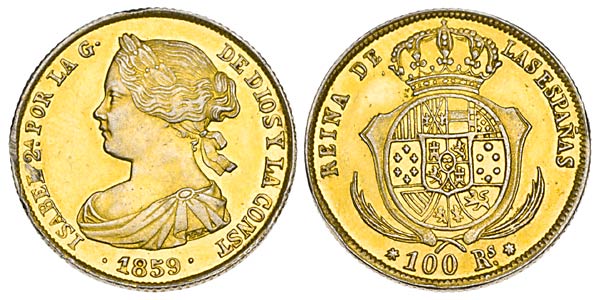 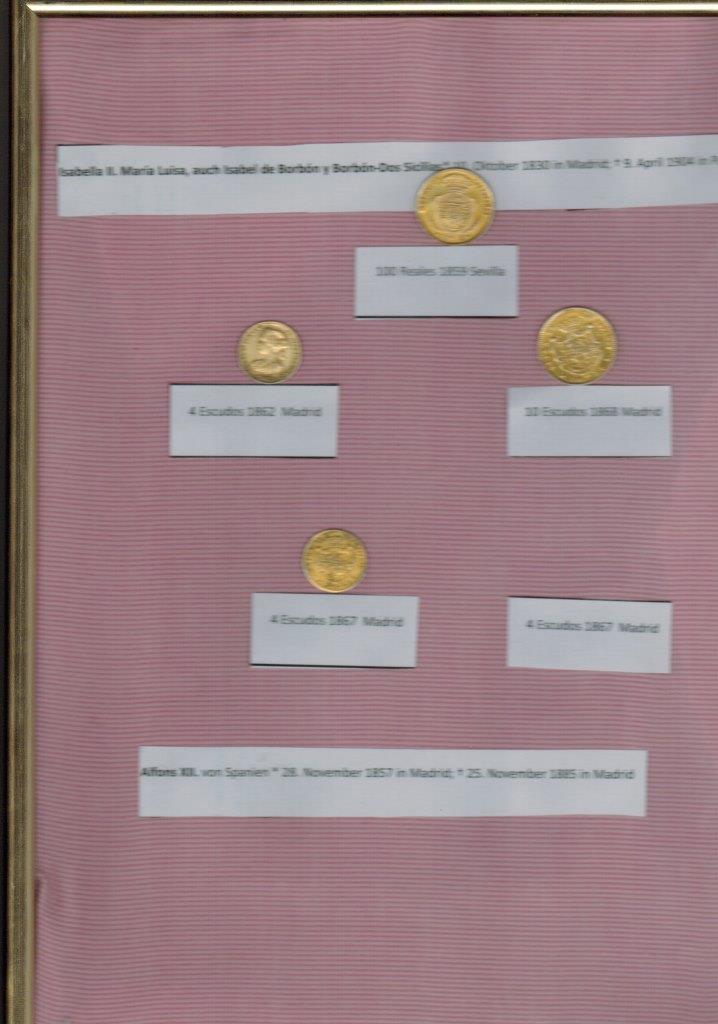 |
|
Pillar of the Community
United Kingdom
701 Posts |
Hi Platin, it definitely isn't the platinum version as I have had it tested and the results were just a fraction under 900 parts/1000 of gold content. The platinum ones are quite easy to spot because the raised surface area rubs easily and the rim is often an applied strip of gold .
My coin could not have been made anywhere else other than at the mint, it is very well struck which would IMO eliminate a counterfeit coin.
During my research I did find a lot of coins from the Madrid mint, on the other hand I can find very few with either the Barcelona or Seville mark. There is also very little information available on the Seville mint which makes further investigation difficult.
|
|
Valued Member
Austria
194 Posts |
Oh believe me, most of the platinum coins were produced at the official mints in spain and france. partly to weaken each others economy (until the 1810s). Ca. 95 percent of the platinum counterfeits are in such a quality, that they only could be produced by the original dies. A large percentage of the platinum coins, dated after the 1850´s were made of russian platinum in the 1860s and 70s.
I have got "tons" of information about platinum coins, the mining outputs, melting and the delivering lines destinations during the 18th and 19th century, in my archive.
known 100 Reales from Sevilla: (mintmark: seven pointed star)
1857
1858
1859
1860
1861
1862
1863
1864
Partly, the rims are fire-gilded, partly they are elektroplated. Some lost their gilding, others have not even a scratch. Believe me, most collectors won´t spot them in their collection.I collect this platinum forgeries for a number of years, now and I have about 190 different pieces in my collection. I also work on a book about them.
Edited by platinrubel
10/27/2014 2:55 pm
|
|
Pillar of the Community
United States
7730 Posts |
If a grading company has doubts about authenticity they will err on the side of caution and not grade it. They will use the term "questionable authenticity" instead of "counterfeit". What exact term did they use on your coin?
Whatever term they used they owe you an explaination as to why they made their decision.
|
|
Pillar of the Community
United Kingdom
701 Posts |
Maybe the ones I have seen are not in the quality of the ones you know of Platin. I do bow to your greater knowledge on this subject but I must re-iterate that I have had it tested and it is gold not platinum.
The main problem I am having is that I cant find any definite proof of what the coin should weigh and why coin sites are using the blanket weight of 8.33g for the whole series from 1850-64 when the 1855-64 series have seriously conflicting weights from the 3 mints in use at the time. I have also found evidence pointing to the later series having a weight of 8.23g but this still doesn't explain why so many coins weigh differently.
If you have any information that you could share I would greatly appreciate it Platin.
TIA.
|
|
Pillar of the Community
United Kingdom
701 Posts |
Hi Westernsky, it came back in a flimsy see through envelope with a sticker on it saying " counterfeit " 100 reales.
There is a barcode on it and a number, when I tried searching the database for it I got no joy !
That's why I need to get the pics uploaded so you can see the number/barcode & coin.
|
|
Valued Member
United States
264 Posts |
Coins of Isabel II are my particular area of interest. I have seen a variety of contemporary counterfeits and agree that most are readily distinguished. There are a few which are more difficult to detect and weight is often the factor relied upon in those cases. The reasoning goes along the lines that assayers were especially careful to issue gold coins at the specified weight. Also, as platinrubel points out several series of counterfeits appear to have been made with original dies. At the time there was a great deal of money to be made by trading gold for Spanish silver coins (greater weight of silver relative to other standard coins of Europe at the time), exporting to France or elsewhere and trading back for gold, and repeating the process. It seems several groups of "enterprising" folks decided to gain further advantage by trading platinum (which was worth less than gold at the time) as gold.
In my experience the mints did not strictly adhere to official weights or tolerances for silver or copper coins. Authentic silver 20 reales often vary from the official weight quite a bit (though not more than 3%) and do not match the official diameter (likely due to issues of minting discovered in practice well after the order was issued based on theory). But based on the gold 100 reales I've encountered they generally fall within 8.25 to 8.35g.
The X-ray diffraction test you mentioned is a great tool, but can only "see" a certain depth into the material. If the plating is well done and intact it is possible it could appear to such a device as proper gold.
I'm not making any declarations about the coin in question. Just trying to explain what might be the thinking behind the decision of PCGS folks. I would like to see photos of both sides and edge of your coin.
I would also very much enjoy hearing more about platinrubel's research!
|
| |
Replies: 41 / Views: 7,689 |






 Posted 10/25/2014 11:18 am





