| Author |
 Replies: 53 / Views: 8,524 Replies: 53 / Views: 8,524 |
|
|
|
Valued Member
United States
128 Posts |
I Have to agree with Sap on this one. Coins go out of and come back into circulation all the time. People decide it is not worth hanging on to any longer. Kids spend Dads coin collection etc.
|
|
Pillar of the Community
United States
1173 Posts |
I'm going to add a couple more comments... 1. (I learned this from Prethen)...watch prices for higher grade coins in an obsolete series. You will periodically see some that are higher priced than mintage figures would predict. That likely indicates that survivorship of high grade examples of that date/mm is low relative to others in the series. It doesn't tell you what the exact survivorship might be, however. 2. No true obsolete coins freely circulate currently in the U.S. unless you count copper cents. Silver (90%) coins occasionally pass into circulation, but they are quickly withdrawn by the first person who recognizes them for what they are. My father-in-law, for example, got a Mercury dime in change the other day. It went straight into my junk silver box. I would suggest that any War Nickel, Wheat cent, silver coin, etc. that you are lucky enough to get in change has only very recently been reintroduced into circulation...and won't be there long. 3. Percent Survivorship is generally a function of the passage of time. More recent coins will have a higher percent survivorship than older coins. (Exceptions may be found where the mint actively recalled certain coins to melt to provide metal for new issues.) And...that's why there are no solid stats on just what the survivorship is in any series or date/mm combo. And that's another reason why collecting is so much fun and often challenging! |
|
Pillar of the Community
Canada
838 Posts |
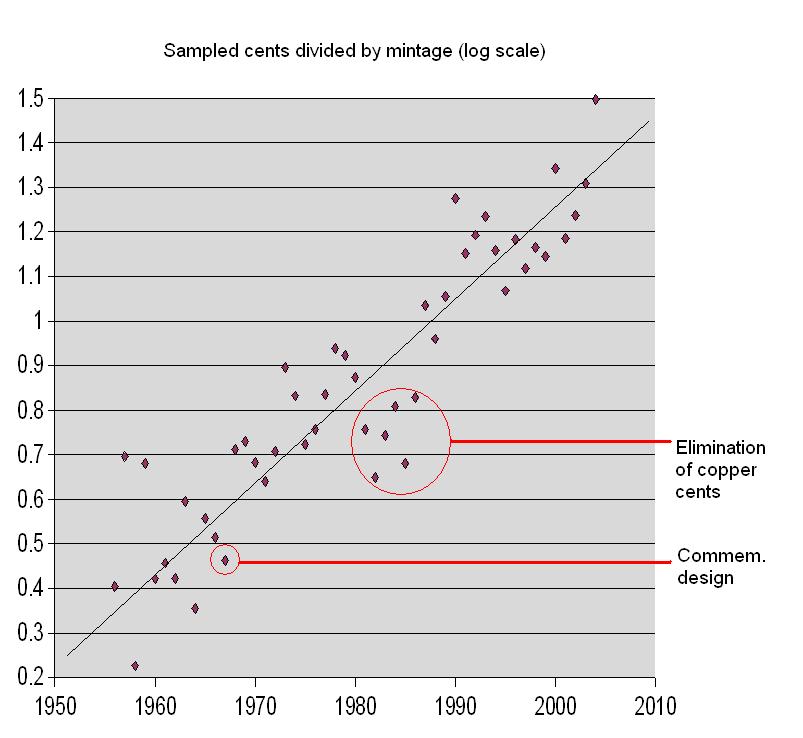
Very interesting topic. I have wondered about this myself, as my interests involve both mathematics and coin collecting. I suspect the model for coins dropping out of circulation is similar to radioactive decay: inverse exponential in the quantity minted. (Granted, this model has its drawbacks, including recirculating dad's coin collection, mint recalls, etc.) Although the data below is taken from off-topic coins (Canadian cents), and of a small sample size, I hope that the spirit of the data is relevant to this discussion. In constructing this graph, I divided the sampled quantity for each year by the mintage of that year. Then I plotted on a logarithmic scale. A linear relationship is roughly there. Of course, what's working against older coins in circulation is: (1) low mintage, (2) decay over the years, and (3) collectability. Image:  sample.jpg sample.jpg57.74 KB It may be of some interest to extrapolate and predict the number of much older circulating coins. I hope that the Cent Project of Charles Daughtry will permit some interesting (and more accurate) analysis along these lines. |
|
Pillar of the Community
United States
543 Posts |
Show off!
nah, I'm just kidding good jod with your mathematical applications!
|
|
Pillar of the Community
Canada
838 Posts |
Yeah... sorry for the technicalities.  I am actually not totally sure of whether the model holds up. (The Cent Project will help to confirm or modify it.) And even if it does hold up, there are anomalies. For instance, I have a feeling that copper cents are a bit more durable than the current ones. But copper is probably starting to get pulled. It's fun to speculate on how many IHPs, for example, are still out there (and not yet in a collection). A regression analysis would give one very crude estimate. |
|
Valued Member
United States
336 Posts |
if the us gov is pulling copper pennies this is how they are saving money.by pulling cir true copper pennies they are making in the future a new type to collect for return value.we will have 4 types to save.the flying eagle,indian head,wheat backs and 1959-1981 not counting the 82 coppers(that you have to weigh)
|
|
Pillar of the Community
 United States
2604 Posts |
I would love to see a link to any story that says the government is pulling copper from circulation. I am very skeptical; it is heresay until I see a legitimate story about that. Whether the private armored car companies are pulling them is a different story. Frankly, I cannot see the government spending time (which is money) pulling coins from circulation. Factoring that in, they would probably make less than half a cent per cent pulled, and aren't they too bound by the law against melting copper?
|
|
Bedrock of the Community
United States
12437 Posts |
quote:
and aren't they too bound by the law against melting copper?
Nope The Treasury did pull silver coinage in the 60s after the clad changeover so it is not unprecedented. Whether they are actually doing it now or it is just mass hoarding by the general public is a point of speculation. It was cost effective for them to do it with silver but I am not sure that they would expend the effort for a lowly copper cent. Edited by biokemist6
04/22/2008 11:33 am
|
|
Pillar of the Community
United States
615 Posts |
Well, I think a lot of silver coins got melted over the years. I think the remaining mintage of those coins is low.
At 50$ an oz 90% silver was worth 36x face. I think it got over $50 an oz in the 80s. I am sure that got some mass melting done. Here about people melting down the junk silver they find all the time. Those 40% halves are melted more than anything I think...atleast I hear about those the most.
Normal Loss:
1% of the remaining are loss each year. That give you 37% left after 100 years. 2% loss would 13% left.
150 years would be 5-22%
As far as cents. I think the copper cents will leave in short order after the ban is removed. Jackson metals melted a lot before the ban.
Even if you only got 80% recoverable on the copper. You are talking about 50% margins or doubling you money. So big outfit will buy sorters and remove them quickly for that kind of return. At least drive the % from 20% to below 5% I am sure some news media will cover it after a while. Making sure everyone knows company X is making good money by going through the penny population. Then for about six months people will throw the copper ones in a different jar (for the grandkids...they did with the silver coins) --- Bye Bye copper.
The melt ban wasn't because of the little guy. It was because Jackson metals could have removed a bunch of pennies quickly.
I bet a ton of gold coins were melted too. A gold coins are worth 40+x face.
What makes it through the time being spent and mass melting is got to be low.
-SWUSC
|
|
Pillar of the Community
United States
716 Posts |
quote:
"Those 40% halves are melted more than anything I think...atleast I hear about those the most. "
You are right. Every time I went to a coin show, I saw people bringing hundreds of 40% halves to sell. I predict that 1965 JFK will gain a premium soon.
|
|
Pillar of the Community
United States
2604 Posts |
How do you melt 40% silver halves- isn't that difficult to separate the copper from the silver? I thought this was the reason why 40% JFKs and the silver War Nickels are not as sought after as the 90% silver pieces- too difficult to melt the lower % silver and it be worthwhile. |
|
Bedrock of the Community
United States
12437 Posts |
quote:
so badly wanted to give a simple answer to the title of this thread.
My answer.... exactly 47 coins
Ok, I will bite  What is the significance of 47  |
|
Pillar of the Community
United States
3234 Posts |
It just seemed like a decent finite number that anyone could grasp. It also seems a pretty darn exact and confident way to answer the question precisely. Precisely wrong...but precise!
|
|
Pillar of the Community
United States
615 Posts |
It is kind of sad that so many get lost and melted.
That said, it is going to happen when people can buy coins for face and sell them to a melter for over face.
The 1959-1981 cents will soon join those forces. I bet some more common wheat join them, if copper goes up to much higher. Assuming the ban is removed with the new metal content.
|
|
Bedrock of the Community
United States
20753 Posts |
I would think this topic is impossible to ever answer to even the slightest amount of accuracy. There are way to many possibilities of where coins are, what happened to them, etc. There are possibly millions and millions in jars, cans, boxes in someone's home. There are many millions more buried for many reasons. My wife buried a pile of cents when she was a kid about 50 years ago and no idea where. Smelters are accepting coinage and just melting them along with wires, contacts and anything else metallic legal or not. Jewelers also melt down Silver and Gold coins for their items. People thow coins in rivers, lakes, oceans, streams all the time. There are just to many variables to ever assertain what is in circulation, hoarded, lost.
|
| |
Replies: 53 / Views: 8,524 |








 First Page


 Posted 04/18/2008 2:59 pm


 sample.jpg


