| Author |
 Replies: 11 / Views: 2,418 Replies: 11 / Views: 2,418 |
|
|
New Member
United States
13 Posts |
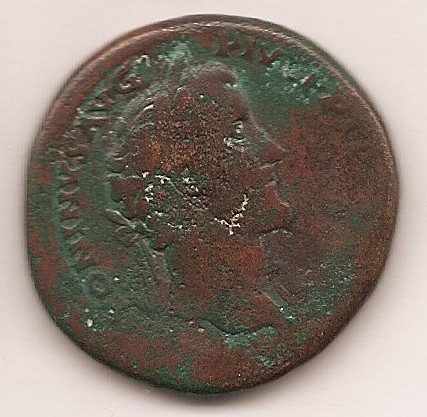
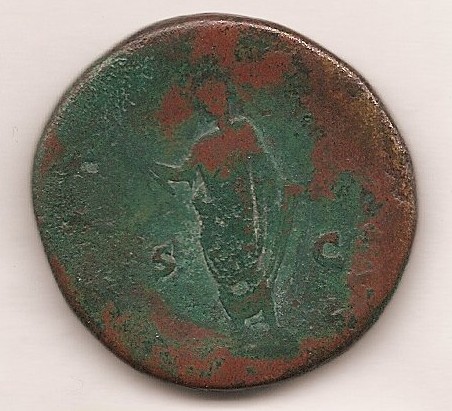
Hi again, I just acquired a Roman Coin. From what research I could do, I'm pretty sure it is real, and it is a Sestertius from 140-144 AD, with Antoninus Pius on the Obverse. If anyone has any other information that might help, I would greatly appreciate it. Also, does anyone know about the value of a coin like this? There is no seam on the edge, it weighs 23g and is 1-1//4" in diameter. Thanks again. Image:  OdvCoin.jpg OdvCoin.jpg57.92 KB Image: RevCoin.jpg61.7 KB |
|
|
|
Moderator
 United States
23731 Posts |
You are correct it is Antoninus Pius 138-161 AD.
|
|
Pillar of the Community
United States
1267 Posts |
I figure it might fetch $5-$20 depending on the amount of interest in the bidders/potential buyers.
Take Care
Ben
|
|
Pillar of the Community
United States
3499 Posts |
Not a bad looking coin at all.
|
|
New Member
 United States
13 Posts |
|
|
Pillar of the Community
United Kingdom
2217 Posts |
Now this is a little lesson to me, I had a little problem with agreeing with this being Antoninus Pius but then reason set in and I remembered something which I think was written earlier in my identification guide book Roman Base Metal Coins. So this would be Obverse C, no radiate (indicating a dupondius denomination by now) crown and the ribbon thing at the back of the head is longer than in obverse B, also the base of the bust has a negative gradient.
The thing that was bothering me, was the edge inscription - clearly, it says '..ONINUS PIVS', which can only be the guy in question himself, but the edge in my guide with regards to this design of bust reads something else completely - 'IMP CAES T AEL HADR ANTO (break at top of obverse) NINVS AVG PIVS PP'. I think what it said was that you can have any ege inscription for any of the obverse designs but I can't find it now, though I should do later..
Basically, is this true?
I just thought it was ineteresting.
By the way these are only listed as 'allegorical types' and given a value of £35 for specimens in Fine state. Clearly this is lower, but recognizable.
Also, who is that on the reverse as I can't seem to find him/her in this list for the allegorical types?
Edited by NumisMattyUk
08/26/2008 2:40 pm
|
|
Moderator
Australia
17006 Posts |
I finally managed to ID the type when I noticed there was actually a little bit of the reverse legend remaining, which I hadn't spotted before: "...TVS", visible at 3 to 5 o'clock. There's only one type of Antoninus Pius sestertius with this ending of the reverse legend and only one figure in the field: Sear #4177, GENIO SENATVS, Spirit of the Senate standing, wearing toga, holding short sceptre and branch. This one on CoinArchives shows what it looks like in better condition. Sear attributes number 4177 to a date of 142 AD. Quote:
...clearly, it says '..ONINUS PIVS', which can only be the guy in question himself... Actually, there were three emperors formally known by that name; the other two are known to history by their nicknames, to avoid confusion. "Antoninus Pius II" is better known to us as Caracalla, and "Antoninus Pius III" is better known as Elagabalus. Coins of the latter two emperors have "ANTONINVS PIVS AVG" as an option for the obverse legend. But on the coins of "the real Antoninus Pius", it's the other way around - "ANTONINVS AVG PIVS" - as it is on this coin. Finally, when in doubt, the portraits of the three emperors are normally quite distinctive. Don't say "infinitely" when you mean "very"; otherwise, you'll have no word left when you want to talk about something really infinite. - C. S. Lewis
|
|
Pillar of the Community
United Kingdom
2217 Posts |
Sap - I knew about Caracalla but not the third one - how confuddling..
Ahh, now I see the reverse! - 'Genio Senatvus' (spirit of the senate?) with branch and sceptre.
Edited by NumisMattyUk
08/27/2008 3:49 pm
|
|
New Member
United States
13 Posts |
What does the 'S C' on the reverse stand for?
|
|
Moderator
Australia
17006 Posts |
"Senatus Consulto" - meaning "by order of the Senate".
During the Republic, "SC" would often appear on the silver coinage. Later, during the Empire, the emperor reserved for himself the right to authorize silver and gold coins, but the Senate of Rome was authorized to issue base-metal coinage, so "SC" is only found on bronzes.
Don't say "infinitely" when you mean "very"; otherwise, you'll have no word left when you want to talk about something really infinite. - C. S. Lewis
|
|
Pillar of the Community
United States
1415 Posts |
SAP, THANX for the information.  That is quite informative |
|
Pillar of the Community
United Kingdom
2217 Posts |
Sap's always good for that sort of thing... ;)
|
| |
Replies: 11 / Views: 2,418 |
|







 OdvCoin.jpg
 RevCoin.jpg


 Posted 08/20/2008 11:06 am





