A revival of the US two-cent coin was proposed in 1920. Two bills were introduced in Congress in January 1920 that called for Theodore Roosevelt to join Abraham Lincoln on US coinage. In the Senate, a bill was introduced by George Paine McLean (R-CT) that proposed a Roosevelt Two-Cent coin, and, in the House of Representatives, a bill was offered by Albert Henry Vestal (R-IN) that called for a Roosevelt 2-1/2 Cent piece. The Senate bill was referred to the Senate Committee on Banking and Currency, the House bill to the House Committee on Coinage, Weights, and Measures.
In each bill, it was left to the Director of the Mint to decide on the quantity to be produced, as well as which Mint facilities were to be used. As the coin was intended for general circulation, it seems likely that Philadelphia, Denver and San Francisco would all have been engaged in production of the new coin.
Other than for the denomination difference, there was little to differentiate the two bills. Both bills called for a coin composition of 95% copper and 5% tin and zinc (the then-current composition of the
Lincoln Cent), and for the new coin to be of a proportional size and weight to properly distinguish it from the one-cent coin.
Each of the bills also called for the following devices and legends:
"Upon one side there shall be the medallion of Theodore Roosevelt, with the dates of his birth and death, and with an inscription of the words, " In God we trust"; and upon the reverse shall be an inscription, " E pluribus unum," and an inscription, " United States of America," and a designation of the value of the coin."
Sounds a bit like the 2014 Theodore Roosevelt $1 coin from the
Presidential dollar Series...
2014 Theodore Roosevelt Presidential Dollar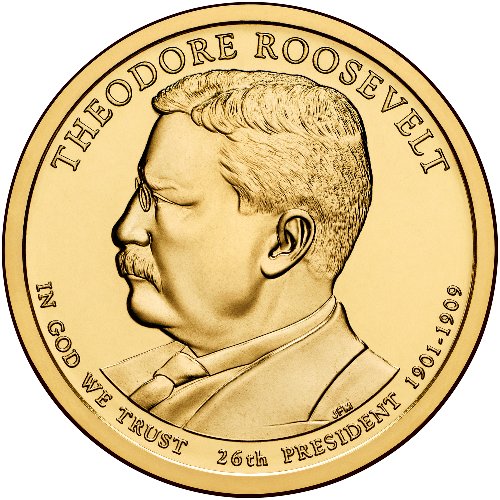 (Image Credit: US Mint media image.)
The bill was reported by the Senate Committee without amendment and with unanimous support. During consideration of the bill in the Senate, William Henry King (D-UT) questioned whether the coin was needed to facilitate commerce or was its purpose to commemorate the life and legacy of Theodore Roosevelt who had died a year before on January 6, 1919. King noted that if for commemorative purposes, "I would be opposed to it, no matter who the man was."
Support for the bill came from those, among others, who believed that a two-cent coin would make paying for fares on street railways (i.e., trolleys) more convenient due to the fact that many fares across the nation had increased from five cents to seven or eight cents. It was reminiscent of some of the arguments made by proponents of the introduction of a three-cent coin in the 1850s to conveniently pay for the standard three-cent postage stamps of the day. (It should be noted that the standard one-ounce postage rate in 1920 was
Two Cents.)
Senator King was not convinced of the coin's commercial need, but did not raise formal objection. The Senate passed the bill without further discussion of note. After its passage, the bill was sent to the House where it was referred to Committee. The House Coinage Committee fully supported the bill, reported it back without amendment and recommended that it pass. Consideration of the bill would go no further, however, and no Roosevelt two-cent coin would be forthcoming (but you already knew that!).
Side Note: The American Numismatic Association's ( ANA) The Numismatist
ran a brief note about the proposed coin in 1921 that mentioned how the Mint had been having difficulty in meeting the demand for one cent coins for three years running and how a two-cent coin could help alleviate the issue.
The brief note also suggested that a primary driver of the proposed new coin was likely that of honoring Theodore Roosevelt vs. filling a specific commercial need. The editorial staff at The Numismatist
either didn't have access to the proceedings of Congress or didn't believe the explanation of the coin's need offered by Senator Paine. Based on the bill's approval in 1920 by the Senate, and its approval by the House Committee in 1921, The Numismatist
believed the coin was "practically assured." (Apparently, the
ANA was not effectively channeling Nostradamus at the time!

)
For the story of another Roosevelt 2-1/2 cent coin proposal, see:
-
What If? 1924 Roosevelt, Harding And Wilson 2-1/2 Cent CoinsFor more of my topics on commemorative coins and medals, including many more What If? stories, see:
Commems Collection.







 Posted 12/31/2022 12:46 pm





