| Author |
 Replies: 6 / Views: 1,247 Replies: 6 / Views: 1,247 |
|
|
Valued Member
United States
116 Posts |
Last month I got my first four Yellen/Malerba notes out of a 1000-note brick. I live in San Jose. Of the four bills, three were FR district B/New York, circulated, and one was a crisp Cleveland, still with the new money smell, and that confused me. It looks CU except.well I got it in circulation
I know that number of notes they print for each Federal Reserve district is directly proportional to the population of that district. But what is the relationship between what's printed and how are they distributed?
For the bills printed representing the population of the Cleveland district, how much of those actually go to the Cleveland district? Are Cleveland notes ever (or routinely) sent directly from BEP to districts other than Cleveland? Are they sent directly from BEP to Cleveland and then Cleveland distributes them to other districts? Or did I somehow just get a crisp new Cleveland note that got here unscathed via ordinary circulation?
|
|
|
|
Pillar of the Community
United States
4637 Posts |
Good question flower guy.
I believe that when federal reserve districts request additional paper money, the BEP tries first to furnish notes linked to that particular district, but sometimes it's not always possible. After the Western Currency Facility opened in Fort Worth, the plan was to try and reduce shipping costs by printing districts G, H, I, J, K, and L in FW and printing districts A through F in Washington DC, thus reducing their shipping costs.
|
|
Valued Member
 United States
116 Posts |
So I can see in the BEP reports for May and June that Fort Worth printed $1 bills for Philadelphia Cleveland and San Francisco districts (C,D and L respectively), and the Washington, DC facility printed $1 bills for the Saint Louis (H). Fort Worth even printed $1 for Boston and NY (A and B) in Feb, and it even printed $5 bills (E) for Richmond even though Richmond is only a 2-hour drive from the Washington, DC BEP!
That would suggest that even though a bill is printed to represent the population of one district, that's not necessarily related to where it's printed or distributed, at least so far this year. From the production record seems likely that, by design, Fort Worth printed the Cleveland bills with the intent of distributing them to the locations served by the Fort Worth facility. That'd explain how I got a crisp uncirculated Cleveland way out here in San Jose!
Edited by TheSerialFlorist
10/18/2023 01:04 am
|
|
Pillar of the Community
 United States
4622 Posts |
It was a mixed brick, so clearly the notes in it came from circulation returned to the Fed and were re-distributed.
Ignoring the mundane explanations:
Clearly, the aliens spent money in Cleveland, hopped into their invisible stealth UFO, and traveled to San Diego. If only we mere mortal humans had similar devices. We could call them cars and airplanes.
-----Burton 50+ year / Life / Emeritus ANA member (joined 12/1/1973) Life member: Numismatics International, CONECA Member: TNA, FtWCC, NETCC, EveryCountry (online) coin club Owned by three cats and a wife of 40+ years (joined 1983) Author: 3rd Edition of the Sample Slabs book, https://www.sampleslabs.info/ |
|
Pillar of the Community
United States
743 Posts |
Quote:
I know that number of notes they print for each Federal Reserve district is directly proportional to the population of that district. I wonder if this is strictly correct. The amount of notes issued by a particular federal reserve bank is determined by that federal reserve bank based on a variety of factors. Up until about the 1970s, unissued federal reserve notes were shipped to individual federal reserve banks and then "issued" at that federal reserve bank. In modern times, federal reserve notes are "issued" at the printing facility prior to shipment. To "issue" a note means that is declared an obligation on the accounting records of a federal reserve bank. This is completely different than the physical distribution of the note. I don't think it really matters if the number of notes issued by a federal reserve note matches the number of notes printed for that federal reserve bank. So maybe the quoted paragraph above is correct. I hope this thread answers some of these questions because I have been wondering about it for a while. |
|
Valued Member
United States
116 Posts |
I now have seen 41 Malerba/Yellen notes (out of 1500 total). 15 from New York and 26 from Cleveland, all very new looking. I have zero bills from Boston, Richmond or Philly even though those districts were printed around the same time or earlier than the Cleveland bills. @BStrauss3, I assume people in Philly and Boston and Richmond have the same access to cars and airplanes as they do in Cleveland, no aliens involved. Given how many bills I have from Cleveland, then I'd expect to see at least some bills arriving in San Jose via car and plane from all those other districts. To me the original premise makes more sense. Printed in FW, issued to Cleveland per @ynnad, and distributed to cost-optimal San Jose per @SteveinTampa. Seems that my getting so many new Clevelands in San Jose, not from the same brick, mere months after printing, is because multiple new bricks were shipped directly from FW to San Jose, then lightly circulated around here, and I then get them near-new intermingled in straps. And that's why I have zero from the others...none were shipped here. Seems to me, at least... Related, @ynnad, below shows the relationship between population distribution in each district and what's been printed. I have seen no way to track what's taken out of circulation by district so it's impossible to know what remains in circulation, but in this snapshot you can see the close match, 96% correlation. I tried different production serieses and population snapshots, the results are all pretty much the same as the picture below. 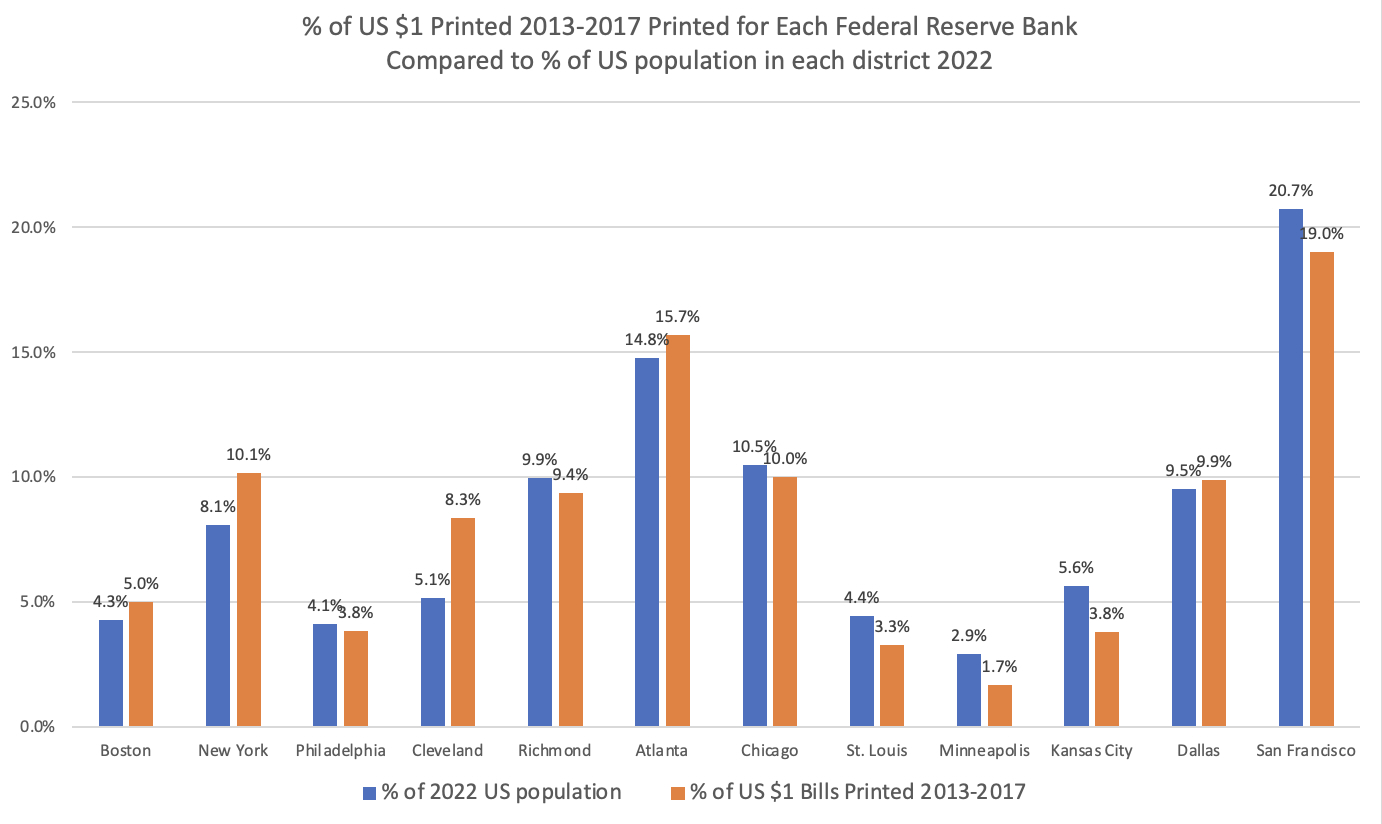 Edited by TheSerialFlorist
10/23/2023 5:54 pm
|
|
Valued Member
United States
126 Posts |
I live in the Boston area and I haven't seen any Series 2021 noted here.
|
| |
Replies: 6 / Views: 1,247 |
|










 Posted 10/18/2023 01:01 am


