First Page
 Previous Page


 Posted 07/30/2010 10:21 am


I hope that you took none of it as attacks Ceylon. It surely wasn't meant as such.
Yes, I understand about the availability of time. I have been spending way, way too much here, and my studies have suffered for it. I'm a student, or at least I am supposed to be, so I'll have to make the hard choice, fun or studies. I also have no equipment other than a scanner. I don't have a camera, a microscope, or even a loupe.....just the scanner.
As far as the O coins go, I think that management of the O mint is likely responsible for much of the inconsistencies and oddball effects that collectors now enjoy on these coins.
For you Gene, bestest VAM buddy, I had no idea that you were mechanically inclined. I'll leave with you (since I doubt anyone else would be interested) something that I found in my drafts. Written about a year ago, I don't remember if this ended up as a post somewhere, or if it culminated as an email reply when being crucified over denticle impressions, but you might enjoy it. It is very condensed and watered down, and intended as a basic overview of the Morgan & Orr to someone who knows nothing beyond coin identification, and was heck bent on claiming tilted dies were the culprit of many things that he saw on coins...................
The big press, the one used to strike Trade, Morgan and Peace, used a unique ejection system unlike virtually all other contemporary presses anywhere. On this press, the collar is fixed (bolted onto the press frame) and the reverse die served as the ejection catalyst. The press was a six ton behemoth. It's die chamber was a long tube made of very thick steel. The toggle joint sat atop the die chamber. The toggle joint assembly is made up of several parts (stirrups, bolts, triangle, pin, shoe, etc) that are critical to it's operation, however, it's main function is to bend and straighten. As it bends, it retracts the obverse die upward. when it straightens, (abruptly with a snap), it rams the obverse die downward. The toggle joint is connected by a locating arm to a bearing and wedge at the rear of the press allowing for vertical motion. It is also connected to a lever to the main geared flywheel which rotates at a speed which though a series of transfer gearing, produces strikes of 80-90 per minute. While the toggle joint is located at the top of the die chamber, the obverse die is located at the bottom. Total movement of the obverse die vertically is considerably less than one inch. The obverse die is the only die located in the die chamber. The collar die is fixed to the press frame by bolts. essentially becoming part of the frame. The collar is a hollow centered plate that fits snugly into the reverse die well opening. The inside of the collar surrounds the reverse die which is within the collar at all times. Under the collar was a cup that sat in the base of the die well. The reverse die was located in this cup fastened in place by a die stake. The reverse die along with the die stake raised 1/8" after strike to eject the coin out of the collar. After ejection, the die and stake retracted back into the cup. That is a very watered down mechanical operation of this particular press.
The dimensions of the coin are exactly the dimensions of the inside diameter of the collar (at recess position of the reverse die) which is 38.1mm (or 1 and 1/2"). The planchet was slightly smaller (and thicker than the struck coin) for ease of placement over the collar mouth by the feeder fingers and subsequent ejection.
The dies themselves were 44.45mm (1 and 3/4") in diameter at their base or 'shaft'. The dies were about 3 inches long, and the shaft began to taper about 2/3 of the way to the face of the die to a diameter of 37.9mm (or 1 & 7/16") at the face. The die chamber was 44.6mm (1 & 1/2') in diameter (inside diameter). The die chamber (with obverse die) was held in place (precisely in line over the collar) by the top of the press arch. This arch weighed over 2 1/2 tons and did not move. The die well (with reverse die) was in fact at the bottom of this arch. The cup in the well held the die and die stake. You can view it all as a huge C clamp frame.
You may have seen pictures of the coining room in which the presses were standing out in the middle of the room. These are the much smaller presses of Ulhorn and other press designs used for striking smaller coins. The press we are speaking of was bolted to the walls of the coining room by huge steel I beam girders at it's arch.
The obverse die in the die chamber had less than 1/16 of wiggle room. The die was centered exactly over the collar. The reverse die and stake was centered in the die well by the cup that fit the base of the die snugly. All were in perfect alignment at all times. No possibility of misalignment on this press.
Malfunctions did occur however.
Say the arch fractured; (and I am aware of at least two occasions when this did occur) what could happen?
An arch fracture would cause the arch to shift out of alignment from top to bottom and would allow the obverse die to contact the collar. (Collar clash). If there is such a thing on a Morgan dollar, that is how it happened.
Say the die stake broke. (Much more common than an arch fracture, but still infrequent). What would happen? The reverse die could shift from side to side or even possibly rotate between strikes in the cup. MAD.
Both of these things, MAD and collar clashes are not die varieties, but press malfunctions. They would be very rare and although some may seem similar, they would each be unique.
Annealing is a process of hardening metals that has been used for eons. I am sure that you are at least basically familiar with the process. The critical step in this process is the cooling of the metal between firings. If the cooling is done to quickly (by aide of soaking in oil or water) the molecules in the metal will crystalize in their moved state. (The molecules move during heating). Crystalization of the molecules will cause the metal to become brittle. This condition occurs primarily at the surface and the edges of the metal. This is the root cause of all those cracks that you see on the periphery of a coin. It is also the cause of breaks at denticles and drop offs into devices. The denticle areas are prime targets for this type of metal fatigue. They 'do' break off of the dies.
Now, consider this law of physics: You cannot stuff 30 gallons of anything into a 10 gallon bucket.
The distance between the obverse die and the collar (at full retraction of the obverse die) is less than one inch. The die is 3 inches long. This means that there is still more than 2 inches of die within the die chamber with 1/16 of wiggle room maximum. The engineers who designed this press knew what they were doing. Any more wiggle room would allow room for striking error, and striking would be haphazard to the point of collar clashes, MAD, and any number of other off strikes at a far greater rate than satisfactory strikes. There is no way to achieve enough tilt of the obverse die (in that one inch space) to accomplish the denticle impressions on the 1878 S VAM 17A (for example), even if the reverse die stake broke simultaneously. Just no way possible. It did not happen.
Gene, if I can dig up some engineering drawings on the press, I'll get them to you.
As Always,
L.
Yes, I understand about the availability of time. I have been spending way, way too much here, and my studies have suffered for it. I'm a student, or at least I am supposed to be, so I'll have to make the hard choice, fun or studies. I also have no equipment other than a scanner. I don't have a camera, a microscope, or even a loupe.....just the scanner.
As far as the O coins go, I think that management of the O mint is likely responsible for much of the inconsistencies and oddball effects that collectors now enjoy on these coins.
For you Gene, bestest VAM buddy, I had no idea that you were mechanically inclined. I'll leave with you (since I doubt anyone else would be interested) something that I found in my drafts. Written about a year ago, I don't remember if this ended up as a post somewhere, or if it culminated as an email reply when being crucified over denticle impressions, but you might enjoy it. It is very condensed and watered down, and intended as a basic overview of the Morgan & Orr to someone who knows nothing beyond coin identification, and was heck bent on claiming tilted dies were the culprit of many things that he saw on coins...................
The big press, the one used to strike Trade, Morgan and Peace, used a unique ejection system unlike virtually all other contemporary presses anywhere. On this press, the collar is fixed (bolted onto the press frame) and the reverse die served as the ejection catalyst. The press was a six ton behemoth. It's die chamber was a long tube made of very thick steel. The toggle joint sat atop the die chamber. The toggle joint assembly is made up of several parts (stirrups, bolts, triangle, pin, shoe, etc) that are critical to it's operation, however, it's main function is to bend and straighten. As it bends, it retracts the obverse die upward. when it straightens, (abruptly with a snap), it rams the obverse die downward. The toggle joint is connected by a locating arm to a bearing and wedge at the rear of the press allowing for vertical motion. It is also connected to a lever to the main geared flywheel which rotates at a speed which though a series of transfer gearing, produces strikes of 80-90 per minute. While the toggle joint is located at the top of the die chamber, the obverse die is located at the bottom. Total movement of the obverse die vertically is considerably less than one inch. The obverse die is the only die located in the die chamber. The collar die is fixed to the press frame by bolts. essentially becoming part of the frame. The collar is a hollow centered plate that fits snugly into the reverse die well opening. The inside of the collar surrounds the reverse die which is within the collar at all times. Under the collar was a cup that sat in the base of the die well. The reverse die was located in this cup fastened in place by a die stake. The reverse die along with the die stake raised 1/8" after strike to eject the coin out of the collar. After ejection, the die and stake retracted back into the cup. That is a very watered down mechanical operation of this particular press.
The dimensions of the coin are exactly the dimensions of the inside diameter of the collar (at recess position of the reverse die) which is 38.1mm (or 1 and 1/2"). The planchet was slightly smaller (and thicker than the struck coin) for ease of placement over the collar mouth by the feeder fingers and subsequent ejection.
The dies themselves were 44.45mm (1 and 3/4") in diameter at their base or 'shaft'. The dies were about 3 inches long, and the shaft began to taper about 2/3 of the way to the face of the die to a diameter of 37.9mm (or 1 & 7/16") at the face. The die chamber was 44.6mm (1 & 1/2') in diameter (inside diameter). The die chamber (with obverse die) was held in place (precisely in line over the collar) by the top of the press arch. This arch weighed over 2 1/2 tons and did not move. The die well (with reverse die) was in fact at the bottom of this arch. The cup in the well held the die and die stake. You can view it all as a huge C clamp frame.
You may have seen pictures of the coining room in which the presses were standing out in the middle of the room. These are the much smaller presses of Ulhorn and other press designs used for striking smaller coins. The press we are speaking of was bolted to the walls of the coining room by huge steel I beam girders at it's arch.
The obverse die in the die chamber had less than 1/16 of wiggle room. The die was centered exactly over the collar. The reverse die and stake was centered in the die well by the cup that fit the base of the die snugly. All were in perfect alignment at all times. No possibility of misalignment on this press.
Malfunctions did occur however.
Say the arch fractured; (and I am aware of at least two occasions when this did occur) what could happen?
An arch fracture would cause the arch to shift out of alignment from top to bottom and would allow the obverse die to contact the collar. (Collar clash). If there is such a thing on a Morgan dollar, that is how it happened.
Say the die stake broke. (Much more common than an arch fracture, but still infrequent). What would happen? The reverse die could shift from side to side or even possibly rotate between strikes in the cup. MAD.
Both of these things, MAD and collar clashes are not die varieties, but press malfunctions. They would be very rare and although some may seem similar, they would each be unique.
Annealing is a process of hardening metals that has been used for eons. I am sure that you are at least basically familiar with the process. The critical step in this process is the cooling of the metal between firings. If the cooling is done to quickly (by aide of soaking in oil or water) the molecules in the metal will crystalize in their moved state. (The molecules move during heating). Crystalization of the molecules will cause the metal to become brittle. This condition occurs primarily at the surface and the edges of the metal. This is the root cause of all those cracks that you see on the periphery of a coin. It is also the cause of breaks at denticles and drop offs into devices. The denticle areas are prime targets for this type of metal fatigue. They 'do' break off of the dies.
Now, consider this law of physics: You cannot stuff 30 gallons of anything into a 10 gallon bucket.
The distance between the obverse die and the collar (at full retraction of the obverse die) is less than one inch. The die is 3 inches long. This means that there is still more than 2 inches of die within the die chamber with 1/16 of wiggle room maximum. The engineers who designed this press knew what they were doing. Any more wiggle room would allow room for striking error, and striking would be haphazard to the point of collar clashes, MAD, and any number of other off strikes at a far greater rate than satisfactory strikes. There is no way to achieve enough tilt of the obverse die (in that one inch space) to accomplish the denticle impressions on the 1878 S VAM 17A (for example), even if the reverse die stake broke simultaneously. Just no way possible. It did not happen.
Gene, if I can dig up some engineering drawings on the press, I'll get them to you.
As Always,
L.


 oh yea world record in the making!!


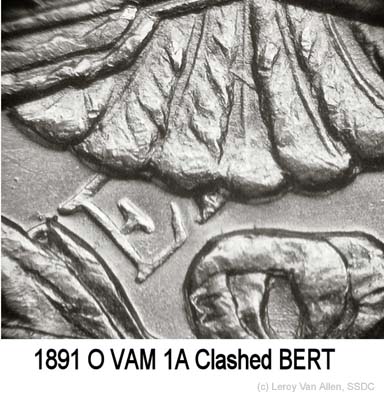
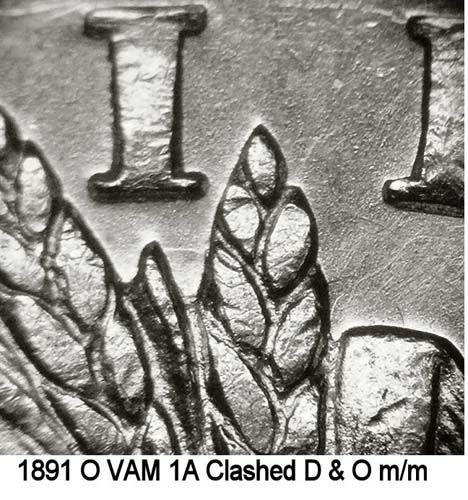 As the die progression continues, more major deterioration continues, with the dome sink. a bulge in the coin...
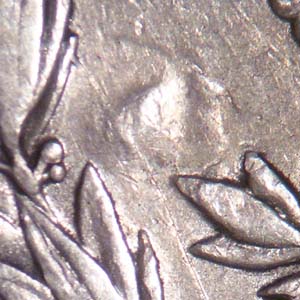 and then the die brake..the final known stage..