| Author |
 Replies: 20 / Views: 9,499 Replies: 20 / Views: 9,499 |
|
Pillar of the Community
Canada
1733 Posts |
As usual I'm still going through large lots of coins I bought years ago trying to sort them into some kind of common cents and I came upon a service medallion from the Government of Canada. I only found ONE reference to it, but if anyone knows a book or site they could direct me to, or have the stats on this medallion, I'd be grateful. The only web reference I could find said this: Quote:
In addition I was presented with a huge silver coin 2 1/2 inches in diameter and 3/8's of an inch thick.On the obverse side is an impression of Queen Elizabeth II, with two boughs of maple leafs from the bottom and up both sides and CANADA across them. On the reverse side is an impression of the center portion of the Parliament Building and the words "Awarded by the Government of Canada for long and efficient service".  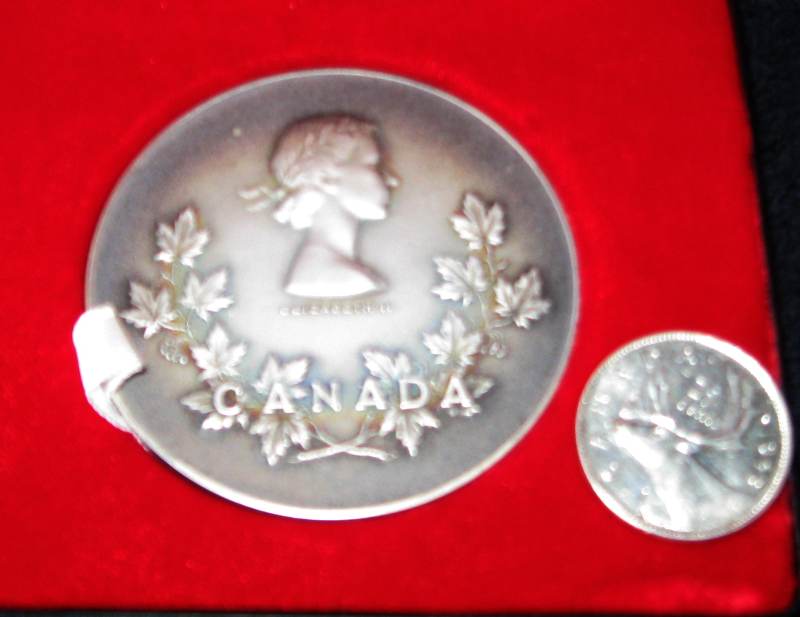 |
|
|
|
Pillar of the Community
 Canada
9909 Posts |
Hopefully Steve will be getting one soon and he'll have enough time on his hands to look into it for you.
|
|
Pillar of the Community
 Canada
1733 Posts |
I know it's an old thread but I'm bumping this, just in case I catch someones eye.
I am still "unknowing".
|
|
Moderator
 Canada
10478 Posts |
I had never seen this before... but I like it! What a neat item...
What is even more impressive, is 45 years of service as a civil servant. That is unheard of in today's times...
"Discovery follows discovery, each both raising and answering questions, each ending a long search, and each providing the new instruments for a new search." -- J. Robert OppenheimerContent of this post is licensed under a Creative Commons Attribution-NonCommercial 3.0 Unported License. See: http://creativecommons.org/licenses...0/deed.en_USMy eBay store
Edited by SPP-Ottawa
12/16/2011 10:43 am
|
|
Pillar of the Community
Canada
1733 Posts |
It's very cool, it's really big in hand and weighs around 4.5 ounces. I'm not entirely sure how they processed it or even what's it's made of. It visually looks more like artificially antiqued pewter than silver, but I just don't know.
|
|
Pillar of the Community
Canada
1502 Posts |
Edited by poboxw
12/16/2011 10:11 am
|
|
Moderator
Canada
10478 Posts |
Ugly, if you want to know what it is made of, that can be easily done with the XRF in my lab, and I would happily do that for you. Unless, of course, it is clad in its structure (then you will only get a surface composition). 
"Discovery follows discovery, each both raising and answering questions, each ending a long search, and each providing the new instruments for a new search." -- J. Robert OppenheimerContent of this post is licensed under a Creative Commons Attribution-NonCommercial 3.0 Unported License. See: http://creativecommons.org/licenses...0/deed.en_USMy eBay store
Edited by SPP-Ottawa
12/16/2011 10:40 am
|
|
Pillar of the Community
Canada
1733 Posts |
I'm game if you are. Has a nice real leather case too.
I do see a minor blush of a bluish tint which often indicates lead and antimony based pewter but it seems too dense. Hardly scientific of me though.
I'm actually not all that attached to it, I'm sure I didn't pay much if anything for it because I usually keep the purchase records with the coin lot until I get around to sorting it out and there's no mention of it even though I see all the coins on the list. Was likely tossed in "just because". I'm also assuming if I don't know what it is now I didn't know then (1987).
|
|
Valued Member
423 Posts |
Edited by realpenny
12/18/2011 01:31 am
|
|
Pillar of the Community
Canada
1733 Posts |
I just noticed the link you posted here Realpenny thanks.
Mine is the young Liz and appears to have a different finish. I wonder if they changed the composition.
|
|
Moderator
Canada
10478 Posts |
Fascinating... I would like to acquire one of these items... I will have to keep my eyes open...
"Discovery follows discovery, each both raising and answering questions, each ending a long search, and each providing the new instruments for a new search." -- J. Robert OppenheimerContent of this post is licensed under a Creative Commons Attribution-NonCommercial 3.0 Unported License. See: http://creativecommons.org/licenses...0/deed.en_USMy eBay store
|
|
Valued Member
Canada
227 Posts |
One would venture a guess you would, with a bit of verbal digging, uncover many of these in and around Ottawa.  |
|
Pillar of the Community
Canada
1733 Posts |
Yeah Kijiji time for sure. I wish I could get a hold of whatever department handed these things out and find the maker. I've tried a few with no luck but civil servants aren't always open to random inquiries tangent to their core responsibilities.
|
|
Valued Member
Canada
451 Posts |
I hate XRF. It is unreliable. You only get a surface composition and the results can be skewed from oxidation, dirt, and other stuff that gets built on the surface. The only way to get a result with XRF is to scuff the surface of what you are measuring; crushing the sample gets the best results. INAA and PGAA are much better detection methods. They get down into the core of your sample and do not require any destruction.
|
|
Moderator
Canada
10478 Posts |
Quote:
I hate XRF. It is unreliable. You only get a surface composition and the results can be skewed from oxidation, dirt, and other stuff that gets built on the surface. Like coins, the reliability of the device is you often get what you pay for. Hand-held XRF devices are so-so. I use a bench-top model, with about 4 times the power of hand helds, it can penetrate through oxidation patina, corrosion crust and even plating if it is thin enough. I have done enough cross-referencing of various data types (soils, rocks, metals) and the bench-top XRF is superior to the hand-held XRF devices, and holds its own against wet chemistry for most major elements (metals) and even quantitative analysis with an SEM. If you want, I can even point you to the scientific papers that prove it. A powerful enough X-ray beam can penetrate the surface, it is a matter of simple physics, really. If you just want an analysis of the surface, I prefer the SEM. Quote:
INAA and PGAA are much better detection methods. So what do you do with your coins after subjecting them to neutron activation? You need to store them in a 'hot room' until enough time passes when it is safe enough to handle indiscriminately? Frankly, nothing beats fire assay (for gold) or wet chemistry or laser ablation ICP-MS for the most precise analysis - but unless you are trying to isotopically fingerprint the source of the metal, or understand its trace element content, it is pointless. A decent XRF can give you relative percentages of metal alloys, down to two or three decimal places. Remember that three decimal places is equivalent to 100 parts per million margin of error. Not so good for analyzing paint on your kids toys or your drinking water, but perfect for planchet classification - that is well beyond the tolerance that the mint has when it orders planchets externally. Lastly, the bench-top XRF is in my lab, and takes 90 seconds to have results, without paying a technician to run a mass spectrometer or booking time on the other instruments. I agree it is not perfect, but it is a heck of a lot better than some of the 'sound analysis' some folks do on silver coins and the 'scratch edge of coin with piece of glass' that some TPG's admit to using. "Discovery follows discovery, each both raising and answering questions, each ending a long search, and each providing the new instruments for a new search." -- J. Robert OppenheimerContent of this post is licensed under a Creative Commons Attribution-NonCommercial 3.0 Unported License. See: http://creativecommons.org/licenses...0/deed.en_USMy eBay store
|
|
Valued Member
Canada
316 Posts |
|
| |
Replies: 20 / Views: 9,499 |




 Posted 12/15/2011 2:10 pm





