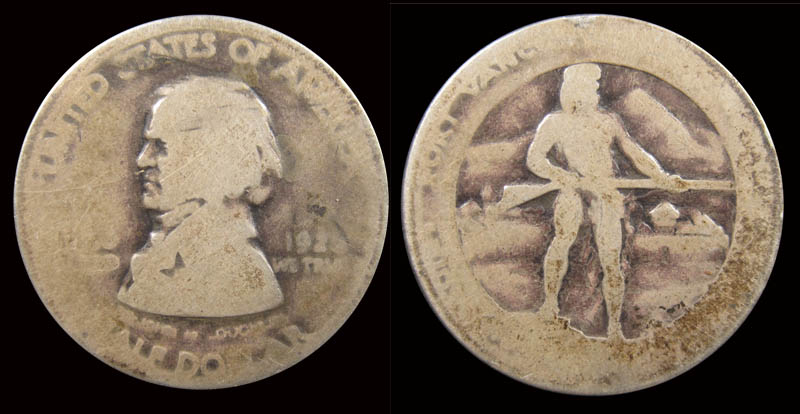
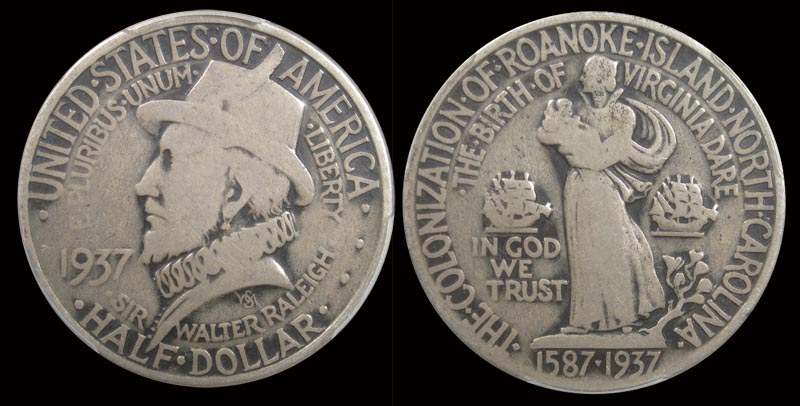
Quoted from commems kind reply to HONDO well circulated Alabama:
Quote:
The uneven wear along the coin's rim seems to suggest that it might have originally been higher on some areas of the coin (e.g., near "OF AMERICA" vs. "UNITED" on the obverse OR maybe the relief of the portraits varied to the extent that they "protected" one area of the coin's rim more than another?
You can observe the same uneven rim wear on the reverse of the Alabama half - note for example the difference between the date '1819' and the legend 'OF ALABAMA'. Note as well that the 'higher rims' are generally 180 degrees apart (more to come on that).
Quote:
Any thoughts on the more likely cause?
@commems -
I do not have a definitive answer ... but offer the following as
informed speculation:
Fact - the obverse and reverse portraits on the 1921 Alabama half (both varieties) were stuck in high relief ... not quite as high as the lovely 1927 Vermont half - but approaching that level of relief relative to the coins fields.
Assume -
Laura Gardin Fraser was a good enough designer to ensure that the rims of her new coin (as issued) were higher than the highest relief of either portrait.
Assume - Ms. Fraser was a good enough designer to ensure the coins rims as issued were of uniform height.
Assume - Any coin reaching this state of circulation wear has most likely been uniformly circulated ... that is ... whatever wear occurred over the coins lifetime has been evenly and uniformly distributed across all surfaces in an equitable manner.
Fact - Whatever wear has occurred (assuming uniform as discussed above) will be most pronounced on the highest points of the coins relief ... and least pronounced on the coins lowest points of relief.
Fact - The 'uneven rim' wear commems commented on is visible as well in mid-circulated grade Alabama half dollars - as evidenced in this photo of my current PCGS VF30 example.
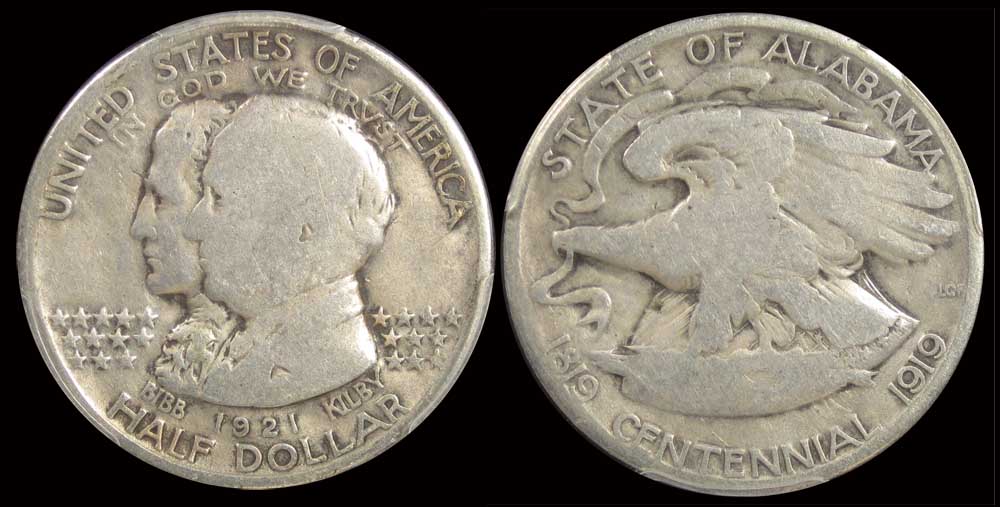
Fact - We observe higher rims in the circulated state adjacent to the legends "OF" on the obverse and "OF ALA" on the reverse ... consistent between both of my and HONDO examples.
Fact (maybe) - If you accept the assumption of uniform circulation wear ... that implies these rim locations were the lowest relief available to wear and hence the most protected.
Fact (maybe) - anyone willing to take apart a true MS Alabama and measure the relief of the coins highest points relative to the rim heights will likely note that Governor T.E. Kilby hair and the eagle left wing feathers are the highest points of portrait relief ... photo of my MS65 Alabama:
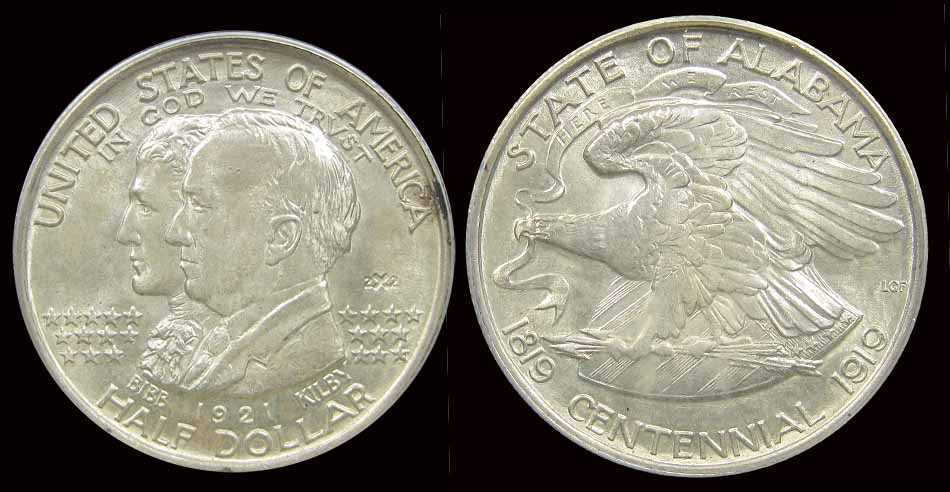
Assume (and this closes the deal) - Those highest points of portrait relief (180 degrees apart) served to protect their respective aligned rims from the otherwise uniform circulation wear observable in these honestly circulated coins.
This was a fun exercise in answering a simple question.
Note as well the joy of discovery in these rarely seen circulated examples of tremendous coins ... fans of MS coins only would likely never note the influence of the coins portrait relief on long-term wear. Hat's off to the circulated set as a valued numismatic experience.
Anyways ... that's my
speculative story ... could be wrong ... but I'm sticking with it.

David








 First Page
 Previous Page


 Posted 12/02/2014 10:56 pm