Hello again everyone!
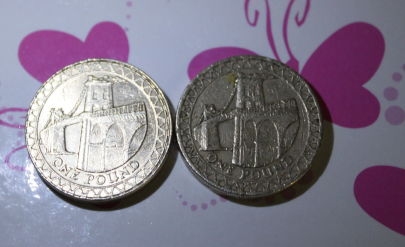
There are now two 'makes' of bi-metallic fake £2 on the scene.
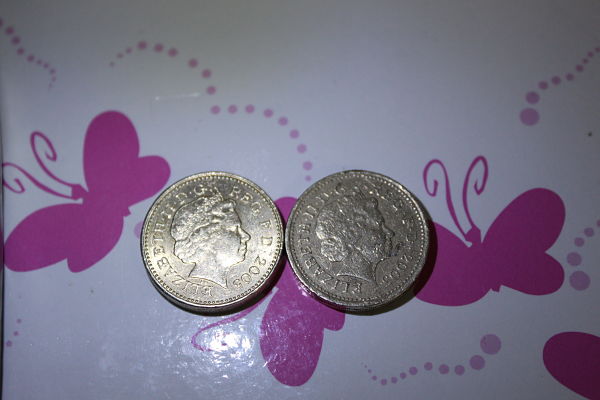
I got the coin below recently from someone who reported getting it in change from a chip shop in Enfield, north London.
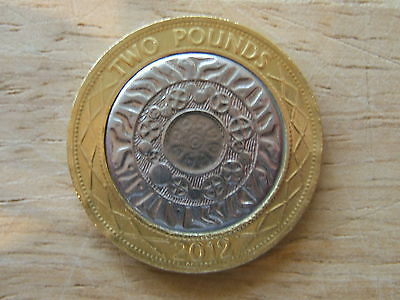
It prompted me to do a bit of digging (I'll come back to this coin in more detail below).
Anyway, I turned up the following Facebook page, from the man who a few years ago amassed a huge database of different varieties of fake £1 he had gathered through his coin-equipment business:
https://www.facebook.com/media/set/..014216616440 I believe another regular Forum contributor is already a fan?
1. The last three examples on this Facebook page, though not of identical metals, all appear to be from the same master dies as the example we discussed on pp8-9 of this thread. A striking common feature is the 2011 date which is larger and wider-spaced than on the real thing, and almost hits the adjoining curvy design. Also the same, simplified centre of the reverse design. RED has another here:
http://ukfakeanderrorcoins.50webs.c...S/FAKE2D.jpgWe discussed above that these were 'new dies'. I think now the actual Queen's portrait on these £2 is imaged from an original but at least sometimes doctored e.g. 'combing' of the hair, to compensate for loss of detail from imaging. Features linking these to the 'new dies' fake £1 series include the hair 'combing' sometimes evident, an apparent lack of nickel in the metals and striking stylistic similarities in the edge lettering, where present.
2. Turning to the coin pictured above. We see others like it:
- the first three examples on the above Facebook page
- another from Willings' Facebook pages here:
https://www.facebook.com/WillingsSe...440946040432- this on another forum:
http://en.numista.com/forum/topic3796.html - 5 March post
- and this that has reached a museum:
http://www.thecollectionmuseum.com/..-your-pocket - second image
It has the following remarkable features:
i. The core has a curious almost glassy uniform appearance reminiscent of lacquered metal or metallised resin. But it had good electrical conductivity and a solid sound when tapped with another metal. I'm wondering if it is some high-tin alloy, which would give appropriate density and a low melting point easy to work with. I don't have proof this isn't just a robust coating.
ii. The ring (surface) metal is a deeper yellow than I've seen on any fake £1, except one extremely crude case. The brass in real £2 does differ slightly from real £1, but this is way off both. If fake £1 were made with this metal it would be spotted much faster.
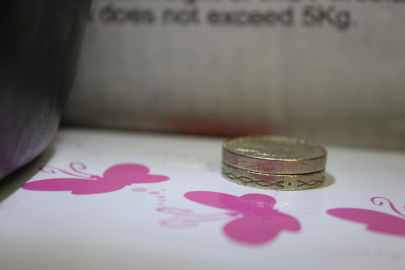
iii. The core and ring are separated by a fine groove, which also separates core and ring design features. But on the reverse the core has the appearance of being on top of the ring metal which extends to the base of the groove and the core curves down to that. However the greatest thickness is at the rim.
iv. In the reverse design, crude grooves have been added to the background to the ring of interlocking cogs. Otherwise the faces appear to be images of originals.
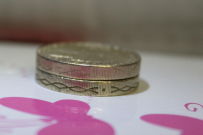
v. The edge motto (STANDING ON THE SHOULDERS...) and cross replicate the course of a genuine edge motto more closely than on any fake £1 with textual edge that I've ever seen. If it is gripped with a genuine technology £2 with the older style font, and the mottos lined up, the characters have very similar shape and position going right round the coins. Though there are fine differences and the cross and groove section are cruder. I think they must have created a master image by clamping a moulding blank with an original on a lathe and using an arm bearing two closely spaced styli to copy it.
You can see how closely they match on one of the Numista forum images above.
@andyg, on your part-painted example on p.8, does the motto have the same property versus an original? I'm wondering if that could be by the same artisan.
@RED, what about your part-painted examples?
vi. Testing with a fingernail I cannot detect any difference in diameter against an original, the thickness at rim is within usual range and the weight appears very similar. The face alignment is only out by a few degrees, comparing with genuine.
vii. If allowed to topple to rest on a table top, it does so more rapidly with fewer bounces on average than any of several £2 I compared it with, and no ringing sound unlike most of them.
viii. Dates featuring are 2008, 2010, 2011 and this 2012 *which sets a new record for late-dated fake Sterling coin?*
ix. The earliest date any of these examples was reported was this March.
With so many differences from other reported kinds of fake £1 and £2, and such a recent emergence, it could well be that these guys are still at it!
And that the focus of faking has indeed shifted to £2, though mainly because of almost all the £1 faking ops getting busted, if not sometimes abandoned.








 First Page
 Previous Page


 Posted 05/27/2014 06:24 am




 .
.