| Author |
 Replies: 18 / Views: 5,492 Replies: 18 / Views: 5,492 |
Page 2 of 2
|
|
|
|
Pillar of the Community
 Hong Kong
1270 Posts |
|
|
Pillar of the Community
United States
5362 Posts |
wonghinghi Hello, I saw that coin when it was offered and I had placed a $55 snipe bid on it which was not high enough to win. Based on my review of the picture posted I had classified in as a Transfer die forgery - probably made in the mid 1800's.
Now I may of course be incorrect, but look closely at the dentils to the left of the Portrait. They make solid contact with the letters and appear to be recut as if added to a mold.
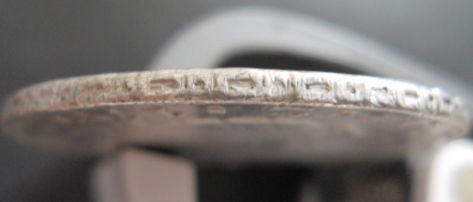
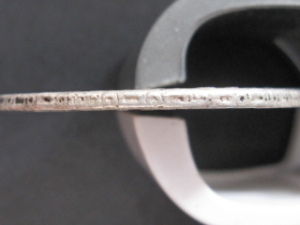
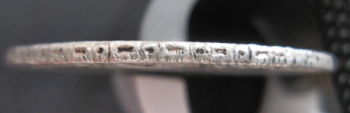
A few of the letters are doubled which could be a transfer error. The surfaces are grainy especially in the fine dentils of the hair. I was hoping to see the edge to see if I was right.
I believe it is a Class 2 forgery of the silver type made for use in China.
|
|
Pillar of the Community
Hong Kong
1270 Posts |
|
|
Pillar of the Community
Hong Kong
1270 Posts |
I add back the observe of this coin. 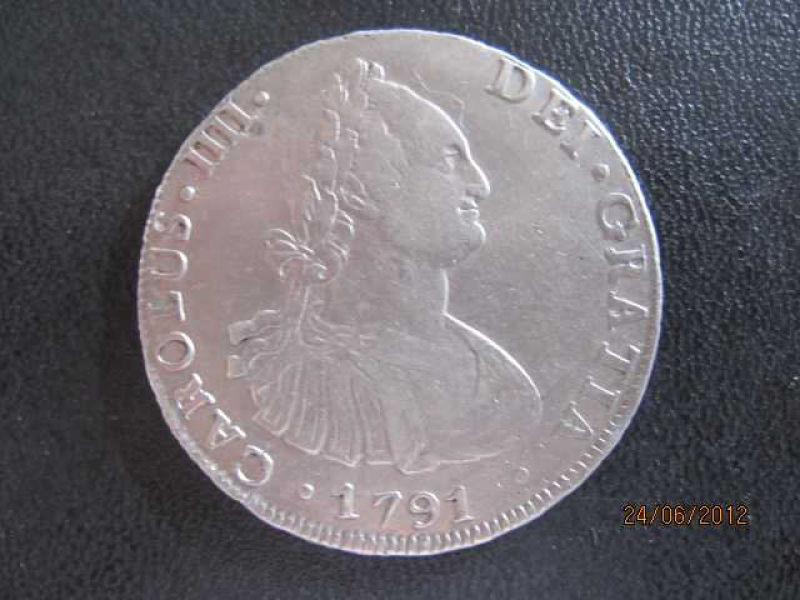 |
|
Pillar of the Community
United States
1763 Posts |
Bob -
See the tilting H in HISPAN and the high 1 in the date - if this makes a difference? After viewing several hundred for the book a non-symmetrical HISPAN is usually indicative of a contemporary if not Zacatecas. Could be just the photo but I am seeing a copper oxide hue in the photos - suggesting? an off-metal issue with high copper.
JPL
Edited by colonialjohn
06/26/2012 3:16 pm
|
|
Pillar of the Community
United States
5362 Posts |
Hi John - I agree with you that the tilt of the letter/numbers are more typical of contemporary forgeries, but the edge detail for me seals the case that the coin is not an original but was likely a Class 2 counterfeit made for the China market in England or Shanghai.
The edge has the partial diagonal cuts and the circles are squared off a bit. The crude application virtually assures the coin is NOT REAL.
Regarding the color - I had chalked it up to lighting but a high copper alloy is possible. It would be a good one to test with XRF to see what comes as a result.
So wonghinghi if you ever want to get rid of it I would cover your costs of $73 to get a closer look at it.
|
|
Pillar of the Community
Hong Kong
1270 Posts |
I don't like counterfeit coin and I have no intention of collecting contemporary counterfeits. No problem.I can sell it to you by $73 and if you pay $76, I will ship it by registered mail to you, swamperbob.
|
|
Pillar of the Community
United States
5362 Posts |
Please contact me at swamperbob22 at aol dot com
I do not object to anyone contacting me with questions or offers to sell interesting counterfeits.
Edited by swamperbob
06/27/2012 12:37 pm
|
|
Pillar of the Community
France
1591 Posts |
You should mask your mail a bit though, so robots don't put it in their spamming list.
|
|
Pillar of the Community
United States
5362 Posts |
MathieuMa Is that better?
|
|
Pillar of the Community
France
1591 Posts |
|
|
Pillar of the Community
United States
1962 Posts |
Guys, while that of course can be a usual attribute seen on contemp. forgeries, don't go nuts diagnosing the crooked lettering and date digits. Some goofy die designs for the portraits (spacing, alignment, etc.) came out of the Potosi mint as compared to the Mexico mint. Compare this piece from an upcoming auction... The date alignment is slightly less extreme, but it's fairly close. Also, I pasted the seller's full-size pic for reference. Looking at that questionable rim area by CAROLUS... there is some apparent die clashing within the lettering. For sake of argument, could that be what's affecting the denticles in that area?   |
|
Pillar of the Community
United States
5362 Posts |
I would say that position of the letters is NOT what is most suspect about the coin. To me it is the edge design. It is interesting to see an almost exact match however. Where is that coin being sold and does the seller know Spanish American? It could be that we are dealing with two counterfeit varieties from the same source as well.
The Potosi coins were not up to Mexican standards (and at the time were noted for at times being low in silver percentage) - but the edge is too crude to be believed in my opinion. I will of course know more when I see the coin in person.
Regarding the die clash - it is possible that the die involved was clashed. I have not seen this exact type of clash in the past and I look forward to examining it up close.
|
|
Pillar of the Community
United States
1962 Posts |
The other 1791 is from Xavier and the gang in Barcelona...
|
|
Pillar of the Community
United States
5362 Posts |
realeswatcher I have bought several coins from Xavier which he believed were real and which I have classified as Counterfeit. The primary difference of opinion is over the existence of the Bullion Class of forgeries.
Coincidentally, I am writing this as I am taking a break from reviewing the section on the Bullion Counterfeits for our book on Portrait counterfeits.
Many dealers believe INCORRECTLY that if an 8R is made of 903 fine silver and is of the correct weight it HAS TO BE REAL. They see no profit in this arrangement.
Their error is in the assumption that there was no profit to be made in making a full weight silver forgery in the period from 1830 to 1930.
But if they knew their history they would know that Carolus Dollars carried a premium of 12-50% over intrinsic value when used to purchase goods in Mainland China. The cost to make and transport the "replica" coins to China in 1880 amounted to under 8% of the intrinsic value. This left a significant profit for the merchants involved.
There is a second incentive that can be gleaned from history as well. In about 1873, world silver prices began to fall, such that most dollar coins became Tokens. Their silver content was far below $1. In that time frame there was an additional incentive provided you could get the coins taken at a FACE value of $1.
So we may have a real silver coin BUT one made after 1830 in one or BOTH cases.
|
|
Page 2 of 2
|
Replies: 18 / Views: 5,492 |
Page 2 of 2
|







 First Page


 Posted 06/25/2012 10:18 pm