| Author |
 Replies: 18 / Views: 5,540 Replies: 18 / Views: 5,540 |
Page 2 of 2
|
|
|
|
Pillar of the Community
 United States
1911 Posts |
Sorry Bob, but what does it mean by corners when talking about a coin? First I have heard of it but definitely wanting to know more!
|
|
Pillar of the Community
United States
1911 Posts |
Ah OK never mind I see it now what you meant. Duh! Anyways I can't tell by looking it at it it appears like it is somewhat rounded corner but then again I checked some of my other coins (1922 Peace dollar) and it seems to have the same look on the corners but by no means does it seem really noticeable. Also on my not super accurate scale it shows 27 grams which is where it should be rounded up and it sounds like silver. |
|
Valued Member
United States
264 Posts |
Overall the design looks good to me. I recently handled a nice 1914 and comparing to my photos (see below) the large dots are OK. There is some variation in denticles, though most seem to have the more refined denticles as seen below and on your 1888 coin. I would check weight, ring test, and check rims as Bob suggests.   Edit: Must have posted at about the same time. I see you already checked the weight and did a ring test. Great minds think alike!  Edited by PatAR
02/19/2016 11:22 pm
|
|
Pillar of the Community
United States
1911 Posts |
Thanks Patar! Yeah my main issue was if they were slight differences between the years and it appears that they are slightly different (other than just the date of course). With the weight and the ring test, coupled with the seller of the coin (Aspencoins on ebay 4000+ 100% good feedback) I think I am willing to say it is legit. Unless others say otherwise here :) |
|
Pillar of the Community
Australia
3837 Posts |
At first appearance it looks odd but after a good look - I'm certain it's the angle of the photo. It looks ok to me as well. I thought I had 1914 yen photographed as well but turns out I forgot to upload mine.
This is the only Taisho silver yen that was struck and it's one of those coins that you really want to fill your coin album type set. This is also an interesting coin as it was a coin struck for overseas market and was never intended to be circulated in Japan.
|
|
Pillar of the Community
United States
1156 Posts |
From my past experience, Aspencoins do not have expert authenticators on their staff and they are not very friendly when you notify them of counterfeit coins that they are trying to sell as genuine.
|
|
Pillar of the Community
United States
5362 Posts |
If you can post a close-up of the edge reeds it may be enlightening. Regarding the corners of a typical Morgan dollar - the shape is established by the shape of the coining chamber. The truncated corners will show NO EVIDENCE of being ground down to conceal the split tails. Also on the reeds produced from genuine reeded collars there will be no seam at the top center of the reed. The seam comes about when the ring die cuts the reeds. Metal curves inward from both sides of the depression being cut. The metal which is the raised reed has a seam down the center. This seam will show even if the edge is ground or polished. A simple 30x magnification should show if the seam is present. |
|
Pillar of the Community
United States
1911 Posts |
Unfortunately I don't have the means to 30x mag I only have my phone and I don't know if anything can be seen from this unfortunately it is the best I can seem to do :( 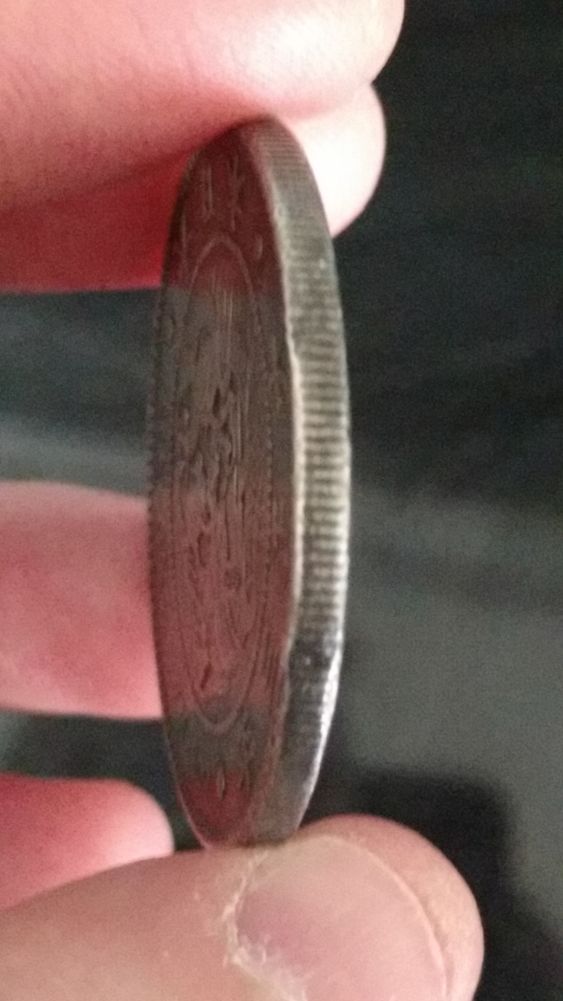 |
|
Pillar of the Community
United States
5362 Posts |
That is not really clear enough. Most jewelers have binocular 30X scopes to check diamonds for chips cracks and inclusions. That would work. Below is a 30x enlargement of the reeds on the edge of a typical Chinese forgery. At the top of the picture is the corner grind - it shows as triangular segments at the ends of the reeds. These triangles show parallel scratches associated with power grinding and not with wear. The second feature to observe are the tops of the reeds that clearly show the center seam where metal from the grooves on each side of the reed is pushed up to create the raised reed. In this case the forger has ground the tops of all the reeds to try to disguise the fact it is faked. 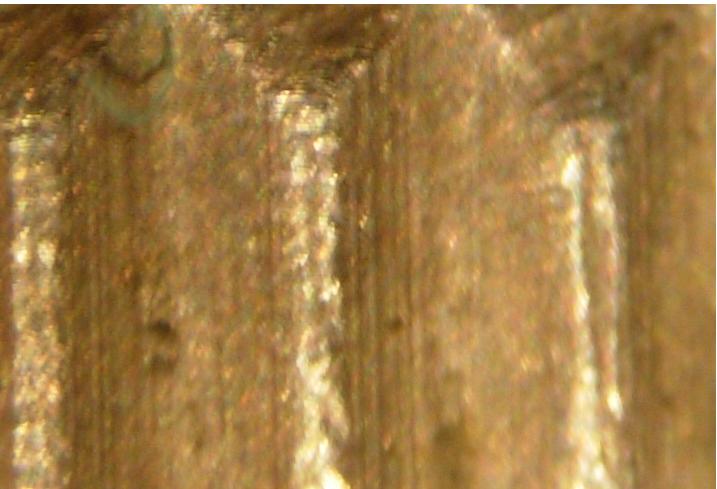 This next image shows two Chinese forgeries with open top seams in the reeds because the forger did not take the time and effort to edge grind. The coins are 1910 British Trade dollars made in the 1980s. 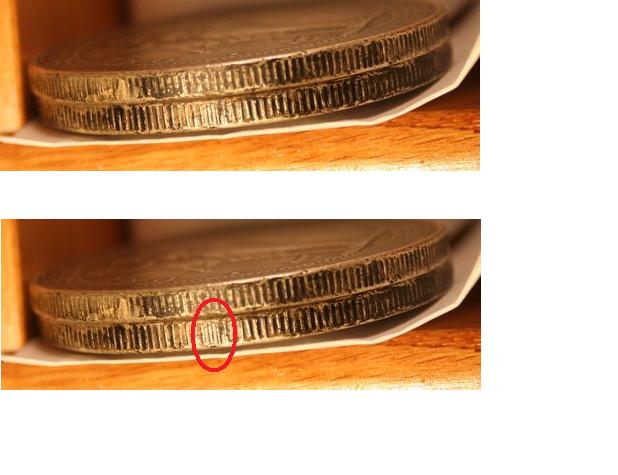 The following schematic drawing is a representation of why the forgeries need to be ground to remove sharp metal spurs created by the edging method. 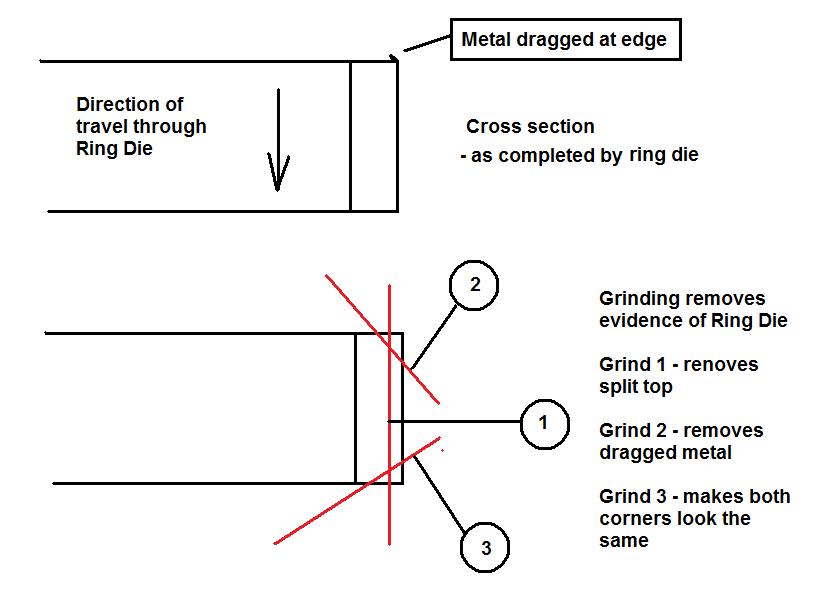 The final picture below shows a coin that was driven through the ring die at an angle so that some of the reeds are actually NOT at a right angle (90 degrees) to the faces. Notice the clear split top reeds in this case. The coin is a forged US $ 5 coin. 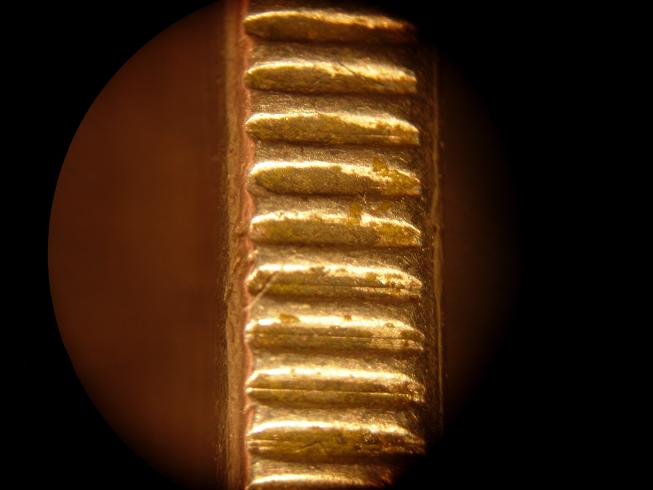 |
|
Pillar of the Community
United States
1911 Posts |
Just an update.. I brought the yen in question to my LCS and it weighed just under what it should (due to wear he said) and with it sounding silver he deemed it as the real thing. Thanks for all the info, especially about the edges on forgeries! I will definitely keep that in mind once I start looking for the last couple of early yen coins for my album. Getting these two for around $75 seems like I have done pretty well so far!
|
|
Pillar of the Community
United States
5362 Posts |
How much lite was the coin? Given the wear level, I would about 0.2 grams loss (net 26.76 grams) more or less should be about right. I am very curious to see what the LCS considers correct in terms of weight loss. I am of the opinion that based on the seller being aspen coins that it is likely genuine, but one of the things I always point out is it is VERY EASY TO OVERESTIMATE the amount of weight loss due to wear. Coins, in the days when they contained valuable metal, were made in low relief so that a 5% reduction in wear could not be missed. In fact most monetary policy had a minimum circulating weight. The weight varied but in most cases a figure of about 95% was employed. Coins below that weight were deemed unfit for circulation because their metal content was too low. The Yen was a Trade dollar - new they weighed 26.96 grams. To reach a non-circulating weight level a yen would be worn to AG levels and weigh 25.61 grams. The weight loss of 1.35 grams may seem trivial today but was very critical then. I mention this to try to inform the average collector that it is human nature to OVERESTIMATE the natural loss of weight due to wear. Many collectors will accept a 24 gram dollar coin as about right. Some will go even lower! |
|
Pillar of the Community
Australia
3837 Posts |
It would be slightly underweight due to the hole. I remember weighing all of the Japanese silver coins that I had in my collection. If I recall correctly, the Weight Tolerance level of the 1 yen coins are quite close to the mint specification. The smaller denomination however were not quite the same. My partial coin collection http://www.omnicoin.com/collection/gxseriesMy numismatics articles and collection: http://www.gxseries.com/numis/numis_index.htmRegularly updated at least once a month. |
|
Pillar of the Community
United States
1911 Posts |
Yeah on the better scale than mine it came to weigh 26.80 grams. And good point on the weights I try to like my coins as close as possible to the newly minted weight anything much lower I am wary of.
|
|
Pillar of the Community
United States
5362 Posts |
gxseries I believe that both coins have gone to the LCS. The coin with the hole in it was the first coin that the LCS saw and it looks legitimate. The question was regarding the second coin which I estimated should weigh 26.8 grams (now confirmed).
I agree that a hole makes a difference but the effect on weight can be calculated in the case of the hole. The surface area of the hole expressed as a percentage of the surface area of the entire coin multiplied by the weight of the coin provides a good estimate of the silver lost.
When using this method make sure the hole was drilled and not simply made by driving a nail through the coin. A hole made by driving a nail through a coin usually results in minimal weight loss. Also allow for any build-up of metal around the drill hole by reducing the estimate.
I do this by blowing up a picture of the coin. I have a large screen so I was able to make the coin 275 mm (about 11 inches) in diameter. I always check to make sure the coins struck in collar (like this one) are round. Measure the diameter horizontally and vertically to determine any distortion. Average the diameter.
Then do the same for the hole. Results 274 mm coin - 14 mm hole.
The factor pie (3.14159) can be eliminated so the ratio of the squares of the radii are all you need.
The radius of the coin is 137mm and the hole 7mm.
The squares are 18,769 and 49 so the amount of weight lost due to the hole is 49/18769 or 0.00261 just over one quarter of a percent. Weight loss would be about 0.07 gram.
Making a guess before making the calculation - I would be willing to guess that most collectors would over estimate the weight loss due to the hole.
When dealing with coins do not rely on your senses alone but rather make calculations whenever possible that others can check. This way you are doing your best to avoid common mistakes of over-estimating weight loss due to wear and damage.
|
|
Pillar of the Community
United States
1911 Posts |
 Thanks, Bob! Now figuring out this I never thought of actually calculating the stuff out like that. That way, I can get pretty close to what the weight should be with holed coins. At least one more step I can take to figure if they are legitimate or not! I love the knowledgeable and helpful people of this forum  |
|
Page 2 of 2
|
Replies: 18 / Views: 5,540 |
Page 2 of 2
|








 First Page

 Posted 02/19/2016 11:06 pm


